
Could Bittensor Ever Be as Successful as Bitcoin?

Source Beincrypto

Bitcoin is now, almost paradoxically to its original ethos, being adopted by Wall Street. Bittensor is a new finger to “the man” of centralization. It’s a sizzling hot narrative. With the rise of AI, concerns have arisen about the tech’s concentration and centralization. 

Bittensor, and its cryptocurrency, TAO, aims to decentralize AI services.  Despite losing nearly 53% in 2025, some believe Bittensor is a next-generation Bitcoin for the AI age. But how realistic is this optimism?

The Premise and Promise of Bittensor

The network just completed a reward halving on December 15, reducing its supply of minted coins. The problem is, many have heard this narrative before. 

Plenty of cryptocurrencies have claimed to be “the next Bitcoin” – because there’s money to be made with that story. 

However, there could be some real value for Bittensor over the long run – though it has hurdles to overcome, as any sort of ambitious crypto project like this would.The tale of Bittensor is not unlike Bitcoin: There are powerful incumbents, and a new network can take on and even upend this world order.

For years, influencers rehashed an often similar, anthemic phrase of “long Bitcoin, short the banks”. Notwithstanding that now Bitcoin is embedded in Wall Street banks and publicly traded DAT stocks, this narrative worked well. 
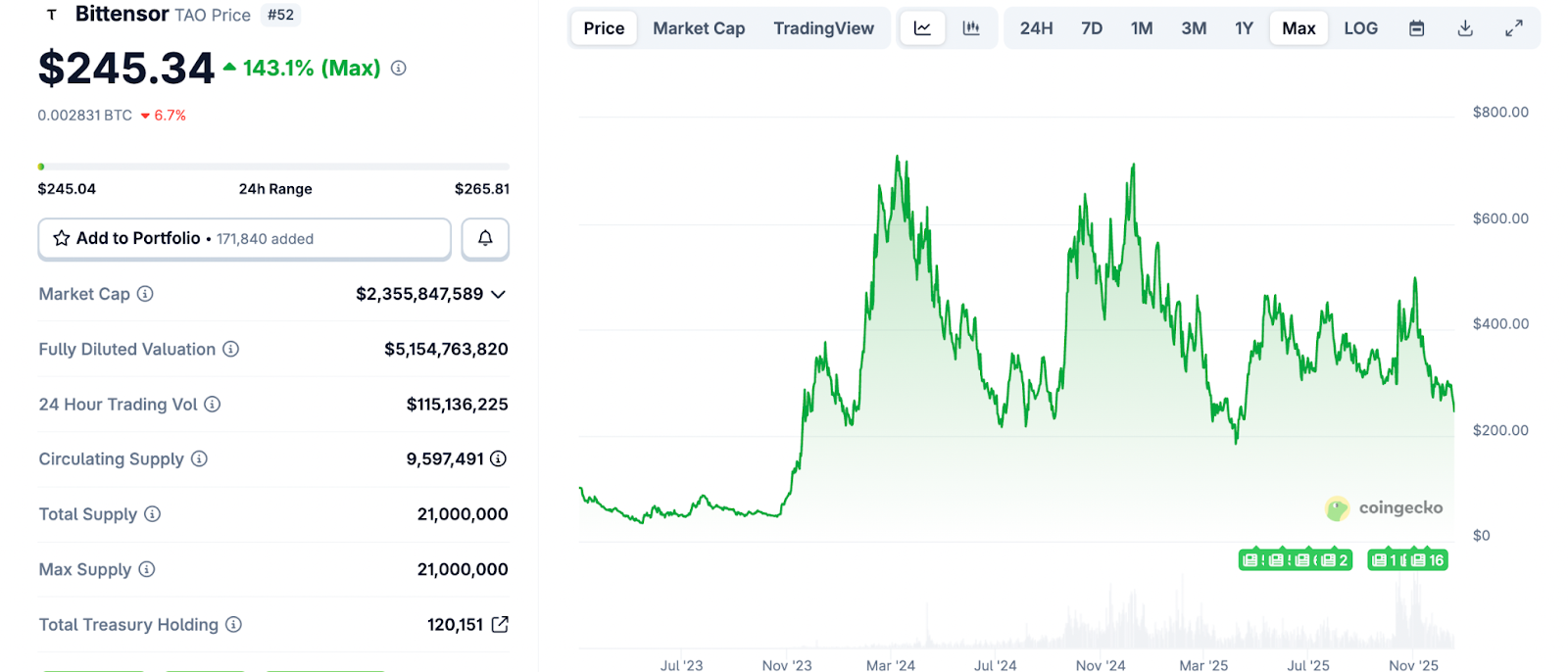
Bittensor’s price history since exchange listing in 2023. Source: CoinGecko

A premise is that AI companies such as OpenAI, Anthropic, and Deepseek have become too big and frightening, and people need to be concerned about their rise.

Decentralizing artificial intelligence workloads and replacing proof-of-work puzzles with actual real-use AI is Bittensor’s basic gist. 

“Bitcoin proved that cryptographic incentives could coordinate a global network of hardware to secure a ledger,” Evan Malanga, an executive at Yuma, one of the largest backers of the Bittensor platform, told BeInCrypto. “Bittensor takes that same mechanism and redirects the compute power toward something that has direct benefits in today’s world: Training and running AI models, applications, and infrastructure.”

Another Bitcoin? Really?

It’s important to note that Yuma is a subsidiary of Digital Currency Group (DCG), whose firm was one of the earliest backers of various cryptocurrencies, including Bitcoin, Zcash, and Decentraland. 

It was also an early investor in Coinbase, Circle, and Chainalysis. DCG’s CEO, Barry Silbert, is clearly on board with Bittensor – which for some could be considered a positive signal. 

Barry Silbert, who started crypto investing in 2012, is on board the TAO train. Source: X

Bittensor does have some Bitcoin-like characteristics. There are only 21 million units of TAO, clearly a nod to BTC. Bittensor also has halvings, which in December reduced its rewards from 7,200 TAO to 3,600 per day. 

Instead of the energy-intensive proof-of-work riddles Bitcoin uses, Bittensor uses something called proof-of-intelligence, where nodes must perform tasks to prove their capability in handling AI workloads. The better a node’s task output quality, the higher the chance it can receive rewards in TAO. 

Nodes that are allowed on the Bittensor network are then assigned a subnet, of which there are currently 128. These subnets have different AI-related specialties. 

“Each subnet is like a specialized marketplace for a specific type of AI service – some focus on image generation, others on language models,” said Arrash Yasavolian, the cofounder of Taoshi, which runs a financial intelligence subnet. 

Centralization Versus Decentralization

Concerns about AI often center on a few companies having concentrated power. Concentration in any industry typically means higher prices and poorer services for customers – sometimes both at the same time. 

Bittensor aims to make AI more of a global good with its decentralization characteristics, like having independent node operators power the subnets for its artificial intelligence capabilities. 

“AI is redefining every industry,” said Ken Jon Miyachi, CEO of BitMind, which runs a subnet focused on deepfake detections on Bittensor. ”Bitcoin revolutionized the store of value, but Bittensor is revolutionizing entire economic systems by making intelligence a global commodity.”

But how decentralized is this network? On July 10, 2024, the Bittensor network was halted amidst an $8 million hack that drained wallets. The chain was put into a “safe mode” that produced blocks without any transaction capabilities. 

“There are legitimate centralization concerns today,” noted Taoshi’s Yasavolian. “The OpenTensor foundation is the sole party responsible for validating blocks. The top 10 largest subnet validators comprise about 67% of total network stake weight.”

Some might argue that Bittensor’s security risks and ability to shut down the network are antithetical to decentralization. Proponents of the network say that full decentralization will come later, becoming “credibly neutral” the same way Bitcoin is supposed to be for store-of-value purposes. 

“Bittensor’s long-term strategic goal is to become a credibly neutral AI development tool. It’s progressive decentralization, similar to how Ethereum evolved,” Yasavolian added. 

The AI Alarm

One way to increase the decentralization of Bittensor and to hear more voices of dissent is via subnet operators. These groups are spending time and money to invest in the network, and they, like Yasavolian, voice their opinions. 

And subnet growth has been strong. Since the start of 2025, the number of subnets has increased 97%, from 65 to 128. 

Sergey Khusnetdinov, Director of AI at Gain Ventures, sees the subnet community as critically important to Bittensor’s success. 

“The result is a meritocratic, self-improving ecosystem where useful intelligence doesn’t come from one lab or one corporation but emerges organically from a worldwide, permissionless community.”
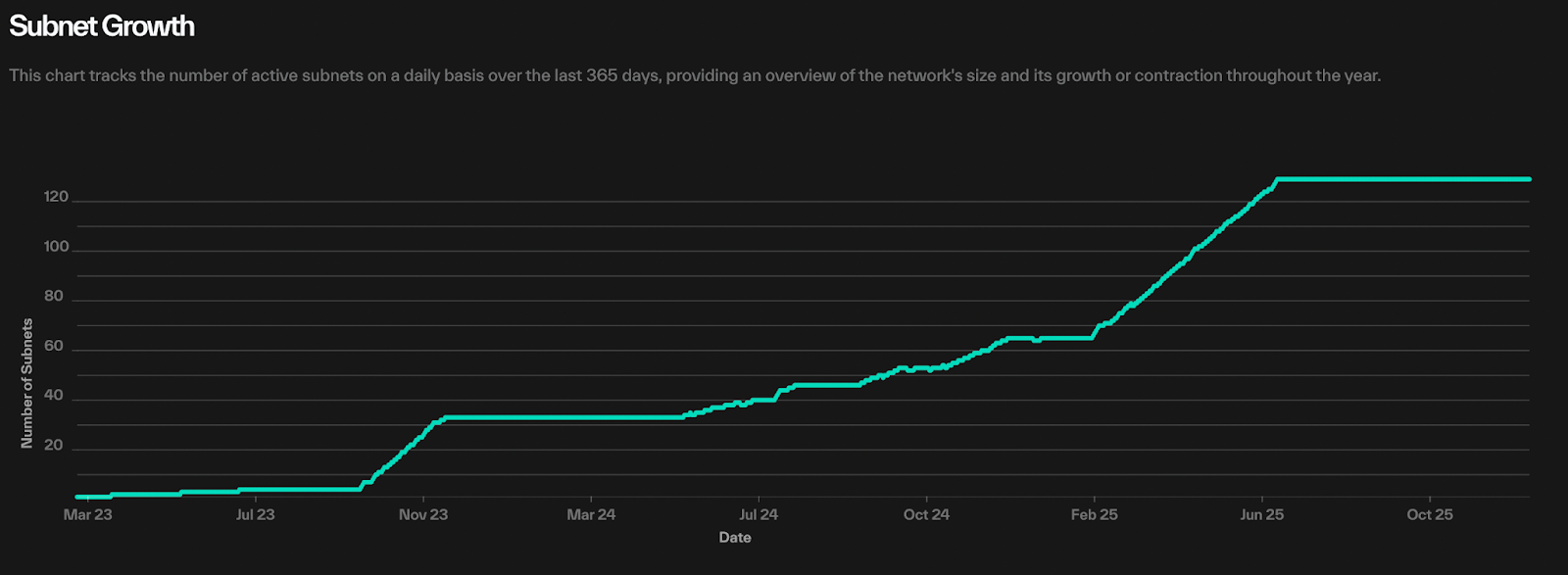
Chart of Bittensor subnet growth since March 2023. Source: Taostats

Centralized AI companies are valued quite ridiculously these days – OpenAI has a $500 billion valuation, Anthropic is at $350 billion. China-based Deepseek is rumored to have a $150 billion. With that in mind, what would be the value of a powerful AI network like Bittensor? 

Miyachi, the BitMind CEO who runs a deepfake detection subnet, bullishly believes the Bittensor network could someday excel over that of Bitcoin. 

“Value produced by the Bittensor ecosystem could surpass Bitcoin’s in the long run,” he told BeInCrypto. 

This could ultimately depend on how people perceive centralized AI systems over time, or whether anyone is concerned. But Bitcoin’s had huge runs as people reacted to economic instability and centralization failures such as a global pandemic, bank runs, and fiat currency debasement.  

Maybe soon, influencers might be saying, “long Bittensor, short centralized AI.” But who knows? Sometimes the future can be even stranger than AI could predict. 

Disclaimer: For information purposes only. Past performance is not indicative of future results.
placeholder
Ethereum Price Slips Lower — $3,000 Looms as the Key BattlegroundEthereum is attempting to recover from a $3,026 low but remains below $3,200 and the 100-hour SMA, with a bearish trend line near $3,175 capping rebounds as bulls need a clean break above $3,200 to target $3,250–$3,400, while a drop below $3,050 risks a retest of $3,000 and $2,940.
Author  Mitrade
Dec 15, Mon
Ethereum is attempting to recover from a $3,026 low but remains below $3,200 and the 100-hour SMA, with a bearish trend line near $3,175 capping rebounds as bulls need a clean break above $3,200 to target $3,250–$3,400, while a drop below $3,050 risks a retest of $3,000 and $2,940.
placeholder
Bitcoin Slides 5% as Sellers Lean In — Can BTC Reclaim $88,000?Bitcoin has dropped back below $88,000 after rolling over from $90,500, with price still trading under the 100-hour Simple Moving Average. The sell-off found a floor at $85,151, and BTC is now consolidating near that base, but rebounds are facing pressure from a bearish trend line around $89,000. Bulls need to retake $88,000–$89,000 to ease downside risk; failure to do so keeps $85,500–$85,000 and then $83,500 in play, with $80,000 as the deeper “line in the sand.” Bitcoin (BTC) is back in damage-control mode after a sharp pullback wiped out recent gains. The price failed to reclaim the $90,000–$90,500 band, rolled over, and slid through $88,500 before briefly dipping under $87,000. Buyers did show up around $85,000, but the rebound so far looks more like stabilization than a clear trend reversal. Bitcoin dips hard, finds a bid near $85,000(h3) BTC’s latest move lower began when it couldn’t build follow-through above $90,000 and $90,500. Once that upside stalled, sellers took control and pushed price down through $88,500. The slide accelerated enough to spike below $87,000, but the market didn’t free-fall. Bulls defended the $85,000 zone, printing a low at $85,151. Since then, Bitcoin has been consolidating below the 23.6% Fibonacci retracement of the drop from the $93,560 swing high to the $85,151 low — a clue that the bounce is still shallow and that sellers haven’t fully backed off yet. Structurally, BTC is still on the back foot: It’s trading below $88,000, and It remains below the 100-hour Simple Moving Average, keeping short-term trend pressure pointed downward. Resistance is layered, and $89,000 is the problem area(h3) If bulls try to turn this into a recovery, they’ll have to climb through multiple ceilings in quick succession. First, BTC faces resistance around $87,150, followed by a more meaningful barrier near $87,500. From there, the market’s attention snaps back to $88,000 — the level BTC just lost and now needs to reclaim. A close back above $88,000 would improve the tone, but it doesn’t solve the bigger issue: there’s a bearish trend line on the hourly BTC/USD chart (Kraken feed) with resistance near $89,000, which also lines up with the next technical hurdle. If BTC can push through $89,000 and hold, the rebound could extend toward $90,000, with follow-through targets at $91,000 and $91,500. But until price clears that $88,000–$89,000 zone, rallies are at risk of being sold rather than chased. If BTC fails to reclaim resistance, the downside path is clear(h3) The near-term bear case is simple: if Bitcoin can’t climb back above the $87,000 area and keep traction, sellers may attempt another leg lower. Support levels line up like this: Immediate support: $85,500 First major support: $85,000 Next support: $83,500 Then $82,500 in the near term Below that, the major “don’t break this” level is still $80,000. If BTC slips under $80,000, the risk of acceleration to the downside increases significantly — not because it’s magic, but because it’s the kind of psychological and structural level that tends to trigger forced de-risking. Indicators: momentum still leans bearish(h3) The intraday indicators aren’t offering much comfort yet: Hourly MACD is losing pace in the bearish zone. Hourly RSI remains below 50, suggesting sellers still have the upper hand on short timeframes. So while the $85,000 defense held for now, the market hasn’t flipped bullish — it’s just stopped bleeding.
Author  Mitrade
Dec 16, Tue
Bitcoin has dropped back below $88,000 after rolling over from $90,500, with price still trading under the 100-hour Simple Moving Average. The sell-off found a floor at $85,151, and BTC is now consolidating near that base, but rebounds are facing pressure from a bearish trend line around $89,000. Bulls need to retake $88,000–$89,000 to ease downside risk; failure to do so keeps $85,500–$85,000 and then $83,500 in play, with $80,000 as the deeper “line in the sand.” Bitcoin (BTC) is back in damage-control mode after a sharp pullback wiped out recent gains. The price failed to reclaim the $90,000–$90,500 band, rolled over, and slid through $88,500 before briefly dipping under $87,000. Buyers did show up around $85,000, but the rebound so far looks more like stabilization than a clear trend reversal. Bitcoin dips hard, finds a bid near $85,000(h3) BTC’s latest move lower began when it couldn’t build follow-through above $90,000 and $90,500. Once that upside stalled, sellers took control and pushed price down through $88,500. The slide accelerated enough to spike below $87,000, but the market didn’t free-fall. Bulls defended the $85,000 zone, printing a low at $85,151. Since then, Bitcoin has been consolidating below the 23.6% Fibonacci retracement of the drop from the $93,560 swing high to the $85,151 low — a clue that the bounce is still shallow and that sellers haven’t fully backed off yet. Structurally, BTC is still on the back foot: It’s trading below $88,000, and It remains below the 100-hour Simple Moving Average, keeping short-term trend pressure pointed downward. Resistance is layered, and $89,000 is the problem area(h3) If bulls try to turn this into a recovery, they’ll have to climb through multiple ceilings in quick succession. First, BTC faces resistance around $87,150, followed by a more meaningful barrier near $87,500. From there, the market’s attention snaps back to $88,000 — the level BTC just lost and now needs to reclaim. A close back above $88,000 would improve the tone, but it doesn’t solve the bigger issue: there’s a bearish trend line on the hourly BTC/USD chart (Kraken feed) with resistance near $89,000, which also lines up with the next technical hurdle. If BTC can push through $89,000 and hold, the rebound could extend toward $90,000, with follow-through targets at $91,000 and $91,500. But until price clears that $88,000–$89,000 zone, rallies are at risk of being sold rather than chased. If BTC fails to reclaim resistance, the downside path is clear(h3) The near-term bear case is simple: if Bitcoin can’t climb back above the $87,000 area and keep traction, sellers may attempt another leg lower. Support levels line up like this: Immediate support: $85,500 First major support: $85,000 Next support: $83,500 Then $82,500 in the near term Below that, the major “don’t break this” level is still $80,000. If BTC slips under $80,000, the risk of acceleration to the downside increases significantly — not because it’s magic, but because it’s the kind of psychological and structural level that tends to trigger forced de-risking. Indicators: momentum still leans bearish(h3) The intraday indicators aren’t offering much comfort yet: Hourly MACD is losing pace in the bearish zone. Hourly RSI remains below 50, suggesting sellers still have the upper hand on short timeframes. So while the $85,000 defense held for now, the market hasn’t flipped bullish — it’s just stopped bleeding.
placeholder
December Santa Claus Rally: New highs in sight for US and European stocks?Historical data show a rising trend of US and European stocks in December. If the momentum is strong, fund managers may rush in with a buying frenzy.
Author  Mitrade
Yesterday 02: 50
Historical data show a rising trend of US and European stocks in December. If the momentum is strong, fund managers may rush in with a buying frenzy.
placeholder
XRP’s Price Action Flashes a Warning Even as ETF Flows Stay PositiveXRP’s structure remains weak despite 18 straight positive closes in spot XRP ETFs, with analysts warning that $1.98 and other nearby resistance zones could cap rebounds unless the YO region is reclaimed, while deeper downside scenarios keep $1.53 on watch as a potential (not guaranteed) accumulation area.
Author  Mitrade
Yesterday 06: 37
XRP’s structure remains weak despite 18 straight positive closes in spot XRP ETFs, with analysts warning that $1.98 and other nearby resistance zones could cap rebounds unless the YO region is reclaimed, while deeper downside scenarios keep $1.53 on watch as a potential (not guaranteed) accumulation area.
placeholder
Gold declines on profit-taking, USD strength ahead of US CPI releaseGold price (XAU/USD) edges lower below $4,350 during the Asian trading hours on Thursday. The precious metal retreats from seven-week highs amid some profit-taking and a rebound in the US Dollar (USD).
Author  FXStreet
3 hours ago
Gold price (XAU/USD) edges lower below $4,350 during the Asian trading hours on Thursday. The precious metal retreats from seven-week highs amid some profit-taking and a rebound in the US Dollar (USD).
goTop
quote