



XRP Liquidity Dries Up: Futures Buy Volume On Binance Falls from $5.8B to $250M

Source Newsbtc

XRP has slipped below the $2 level, a psychologically important threshold, as broader market conditions continue to deteriorate and selling pressure weighs on risk assets. While Bitcoin dominates liquidity and investor attention, altcoins are struggling to attract sustained demand, and XRP is increasingly reflecting this imbalance.

According to a CryptoQuant report by Darkfost, the weakness in XRP is not an isolated event but part of a broader contraction across the altcoin market. Whether on spot markets or in derivatives, trading activity has been shrinking significantly over recent months. Liquidity is gradually drying up, signaling a clear retreat from speculative positioning as investors reduce exposure to higher-risk assets.

This trend is especially visible in XRP’s derivatives data. The Taker Buy Volume on Binance, which tracks aggressive buy orders in futures markets, has collapsed to its lowest levels of the year. After peaking above $5.8 billion in July, this metric has fallen to roughly $250 million, representing a sharp 95.7% decline.

XRP Ledger Taker Buy Volume on Binance | Source: CryptoQuant

Such a dramatic contraction highlights the near-total evaporation of buying pressure and underscores the lack of conviction among traders.

XRP Liquidity Compression Signals Downside Risk

According to Darkfost, the broader market context is a major factor amplifying XRP’s current weakness. Liquidations have been accumulating across crypto markets, confidence remains fragile, and many participants are still psychologically impacted by the October 10 event. This lingering stress has reduced risk tolerance, particularly among short-term traders who typically provide liquidity during corrective phases.

Beyond sentiment, altcoins are facing a clear structural headwind. Bitcoin continues to absorb the majority of available capital, both in spot and derivatives markets. As BTC dominance remains elevated, liquidity that would normally rotate into altcoins during recoveries is instead staying concentrated in Bitcoin. This leaves very limited room for a sustained rebound across the broader altcoin market, including XRP.

Within this environment, the sharp collapse in XRP’s Taker Buy Volume is not surprising. The signal becomes even more relevant given that it is unfolding on Binance, which still accounts for the largest share of global XRP trading activity. A sustained drop in aggressive buying on the dominant exchange highlights the depth of demand erosion.

At the same time, the Taker Buy Sell Ratio has remained negative for most of the period, confirming that sellers continue to dominate XRP’s derivatives market. Historically, such severe volume compression can precede volatility expansions.

XRP Ledger Taker Buy Sell Ratio on Binance | Source: CryptoQuant

However, in the current setup, the lack of meaningful buying pressure and persistent bearish positioning suggests downside risks remain elevated. Even ETF-related optimism has failed to offset these structural weaknesses.

XRP Price Struggles Below Key Moving Averages

XRP price action on the 3-day chart reflects a clear loss of bullish structure and growing downside pressure. After peaking above the $3.40–$3.60 zone earlier in the year, XRP has formed a sequence of lower highs and lower lows, confirming a medium-term downtrend. The recent breakdown below the psychological $2.00 level is particularly significant, as this zone previously acted as both support and consolidation.
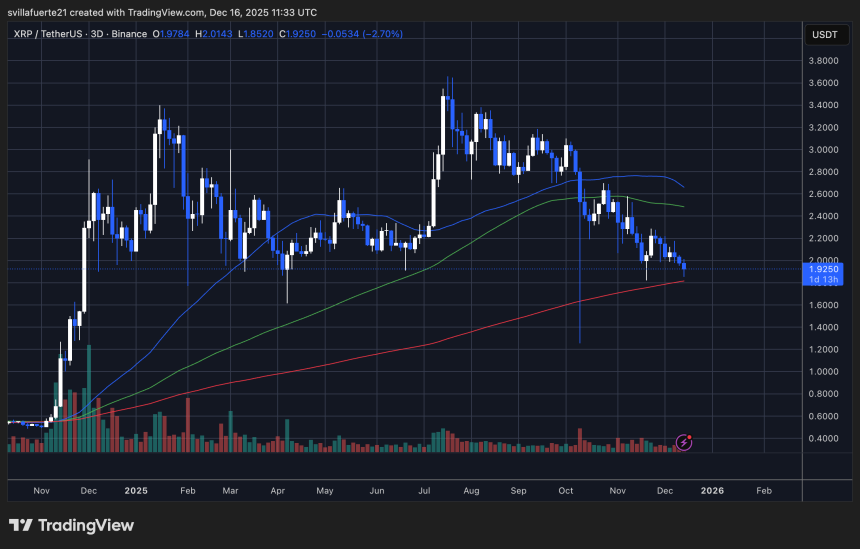
XRP testing key demand level | Source: XRPUSDT chart on TradingView

From a technical perspective, XRP is now trading below its 50-day and 100-day moving averages, both of which have started to slope downward. This alignment reinforces bearish momentum and suggests that rallies are being sold rather than accumulated. The 200-day moving average, currently near the $1.70–$1.80 area, represents the next major structural support. A sustained move toward this level would not be surprising if selling pressure persists.

Volume dynamics further confirm weakness. Since the August high, volume has steadily declined, indicating fading participation and weak dip-buying interest. The sharp volatility spike in October was followed by distribution rather than continuation, often a sign of a local market top.

As long as XRP remains below $2.00 and fails to reclaim the declining moving averages, the path of least resistance remains to the downside. For any meaningful trend reversal, XRP would need to regain $2.30–$2.50 with expanding volume, signaling renewed demand rather than short-term relief rallies.

Featured image from ChatGPT, chart from TradingView.com

Disclaimer: For information purposes only. Past performance is not indicative of future results.
placeholder
Gold Price Forecast: XAU/USD drifts higher above $4,200 as Fed delivers expected cutGold price (XAU/USD) gains momentum to around $4,235 during the early Asian session on Thursday. The precious metal extends its upside after the US Federal Reserve (Fed) delivered an expected third consecutive interest rate cut and maintained its outlook for just one cut in 2026.
Author  FXStreet
Dec 11, Thu
Gold price (XAU/USD) gains momentum to around $4,235 during the early Asian session on Thursday. The precious metal extends its upside after the US Federal Reserve (Fed) delivered an expected third consecutive interest rate cut and maintained its outlook for just one cut in 2026.
placeholder
Ethereum Price Slips Lower — $3,000 Looms as the Key BattlegroundEthereum is attempting to recover from a $3,026 low but remains below $3,200 and the 100-hour SMA, with a bearish trend line near $3,175 capping rebounds as bulls need a clean break above $3,200 to target $3,250–$3,400, while a drop below $3,050 risks a retest of $3,000 and $2,940.
Author  Mitrade
Dec 15, Mon
Ethereum is attempting to recover from a $3,026 low but remains below $3,200 and the 100-hour SMA, with a bearish trend line near $3,175 capping rebounds as bulls need a clean break above $3,200 to target $3,250–$3,400, while a drop below $3,050 risks a retest of $3,000 and $2,940.
placeholder
Macro Analysts: Hawkish Japan Could Push Bitcoin Below $70KAnalysts predict Bitcoin may face further declines towards the $70,000 mark if the Bank of Japan raises interest rates as expected.
Author  Mitrade
Dec 15, Mon
Analysts predict Bitcoin may face further declines towards the $70,000 mark if the Bank of Japan raises interest rates as expected.
placeholder
Bitcoin Slides 5% as Sellers Lean In — Can BTC Reclaim $88,000?Bitcoin has dropped back below $88,000 after rolling over from $90,500, with price still trading under the 100-hour Simple Moving Average. The sell-off found a floor at $85,151, and BTC is now consolidating near that base, but rebounds are facing pressure from a bearish trend line around $89,000. Bulls need to retake $88,000–$89,000 to ease downside risk; failure to do so keeps $85,500–$85,000 and then $83,500 in play, with $80,000 as the deeper “line in the sand.” Bitcoin (BTC) is back in damage-control mode after a sharp pullback wiped out recent gains. The price failed to reclaim the $90,000–$90,500 band, rolled over, and slid through $88,500 before briefly dipping under $87,000. Buyers did show up around $85,000, but the rebound so far looks more like stabilization than a clear trend reversal. Bitcoin dips hard, finds a bid near $85,000(h3) BTC’s latest move lower began when it couldn’t build follow-through above $90,000 and $90,500. Once that upside stalled, sellers took control and pushed price down through $88,500. The slide accelerated enough to spike below $87,000, but the market didn’t free-fall. Bulls defended the $85,000 zone, printing a low at $85,151. Since then, Bitcoin has been consolidating below the 23.6% Fibonacci retracement of the drop from the $93,560 swing high to the $85,151 low — a clue that the bounce is still shallow and that sellers haven’t fully backed off yet. Structurally, BTC is still on the back foot: It’s trading below $88,000, and It remains below the 100-hour Simple Moving Average, keeping short-term trend pressure pointed downward. Resistance is layered, and $89,000 is the problem area(h3) If bulls try to turn this into a recovery, they’ll have to climb through multiple ceilings in quick succession. First, BTC faces resistance around $87,150, followed by a more meaningful barrier near $87,500. From there, the market’s attention snaps back to $88,000 — the level BTC just lost and now needs to reclaim. A close back above $88,000 would improve the tone, but it doesn’t solve the bigger issue: there’s a bearish trend line on the hourly BTC/USD chart (Kraken feed) with resistance near $89,000, which also lines up with the next technical hurdle. If BTC can push through $89,000 and hold, the rebound could extend toward $90,000, with follow-through targets at $91,000 and $91,500. But until price clears that $88,000–$89,000 zone, rallies are at risk of being sold rather than chased. If BTC fails to reclaim resistance, the downside path is clear(h3) The near-term bear case is simple: if Bitcoin can’t climb back above the $87,000 area and keep traction, sellers may attempt another leg lower. Support levels line up like this: Immediate support: $85,500 First major support: $85,000 Next support: $83,500 Then $82,500 in the near term Below that, the major “don’t break this” level is still $80,000. If BTC slips under $80,000, the risk of acceleration to the downside increases significantly — not because it’s magic, but because it’s the kind of psychological and structural level that tends to trigger forced de-risking. Indicators: momentum still leans bearish(h3) The intraday indicators aren’t offering much comfort yet: Hourly MACD is losing pace in the bearish zone. Hourly RSI remains below 50, suggesting sellers still have the upper hand on short timeframes. So while the $85,000 defense held for now, the market hasn’t flipped bullish — it’s just stopped bleeding.
Author  Mitrade
21 hours ago
Bitcoin has dropped back below $88,000 after rolling over from $90,500, with price still trading under the 100-hour Simple Moving Average. The sell-off found a floor at $85,151, and BTC is now consolidating near that base, but rebounds are facing pressure from a bearish trend line around $89,000. Bulls need to retake $88,000–$89,000 to ease downside risk; failure to do so keeps $85,500–$85,000 and then $83,500 in play, with $80,000 as the deeper “line in the sand.” Bitcoin (BTC) is back in damage-control mode after a sharp pullback wiped out recent gains. The price failed to reclaim the $90,000–$90,500 band, rolled over, and slid through $88,500 before briefly dipping under $87,000. Buyers did show up around $85,000, but the rebound so far looks more like stabilization than a clear trend reversal. Bitcoin dips hard, finds a bid near $85,000(h3) BTC’s latest move lower began when it couldn’t build follow-through above $90,000 and $90,500. Once that upside stalled, sellers took control and pushed price down through $88,500. The slide accelerated enough to spike below $87,000, but the market didn’t free-fall. Bulls defended the $85,000 zone, printing a low at $85,151. Since then, Bitcoin has been consolidating below the 23.6% Fibonacci retracement of the drop from the $93,560 swing high to the $85,151 low — a clue that the bounce is still shallow and that sellers haven’t fully backed off yet. Structurally, BTC is still on the back foot: It’s trading below $88,000, and It remains below the 100-hour Simple Moving Average, keeping short-term trend pressure pointed downward. Resistance is layered, and $89,000 is the problem area(h3) If bulls try to turn this into a recovery, they’ll have to climb through multiple ceilings in quick succession. First, BTC faces resistance around $87,150, followed by a more meaningful barrier near $87,500. From there, the market’s attention snaps back to $88,000 — the level BTC just lost and now needs to reclaim. A close back above $88,000 would improve the tone, but it doesn’t solve the bigger issue: there’s a bearish trend line on the hourly BTC/USD chart (Kraken feed) with resistance near $89,000, which also lines up with the next technical hurdle. If BTC can push through $89,000 and hold, the rebound could extend toward $90,000, with follow-through targets at $91,000 and $91,500. But until price clears that $88,000–$89,000 zone, rallies are at risk of being sold rather than chased. If BTC fails to reclaim resistance, the downside path is clear(h3) The near-term bear case is simple: if Bitcoin can’t climb back above the $87,000 area and keep traction, sellers may attempt another leg lower. Support levels line up like this: Immediate support: $85,500 First major support: $85,000 Next support: $83,500 Then $82,500 in the near term Below that, the major “don’t break this” level is still $80,000. If BTC slips under $80,000, the risk of acceleration to the downside increases significantly — not because it’s magic, but because it’s the kind of psychological and structural level that tends to trigger forced de-risking. Indicators: momentum still leans bearish(h3) The intraday indicators aren’t offering much comfort yet: Hourly MACD is losing pace in the bearish zone. Hourly RSI remains below 50, suggesting sellers still have the upper hand on short timeframes. So while the $85,000 defense held for now, the market hasn’t flipped bullish — it’s just stopped bleeding.
placeholder
Senate Delays Crypto Market Structure Hearings to Early 2026The Senate Banking Committee has postponed cryptocurrency market structure hearings until 2026, citing ongoing bipartisan negotiations.
Author  Mitrade
18 hours ago
The Senate Banking Committee has postponed cryptocurrency market structure hearings until 2026, citing ongoing bipartisan negotiations.
goTop
quote