

Peter Schiff to CZ: ‘Bitcoin Payments? They’re Just Liquidated Bets’
A fiery debate erupted at Binance Blockchain Week in Dubai on December 4, 2025, as gold advocate Peter Schiff squared off against Binance CEO Changpeng Zhao (CZ) over the future of money.
The discussion centered on whether Bitcoin or tokenized gold better serves as a store of value, a medium of exchange, and a unit of account in today’s financial ecosystem.
Peter Schiff Slams Bitcoin: Payments? They’re Just Liquidated Bets
The conversation quickly turned heated as goldbug Peter Schiff questioned the practical utility of Bitcoin for payments.
“Bitcoin payments aren’t really payments,” he said. “They’re just liquidated bets.”
Schiff argued that most users who transact with Bitcoin are not actually spending the cryptocurrency itself. Instead, they are selling Bitcoin into fiat to pay merchants, essentially making every transaction a speculative move on the asset’s future price.
CZ countered, emphasizing that from a user perspective, Bitcoin can function seamlessly for payments.
Using crypto cards as an example, he explained that the user swipes their card, Bitcoin is deducted, and the merchant receives their preferred currency.
This aligns with a recent BeInCrypto report highlighting crypto cards as a promising narrative heading into 2026.
CZ argued that intermediaries handle the conversion, simplifying the process for both parties. He also highlighted that the same system could be applied to gold or other assets, but Bitcoin’s digital nature and growing adoption offer unique advantages.
Bitcoin’s Speculative Nature
The debate then shifted to the speculative nature of Bitcoin. Schiff maintained that Bitcoin’s value is purely determined by what the next buyer will pay, contrasting it with stocks or businesses, which generate tangible income and dividends.
“When people buy Bitcoin, they think they’re going to get rich,” Schiff said. “It’s a lottery ticket, not a store of value.”
Binance founder and former CEO CZ responded that Bitcoin has proven itself as a long-term asset, attracting developers, investors, and institutions, and that speculation is only one facet of its broader ecosystem.
Both participants also discussed the concept of tokenized gold and the potential for merchants to accept it in the future.
Schiff argued that amid rising inflation, merchants might prefer to receive payment in gold, which preserves real purchasing power. CZ acknowledged the point but noted that Bitcoin can achieve similar functionality through tokenization and instant verification.
The debate highlighted fundamental differences in philosophy:
- Schiff favors assets with intrinsic backing, such as gold, which he believes provide stability and security.
- CZ champions digital assets, emphasizing convenience, liquidity, and technological innovation.
While Schiff criticized Bitcoin’s lack of income generation, CZ focused on its growing ecosystem of applications and adoption across payments, trading, and financial infrastructure.
Attendees at Binance Blockchain Week described the event as both tense and enlightening. “What a show at the debate between CZ and Peter Schiff!” one attendee noted.
Indeed, it offered a rare glimpse into the clash between traditional finance advocates and crypto pioneers.
“I am a believer of digital assets, but Peter Schiff made very strong arguments,” one observer remarked.
The debate highlighted a growing trend in finance: the tension between digital currencies and physical assets, and how each can be used to hedge against volatility, inflation, and market speculation.
As Bitcoin and tokenized gold continue to gain attention from retail users, merchants, and institutional investors alike, the debate between CZ and Schiff illustrates that the conversation is far from settled.
Whether Bitcoin can evolve beyond speculation into a true medium of exchange remains a central question for the future of money.
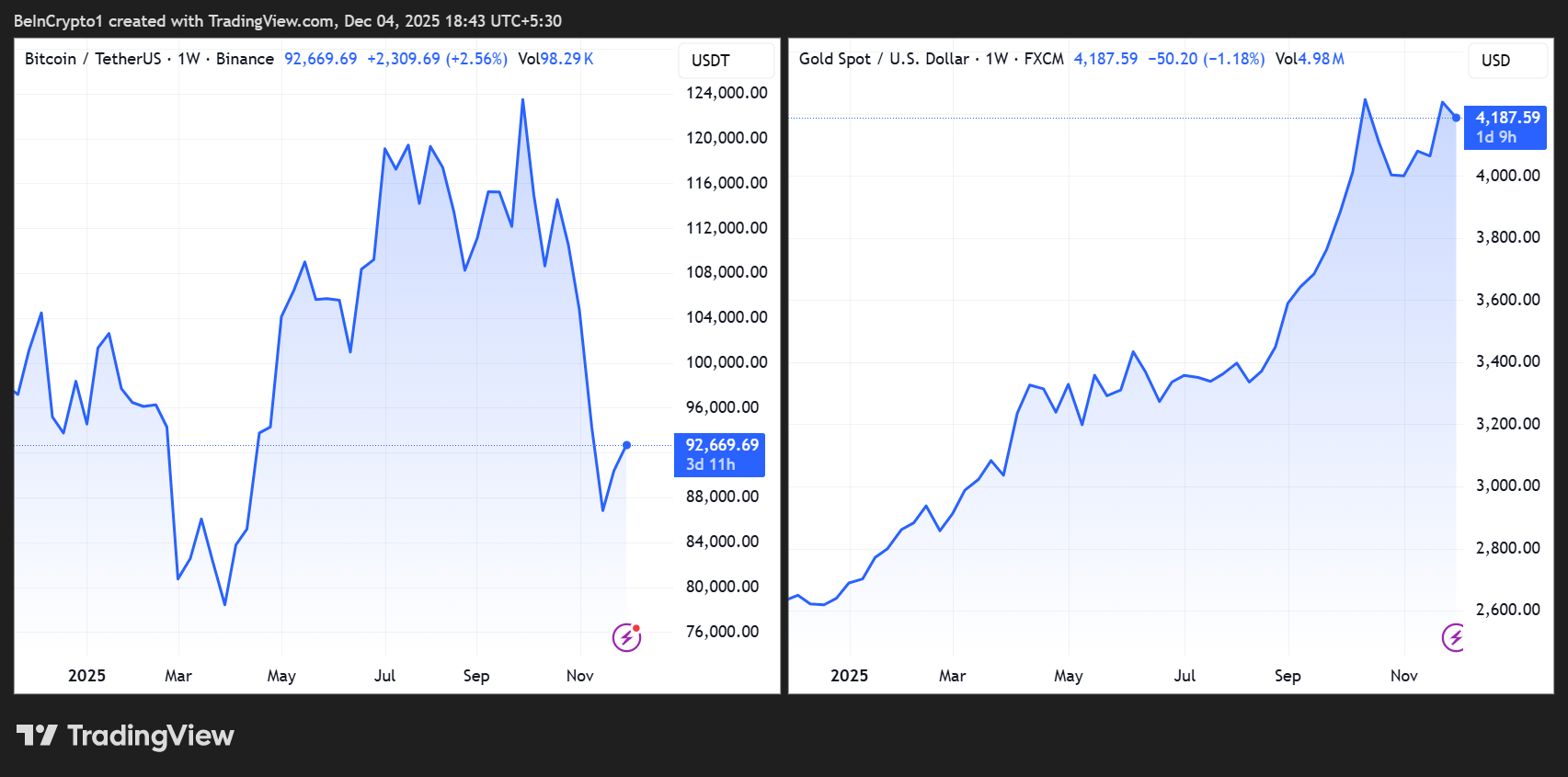 Bitcoin (BTC) and Gold (XAU) Price Performances YTD. Source: TradingView
As of this writing, Bitcoin was trading for $92,669, down by over 2% from its 2025 opening price of $94,591. Meanwhile, gold was exchanging hands for $4,187 as of this writing, up by over 57% from its 2025 opener of $2,657
Recommended Articles


