
After Monero Hit, Qubic Group Puts Dogecoin On Target List

Source Newsbtc

Qubic’s mining group has picked Dogecoin as its next target after claiming it briefly gained majority control of Monero’s network, according to reports.

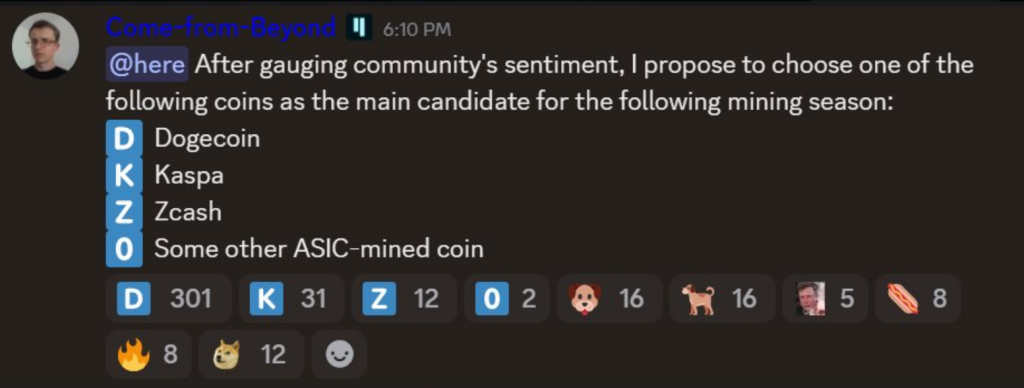
The group said it reorganized six blocks on Monero and then asked its community to vote on which ASIC-friendly proof-of-work coin to test next. The vote came on Aug. 17.

Community Picks Dogecoin

Based on reports, Dogecoin won the vote with more than 300 votes. Qubic’s founder, Sergey Ivancheglo, shared that Dogecoin beat out Zcash and Kaspa in a public poll.

The project says its Monero pool reached a 51% share and that it currently runs about two point three GH/s of Monero hashrate.

The group calls these moves “stress tests” and says they are meant to show how its mining model works, while also using pool profits to buy and burn QUBIC tokens. The group added it does not want to destroy networks.

The technical claim has sparked debate in the Monero community. Some developers and miners question whether the pool ever held sustained, uncontested control.

Others say the actions — which reorganized blocks — are proof the group can alter short stretches of chain history. Either way, the interruption was enough for Kraken to pause Monero deposits while exchanges and services assessed risk.

What A 51% Attack Can Do

A 51% attack lets the controller reorganize blocks or stop transactions. A group that controls more than half of a network’s mining power can rewrite recent blocks, halt certain transactions, or try double-spends.

Qubic’s move showed it could force a small reorg on Monero. If a similar level of control were applied to Dogecoin, the effect could be larger because Dogecoin has a market capitalization above $35 billion.

Still, Dogecoin benefits from merged-mining with Litecoin and runs at a much higher hashrate, so an attack would likely cost far more.

Markets and exchanges reacted quickly. Prices moved on the news and custodial services tightened checks.

Kraken’s decision to pause deposits underscored how exchanges will act fast when block reorgs or other threats appear. Users and traders faced increased short-term uncertainty.

What To Watch Next

Based on reports, the timeline is unclear but the issue raises bigger questions. Qubic has not given a clear timeline for any action against Dogecoin.

Observers will watch for technical logs, more statements from the project, and any responses from Dogecoin and Litecoin developers.

A Hostile Act?

People will also be looking for proof that Qubic’s tests were non-destructive and for evidence about how long the pool actually held control.

Most outlets call what Qubic did a 51% attack (a chain reorg), not a “hack” in the usual sense — but it’s still an attack on network consensus and many people treat it as hostile.

Featured image from Meta, chart from TradingView

Disclaimer: For information purposes only. Past performance is not indicative of future results.
placeholder
Bitcoin CME gaps at $35,000, $27,000 and $21,000, which one gets filled first?Prioritize filling the $27,000 gap and even try higher.
Author  FXStreet
Aug 22, 2023
Prioritize filling the $27,000 gap and even try higher.
placeholder
Pinduoduo Earnings Incoming: Morgan Stanley Sees Long-Term Profit Potential​Insights – On November 21, Chinese e-commerce giant Pinduoduo (PDD) will release its Q3 2024 earnings.
Author  Mitrade
Nov 20, 2024
​Insights – On November 21, Chinese e-commerce giant Pinduoduo (PDD) will release its Q3 2024 earnings.
placeholder
Elon Musk’s xAI and Neuralink Launch New Funding Rounds​Billionaire Elon Musk recently raised funds for his two high-profile tech companies, xAI and Neuralink.
Author  Insights
Jun 03, 2025
​Billionaire Elon Musk recently raised funds for his two high-profile tech companies, xAI and Neuralink.
placeholder
Bitcoin briefly loses 2025 gains as crypto plunges over the weekend.Bitcoin experienced a sharp decline this weekend, briefly erasing its 2025 gains and dipping below its year-opening value of $93,507. The cryptocurrency fell to a low of $93,029 on Sunday, representing a 25% drop from its all-time high in October. Although it has rebounded slightly to around $94,209, the pressures on the market remain significant. The downturn occurred despite the reopening of the U.S. government on Thursday, which many had hoped would provide essential support for crypto markets. This year initially appeared promising for cryptocurrencies, particularly after the inauguration of President Donald Trump, who has established the most pro-crypto administration thus far. However, ongoing political tensions—including Trump's tariff strategies and the recent government shutdown, lasting a historic 43 days—have contributed to several rapid price pullbacks for Bitcoin throughout the year. Market dynamics are also being influenced by Bitcoin whales—investors holding large amounts of Bitcoin—who have been offloading portions of their assets, consequently stalling price rallies even as positive regulatory developments emerge. Despite these sell-offs, analysts from Glassnode argue that this behavior aligns with typical patterns seen among long-term investors during the concluding stages of bull markets, suggesting it is not indicative of a mass exodus. Notably, Bitcoin is not alone in its struggles, as Ethereum and Solana have also recorded declines of 7.95% and 28.3%, respectively, since the start of the year, while numerous altcoins have faced even steeper losses. Looking ahead, questions linger regarding the viability of the four-year cycle thesis, particularly given the increasing institutional support and regulatory frameworks now in place in the crypto landscape. Matt Hougan, chief investment officer at Bitwise, remains optimistic, suggesting a potential Bitcoin resurgence in 2026 driven by the “debasement trade” thesis and a broader trend toward increased adoption of stablecoins, tokenization, and decentralized finance. Hougan emphasized the soundness of the underlying fundamentals, pointing to a positive outlook for the sector in the longer term.
Author  Mitrade
Nov 17, 2025
Bitcoin experienced a sharp decline this weekend, briefly erasing its 2025 gains and dipping below its year-opening value of $93,507. The cryptocurrency fell to a low of $93,029 on Sunday, representing a 25% drop from its all-time high in October. Although it has rebounded slightly to around $94,209, the pressures on the market remain significant. The downturn occurred despite the reopening of the U.S. government on Thursday, which many had hoped would provide essential support for crypto markets. This year initially appeared promising for cryptocurrencies, particularly after the inauguration of President Donald Trump, who has established the most pro-crypto administration thus far. However, ongoing political tensions—including Trump's tariff strategies and the recent government shutdown, lasting a historic 43 days—have contributed to several rapid price pullbacks for Bitcoin throughout the year. Market dynamics are also being influenced by Bitcoin whales—investors holding large amounts of Bitcoin—who have been offloading portions of their assets, consequently stalling price rallies even as positive regulatory developments emerge. Despite these sell-offs, analysts from Glassnode argue that this behavior aligns with typical patterns seen among long-term investors during the concluding stages of bull markets, suggesting it is not indicative of a mass exodus. Notably, Bitcoin is not alone in its struggles, as Ethereum and Solana have also recorded declines of 7.95% and 28.3%, respectively, since the start of the year, while numerous altcoins have faced even steeper losses. Looking ahead, questions linger regarding the viability of the four-year cycle thesis, particularly given the increasing institutional support and regulatory frameworks now in place in the crypto landscape. Matt Hougan, chief investment officer at Bitwise, remains optimistic, suggesting a potential Bitcoin resurgence in 2026 driven by the “debasement trade” thesis and a broader trend toward increased adoption of stablecoins, tokenization, and decentralized finance. Hougan emphasized the soundness of the underlying fundamentals, pointing to a positive outlook for the sector in the longer term.
placeholder
Gold declines as Trump scraps Iran memorandum, markets await Fed minutesGold (XAU/USD) trades around $4,050 on Wednesday, down 1.40% on the day at the time of writing, as investors favor the US Dollar (USD) following a fresh deterioration in tensions between the United States (US) and Iran.
Author  FXStreet
Jul 08, Wed
Gold (XAU/USD) trades around $4,050 on Wednesday, down 1.40% on the day at the time of writing, as investors favor the US Dollar (USD) following a fresh deterioration in tensions between the United States (US) and Iran.
goTop
quote