




Ripple’s David Schwartz states that Ripple didn’t conceal XRP sales, altcoin begins recovery
- Ripple’s CTO David Schwartz thwarts claims that the payment remittance firm was looking to conceal its XRP sales from the public.
- The US SEC will file an opening brief under seal on Friday in its lawsuit against Ripple.
- XRP price's recent decline appears to have bottomed out.
XRP price trades above the key $0.60 psychological level on Friday, holding on its recent gains as the Securities and Exchange Commission (SEC) is expected to file its remedies-related opening brief in the Ripple lawsuit. As the two parties have agreed, the filings will temporarily remain sealed from the public.
Meanwhile, Ripple CTO David Schwartz recently rejected the claims that the firm concealed its XRP sales from the public.
Also read: XRP holders lose interest, shed holdings as Ripple and SEC seal lawsuit proceedings
Daily digest market movers: Ripple CTO addresses claims of concealed XRP sales
- The SEC is set to file its remedies-related opening brief on Friday. The remedies-related legal proceedings in the SEC vs. Ripple lawsuit will take place under seal as previously agreed upon by the two parties.
- XRP price started its recovery as anticipation surrounding the lawsuit’s progress increased, posting daily gains on both Wednesday and Thursday..
- Ripple’s opposing brief is due no later than April 22, according to the lawsuit’s deadlines.
- Ripple CTO David Schwartz addressed concerns from the community regarding the firm’s token sales in a recent Spaces discussion on X. Schwartz said that Ripple could have directly sold XRP tokens on exchanges, but the payment remittance firm sold the tokens in a manner as to not influence the altcoin’s price on cryptocurrency exchanges.
- Ripple sourced XRP from exchanges to ensure a sufficient reserve for on-demand liquidity businesses.
- Schwartz said in a tweet on X:
Ripple can sell all the XRP we want on exchanges with less accountability than doing so on blockchains.
Technical analysis: XRP sees recovery
XRP price made a comeback above the psychologically important price level of $0.60 on Friday. The altcoin is recouping recent losses and could to retest resistance at $0.6561, the 50% Fibonacci retracement of the drawdown from XRP’s year-to-date peak of $0.7440 from March 11 to the trough of $0.5681 on March 20.
XRP price could face the next resistances at $0.7025 and $0.7440, on its path to the Fair Value Gap (FVG) between the range of $0.7527 and $0.7609.
The Moving Average Convergence/Divergence indicator is flashing red bars below the zero line, meaning that negative momentum persists. XRP’s recovery is an uphill battle and needs sustained demand from traders to push its price higher.
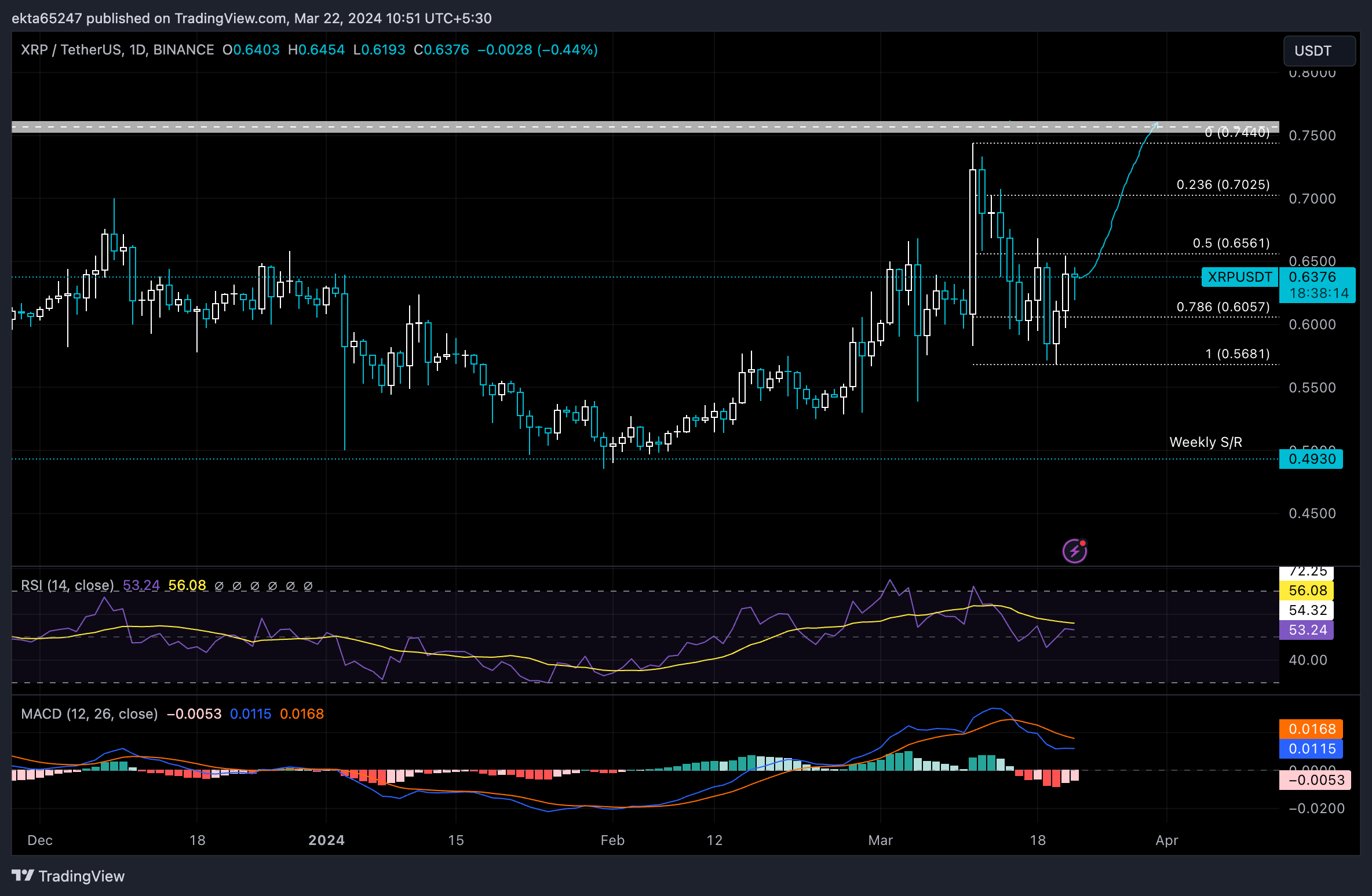
XRP/USDT 1-day chart
In the downside scenario, XRP price could suffer a correction to $0.6057, the 78.6% Fibonacci retracement level. The next significant support would be at the March 20 low of $0.5681.
Ripple FAQs
Ripple is a payments company that specializes in cross-border remittance. The company does this by leveraging blockchain technology. RippleNet is a network used for payments transfer created by Ripple Labs Inc. and is open to financial institutions worldwide. The company also leverages the XRP token.
XRP is the native token of the decentralized blockchain XRPLedger. The token is used by Ripple Labs to facilitate transactions on the XRPLedger, helping financial institutions transfer value in a borderless manner. XRP therefore facilitates trustless and instant payments on the XRPLedger chain, helping financial firms save on the cost of transacting worldwide.
XRPLedger is based on a distributed ledger technology and the blockchain using XRP to power transactions. The ledger is different from other blockchains as it has a built-in inflammatory protocol that helps fight spam and distributed denial-of-service (DDOS) attacks. The XRPL is maintained by a peer-to-peer network known as the global XRP Ledger community.
XRP uses the interledger standard. This is a blockchain protocol that aids payments across different networks. For instance, XRP’s blockchain can connect the ledgers of two or more banks. This effectively removes intermediaries and the need for centralization in the system. XRP acts as the native token of the XRPLedger blockchain engineered by Jed McCaleb, Arthur Britto and David Schwartz.
Recommended Articles


