




Gold prices soar after Israel attack on Iran sparks safe-haven flows
- Gold prices surge after Israel attacks Iran’s nuclear facilities in Tehran, with multiple countries condemning the attacks.
- XAU/USD rallies to the second-highest level this year, trading above $3,400 at the time of writing.
- The US economic calendar features the release of Michigan Consumer Sentiment data, which could influence the USD.
Gold (XAU/USD) is trading in a strong uptrend after Israel’s attack on Iran. The strikes were reported on Friday morning, two days before Iran and the United States (US) were expected to hold the sixth round of talks over Tehran’s nuclear program in Oman on Sunday.
At the time of writing, Gold is trading above $3,400 against the US Dollar (USD) on Friday, with markets focused on any further developments in the Middle East, particularly the threats of retaliation from Iran.
On the US economic calendar, market participants will also be looking out for the results from the University of Michigan Consumer Sentiment report and Inflation Expectations, scheduled for release on Friday.
Gold prices are highly sensitive to shifts in consumer sentiment, making this Friday’s consumer sentiment release a critical event to watch. As a leading indicator of economic confidence and inflation expectations, the index offers early insight into potential changes in US consumer behavior and pricing pressures.
Israel attacks Iran’s nuclear facilities - Gold prices rally
On Friday, Reuters and Bloomberg reported that Israel had struck multiple facilities in Iran.
Israeli Prime Minister Netanyahu confirmed the attacks, citing that Israel had “struck at the heart of Iran’s nuclear enrichment program”. Reports from Israel confirmed that roughly 100 targets had been hit using 200 air force planes.
Several senior officials of Iran have been killed, including Hossein Salami, the head of the Islamic Revolutionary Guard Corps, and the military chief of staff, Mohammed Bagheri.
Multiple nations, including Saudi Arabia and China, have condemned the attacks. Chinese foreign ministry spokesperson, Lin Jian, said that “China urges all relevant parties to do more to promote regional peace and stability and to avoid further escalation of the situation. China stands ready to play a constructive role in helping de-escalate the situation.”
Daily digest market movers: Israel attacks, US Michigan Sentiment in focus
- The escalation in tensions emerged on Thursday after the United Nations' nuclear watchdog adopted a resolution stating that Iran is violating its obligations under the nuclear non-proliferation agreement. In response, Tehran announced plans to escalate its nuclear activities, asserting that it had “no option but to respond.” Uranium, the core fuel used in nuclear energy, can be weaponized when highly enriched. Iran continues to insist that its nuclear program is intended solely for peaceful purposes.
- Trump said on Thursday that an Israeli strike on Iran “could very well happen,” and warned of a possible “massive conflict” taking place in the Middle East “soon.”
- Trump confirmed on Wednesday that US personnel are being moved out of parts of the Middle East due to the escalating tensions between Israel and Iran. This occurs ahead of the sixth round of nuclear talks between the US and Iran, scheduled for this weekend which has since been cancelled.
- On the economic data front, the release of US Producer Price Index (PPI) data on Thursday showed that inflation is slowing on the wholesale level. Headline PPI showed an annual increase of 2.6% in May, in line with analyst forecasts, following a 2.5% increase in April. Core PPI, which excludes volatile goods, fell to 3% in May, down from 3.2% in April.
- PPI data followed the release of the US Consumer Price Index (CPI) on Wednesday, which showed that inflation at the consumer level continued to ease in May.
- As for the University of Michigan release, traders will pay particular attention to the one-year and five-year inflation expectations included in the report, which are closely monitored by the Federal Reserve.
Technical analysis: Gold prices break $3,400
Gold prices rallied on Friday after reports of the attacks, breaking above the former $3,400 psychological resistance level, which has now turned into support.
The safe-haven appeal of Gold lifted XAU/USD to its second-highest peak this year near $3,444. This level is now providing intermediate resistance for the yellow metal.
Meanwhile, support remains firm at $3,400, with a move lower bringing the $3,385 mark into play. The latter is another crucial level that has limited the upside move in Gold prices on several occasions throughout the week.
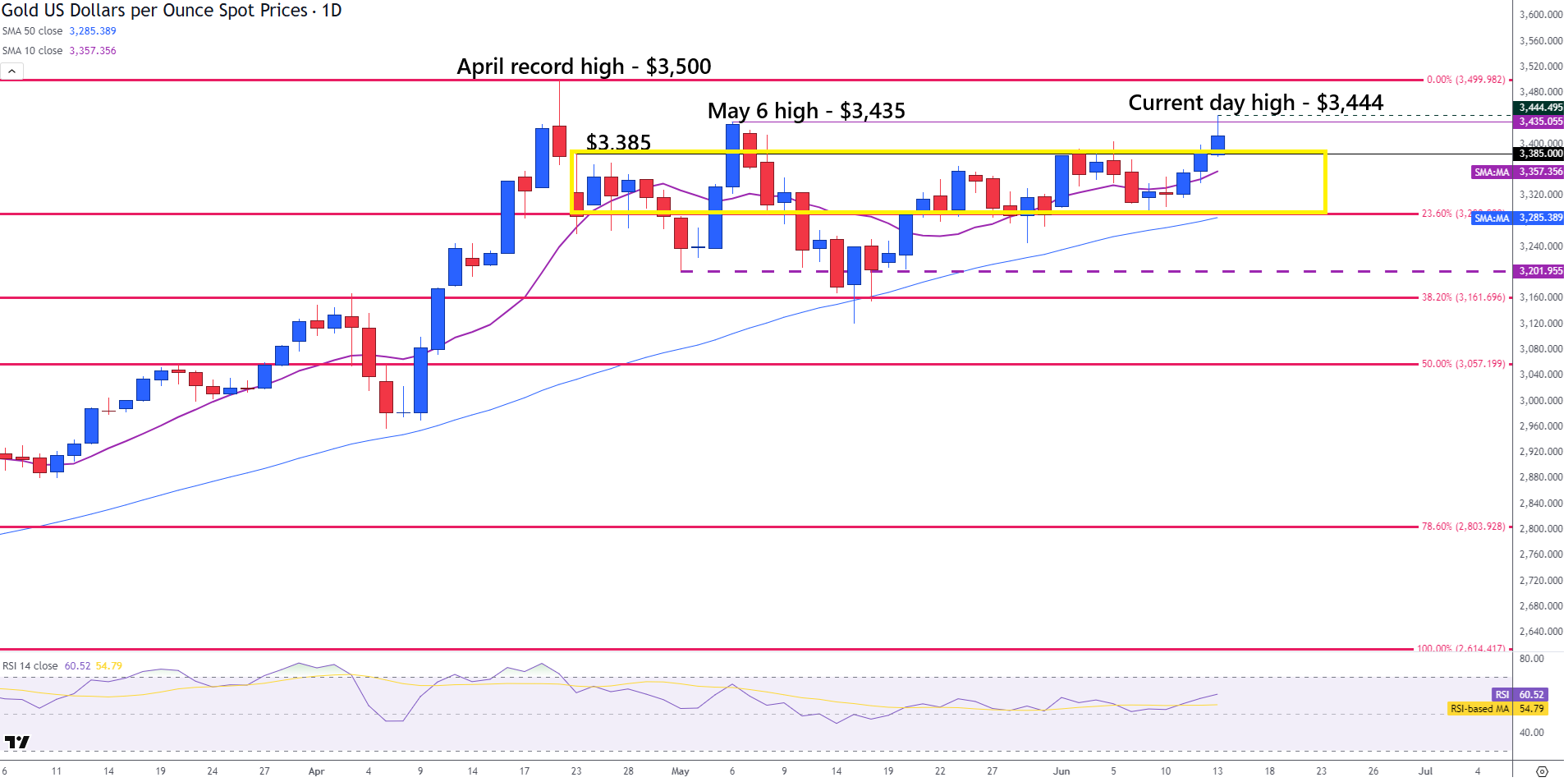
Meanwhile, the Relative Strength Index (RSI) stands at 60 and points upwards, indicating a bullish bias. On the downside, the $3,350 psychological level, which has provided support throughout the week, remains intact. Below that is $3,291, the 23.6% Fibonacci retracement of the January-April uptrend.
For bearish momentum to gain traction, a breach of this zone may pave the way for the next big psychological level of $3,200.
Risk sentiment FAQs
In the world of financial jargon the two widely used terms “risk-on” and “risk off'' refer to the level of risk that investors are willing to stomach during the period referenced. In a “risk-on” market, investors are optimistic about the future and more willing to buy risky assets. In a “risk-off” market investors start to ‘play it safe’ because they are worried about the future, and therefore buy less risky assets that are more certain of bringing a return, even if it is relatively modest.
Typically, during periods of “risk-on”, stock markets will rise, most commodities – except Gold – will also gain in value, since they benefit from a positive growth outlook. The currencies of nations that are heavy commodity exporters strengthen because of increased demand, and Cryptocurrencies rise. In a “risk-off” market, Bonds go up – especially major government Bonds – Gold shines, and safe-haven currencies such as the Japanese Yen, Swiss Franc and US Dollar all benefit.
The Australian Dollar (AUD), the Canadian Dollar (CAD), the New Zealand Dollar (NZD) and minor FX like the Ruble (RUB) and the South African Rand (ZAR), all tend to rise in markets that are “risk-on”. This is because the economies of these currencies are heavily reliant on commodity exports for growth, and commodities tend to rise in price during risk-on periods. This is because investors foresee greater demand for raw materials in the future due to heightened economic activity.
The major currencies that tend to rise during periods of “risk-off” are the US Dollar (USD), the Japanese Yen (JPY) and the Swiss Franc (CHF). The US Dollar, because it is the world’s reserve currency, and because in times of crisis investors buy US government debt, which is seen as safe because the largest economy in the world is unlikely to default. The Yen, from increased demand for Japanese government bonds, because a high proportion are held by domestic investors who are unlikely to dump them – even in a crisis. The Swiss Franc, because strict Swiss banking laws offer investors enhanced capital protection.
Recommended Articles


