


Gold price stands firm near all-time peak, just below $2,800 mark
- Gold price continues to attract haven flows amid trade war fears and geopolitical risks.
- Rebounding US bond yields underpin the USD and cap the upside for the precious metal.
- Traders now look forward to the release of the US PCE Price Index for a fresh impetus.
Gold price enters a bullish consolidation phase after hitting a fresh record high during the Asian session on Friday and currently trades just below the $2,800 mark. Concerns over the potential economic fallout from US President Donald Trump's tariff plans, along with geopolitical tensions, continue to boost demand for the safe-haven bullion. Adding to this, expectations that Trump's protectionist policies would boost inflation further benefit the precious metal's hedge against rising price pressures.
That said, the Federal Reserve's (Fed) first pause since the start of its easing cycle in September and a relatively hawkish outlook triggers a modest bounce in the US Treasury bond yields. This assists the US Dollar (USD) in preserving its weekly recovery gains and keeps a lid on any further gains for the non-yielding Gold price. Traders also seem reluctant to place fresh bullish bets and now seem to wait for the release of the US Personal Consumption Expenditure (PCE) Price Index later this Friday.
Gold price remains well supported by Trump’s tariff threats-inspired haven flows
- US President Donald Trump reiterated his threat to impose 25% tariffs on Mexico and Canada – the top two US trade partners – and warned of potential 100% tariffs if BRICS attempts to replace the US Dollar.
- Japan’s Joint Staff Office (JSO) stated that a pair of Russian Tu-95 bombers escorted by two Russian fighter aircraft carried out an eight-hour flight over the Sea of Okhotsk and Sea of Japan on Thursday.
- The US Bureau of Economic Analysis' (BEA) first estimate published on Thursday showed that Gross Domestic Product (GDP) grew at an annualized rate of 2.3% during the October-December period.
- The reading marked a notable slowdown from the 3.1% expansion recorded in the previous quarter and was below the market expectation of 2.6% and boosted demand for the safe-haven Gold price.
- Investors remain concerned that Trump's protectionist policies will reignite inflationary pressures. Adding to this, the Federal Reserve's hawkish stance provides a modest lift to the US Treasury bond yields.
- The US central bank decided to stand pat at the end of a two-day meeting on Wednesday and signaled that there would be no rush to lower borrowing costs until inflation and jobs data made it appropriate.
- The US Dollar preserves its weekly recovery gains from over a one-month low, which, along with a generally positive tone around the equity markets, keeps a lid on gains for the precious metal.
- Traders now look to the release of the US Personal Consumption Expenditure (PCE) Price Index – the Fed's preferred inflation gauge – for some impetus later during the North American session.
Gold price needs to consolidate before the next leg up; bullish potential seems intact
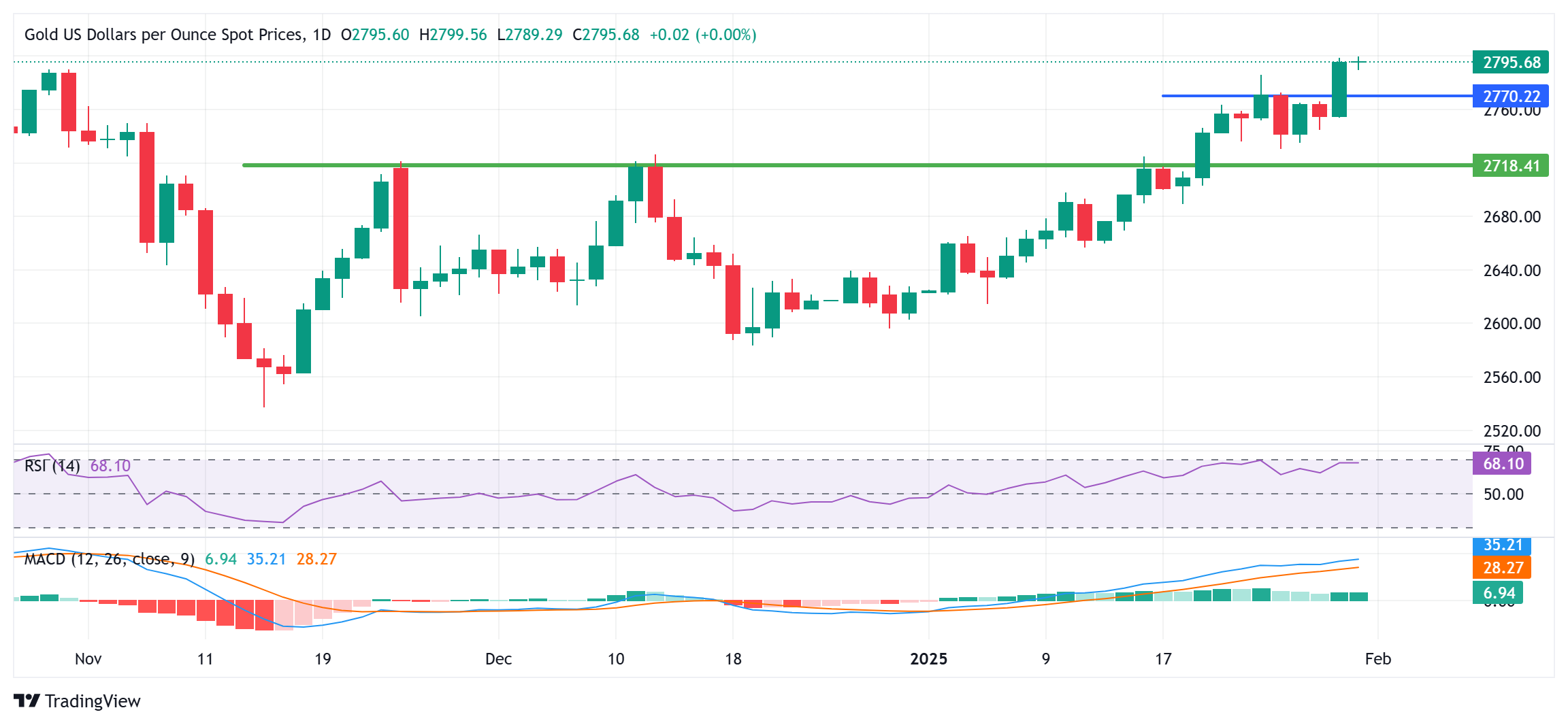
From a technical perspective, sustained strength and acceptance above the $2,800 mark will be seen as a fresh trigger for bulls. That said, the daily Relative Strength Index (RSI) is on the verge of breaking into the overbought zone. This makes it prudent to wait for some near-term consolidation or a modest pullback before placing fresh bullish bets around the Gold price and positioning for an extension of the strong move-up witnessed over the past month or so.
Meanwhile, any corrective slide is more likely to find decent support and remain limited near the $2,773-2,772 horizontal zone. This is followed by the $2,758-2,756 region, which if broken might prompt some long-unwinding and drag the Gold price further towards the $2,740 area en route to the $2,725-2,720 pivotal support. A convincing break below the latter could set the stage for some meaningful downside in the near term.
Gold FAQs
Gold has played a key role in human’s history as it has been widely used as a store of value and medium of exchange. Currently, apart from its shine and usage for jewelry, the precious metal is widely seen as a safe-haven asset, meaning that it is considered a good investment during turbulent times. Gold is also widely seen as a hedge against inflation and against depreciating currencies as it doesn’t rely on any specific issuer or government.
Central banks are the biggest Gold holders. In their aim to support their currencies in turbulent times, central banks tend to diversify their reserves and buy Gold to improve the perceived strength of the economy and the currency. High Gold reserves can be a source of trust for a country’s solvency. Central banks added 1,136 tonnes of Gold worth around $70 billion to their reserves in 2022, according to data from the World Gold Council. This is the highest yearly purchase since records began. Central banks from emerging economies such as China, India and Turkey are quickly increasing their Gold reserves.
Gold has an inverse correlation with the US Dollar and US Treasuries, which are both major reserve and safe-haven assets. When the Dollar depreciates, Gold tends to rise, enabling investors and central banks to diversify their assets in turbulent times. Gold is also inversely correlated with risk assets. A rally in the stock market tends to weaken Gold price, while sell-offs in riskier markets tend to favor the precious metal.
The price can move due to a wide range of factors. Geopolitical instability or fears of a deep recession can quickly make Gold price escalate due to its safe-haven status. As a yield-less asset, Gold tends to rise with lower interest rates, while higher cost of money usually weighs down on the yellow metal. Still, most moves depend on how the US Dollar (USD) behaves as the asset is priced in dollars (XAU/USD). A strong Dollar tends to keep the price of Gold controlled, whereas a weaker Dollar is likely to push Gold prices up.
Recommended Articles


