


Gold rises on mixed US data, though Fed’s hawkish tone limits gains
- Gold edges bouncing from a daily low of $2,603 after US inflation data showed a slight increase, tempered by weaker jobs figures.
- The swaps market now expects the Fed to cut rates by 25 bps at the November meeting, boosting Bullion prices.
- Fed officials, including Austan Goolsbee and John Williams, hinted at gradual rate cuts, while Raphael Bostic remains open to pausing cuts in November.
Gold prices recovered some ground on Thursday during the North American session, edging up some 0.67% after a hotter-than-expected US inflation report, which was tempered by soft US jobs data. Nonetheless, recent hawkish comments by a Federal Reserve (Fed) official capped the precious metal’s advance. The XAU/USD trades at $2,624 after bouncing off a daily low of $2,603.
August’s inflation in the United States (US) was slightly higher than expected, though jobs data offset it. The US Department of Labor announced that more people than expected applied for unemployment benefits, which could cause the Fed to lower borrowing costs aggressively.
After the data, the swaps market sees the Fed cutting interest rates by 25 bps at the November meeting.
The US economic schedule featured some Fed speakers. First, Chicago Fed President Austan Goolsbee said he sees gradual cuts over the next year and a half now that inflation is close to the Fed’s 2% goal.
New York Fed President John Williams said he expects more rate cuts at an appearance in Binghamton, New York. He added, “The timing and pace of future adjustments to interest rates will be based on the evolution of the data, the economic outlook, and the risks to achieving our goals.”
Recently, Atlanta Fed President Raphael Bostic, a voter in the FOMC in 2024, commented that he’s open to skipping rate cuts in November, according to The Wall Street Journal.
Bullion traders will watch Friday's release of the Producer Price Index (PPI) and the University of Michigan (UoM) Consumer Sentiment.
Daily digest market movers: Gold price climbs despite high US yields, strong USD
- Gold price upside remains capped by the rise in US Treasury yields. The US 10-year benchmark note edges up two basis points, yielding 4.096%.
- Consequently, the buck posts gains as seen by the US Dollar Index (DXY). The DXY posts minimal gains of 0.09% at 102.97.
- The US Consumer Price Index (CPI) for September rose by 2.4% YoY, exceeding estimates of 2.3%, though still lower than August's figure. Core CPI increased by 3.3% YoY, surpassing forecasts and August's 3.2%.
- On a monthly basis, CPI rose by 0.2%, unchanged from the previous month and above the consensus estimate of 0.1%. Core CPI remained steady at 0.3%, exceeding the forecast of 0.2%.
- Initial Jobless Claims for the week ending October 5 rose to 258K, up from 225K the previous week, and exceeded the estimated 230K.
- New York Fed's John Williams expects inflation to end at 2.25% in 2024 and GDP to hit 2.25% to 2.50% by the end of the year.
- Data from the Chicago Board of Trade via the December fed funds rate futures contract shows investors estimate 47 bps of easing by the Fed toward the end of 2024.
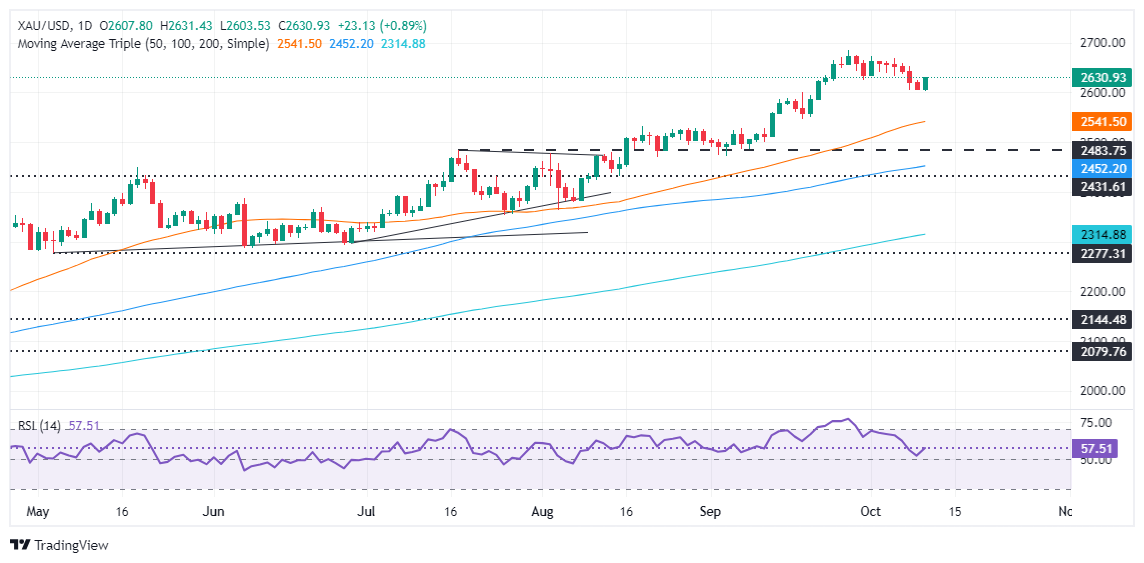
XAU/USD technical analysis: Gold price uptrend resumes, yet remains below $2,650
Gold price resumed its uptrend after diving to a weekly low of $2,603. Although momentum was negative for the last six days, it turned slightly positive on Thursday, as seen by the Relative Strength Index (RSI) aiming up. However, XAU/USD must clear the October 8 daily high of $2,653, so buyers can remain hopeful of challenging the YTD high at $2,685.
If Gold clears $2,653, the next resistance would be the $2,670 area, ahead of $2,685. Conversely, if XAU/USD stays below $2,650, this could sponsor a leg-down toward the $2,600 figure. A breach of the latter will expose the 50-day Simple Moving Average (SMA) at $2,540.
Gold FAQs
Gold has played a key role in human’s history as it has been widely used as a store of value and medium of exchange. Currently, apart from its shine and usage for jewelry, the precious metal is widely seen as a safe-haven asset, meaning that it is considered a good investment during turbulent times. Gold is also widely seen as a hedge against inflation and against depreciating currencies as it doesn’t rely on any specific issuer or government.
Central banks are the biggest Gold holders. In their aim to support their currencies in turbulent times, central banks tend to diversify their reserves and buy Gold to improve the perceived strength of the economy and the currency. High Gold reserves can be a source of trust for a country’s solvency. Central banks added 1,136 tonnes of Gold worth around $70 billion to their reserves in 2022, according to data from the World Gold Council. This is the highest yearly purchase since records began. Central banks from emerging economies such as China, India and Turkey are quickly increasing their Gold reserves.
Gold has an inverse correlation with the US Dollar and US Treasuries, which are both major reserve and safe-haven assets. When the Dollar depreciates, Gold tends to rise, enabling investors and central banks to diversify their assets in turbulent times. Gold is also inversely correlated with risk assets. A rally in the stock market tends to weaken Gold price, while sell-offs in riskier markets tend to favor the precious metal.
The price can move due to a wide range of factors. Geopolitical instability or fears of a deep recession can quickly make Gold price escalate due to its safe-haven status. As a yield-less asset, Gold tends to rise with lower interest rates, while higher cost of money usually weighs down on the yellow metal. Still, most moves depend on how the US Dollar (USD) behaves as the asset is priced in dollars (XAU/USD). A strong Dollar tends to keep the price of Gold controlled, whereas a weaker Dollar is likely to push Gold prices up.
Recommended Articles


