


Gold extends recovery after weak US private payrolls data
- Gold extends its recovery after the release of more weak jobs’ data out of the US.
- The data increases the chance of the Federal Reserve lowering interest rates aggressively – a plus for Gold.
- US Nonfarm Payrolls data out on Friday will be the most important release in shaping interest-rate expectations.
Gold (XAU/USD) trades back inside familiar territory, exchanging hands in the $2,510s on Friday after extending its rebound following the release of more weak jobs’ data from the US on Thursday, this time in the form of private payrolls data, which grew at a slower pace than expected.
Although the negative data was tempered by a marginal fall in unemployment claims, it still painted a picture of a stagnant jobs market going into Friday’s much-anticipated official Nonfarm Payrolls (NFP) report from the US Bureau of Labor Statistics (BLS), which is scheduled for release at 12:30 GMT.
The NFP is likely to be critical in shaping expectations for the future path of interest rates in the US and the value of the US Dollar (USD), two important factors for determining the price of Gold.
Gold focus on US employment and geopolitics
Gold recovers after the release of lower-than-expected ADP Employment Change data showed the private-sector US economy added 99K new hires in August, a figure that fell below both the previous month’s downwardly-revised 111k (from 122K) and economists’ 145K estimate.
Although US Initial Jobless Claims took some of the sting out of the ADP data after it showed a fall in benefit claimants to 227K, from an upwardly-revised 232K in the previous week and 230K expected, the overall picture was one of a slowing labor market.
The data fed into concerns regarding the fragile US labor market that are driving Federal Reserve (Fed) interest rate expectations. This comes after a recent shift from the Fed to focusing on labor-market risks rather than solely inflation.
It follows weak JOLTS jobs data released on Wednesday and keeps the probability of the Fed cutting interest rates by a larger 0.50% at their September 18 meeting relatively high. This, in turn, is positive for Gold, since lower interest rates reduce the opportunity cost of holding the non-interest paying asset.
Friday’s NFP is likely to provide the last significant piece of evidence for how well the US labor market is managing, and will be critical in setting probabilities for the Fed making a larger 0.50% at its September meeting, as opposed to a standard 0.25% cut.
Current market-based expectations show that the chances of a 0.50% cut stand at just over 40%, whilst a 0.25% cut is fully priced in, according to the CME FedWatch tool. If the NFP data is lower than predicted and stokes fresh concerns, the Fed will be more likely to opt for the bigger half-percent cut, an outcome that is likely to boost Gold’s price.
On the geopolitical front, US negotiators claim to be 90% close to agreeing on a ceasefire deal between Israel and Hamas, according to Bloomberg News. If they are successful, it may reduce safe-haven flows to Gold.
In Ukraine, Russia continues its advance towards the key strategic hub city of Pokrovsk. If successful, it could dramatically impact the war on the eastern front and threaten Ukraine’s whole defensive line in the Donbass. Such an outcome, though still unlikely to occur soon, would nevertheless ratchet up tensions in the region and increase demand for Gold. The Central Bank of Poland (NBP), for example, has been hoarding Gold since the war began, according to data from the World Gold Council (WGC).
Technical Analysis: Hammer candlestick followed by up day confirms bullish bias
Gold (XAU/USD) posted two bullish-looking Japanese Hammer candlesticks in a row (box on the chart below) on Tuesday and Wednesday, and with Thursday ending as a solid green-up day, the pattern also gained bullish confirmation. The pattern suggests the odds favor more upside in the very short term.
XAU/USD Daily Chart
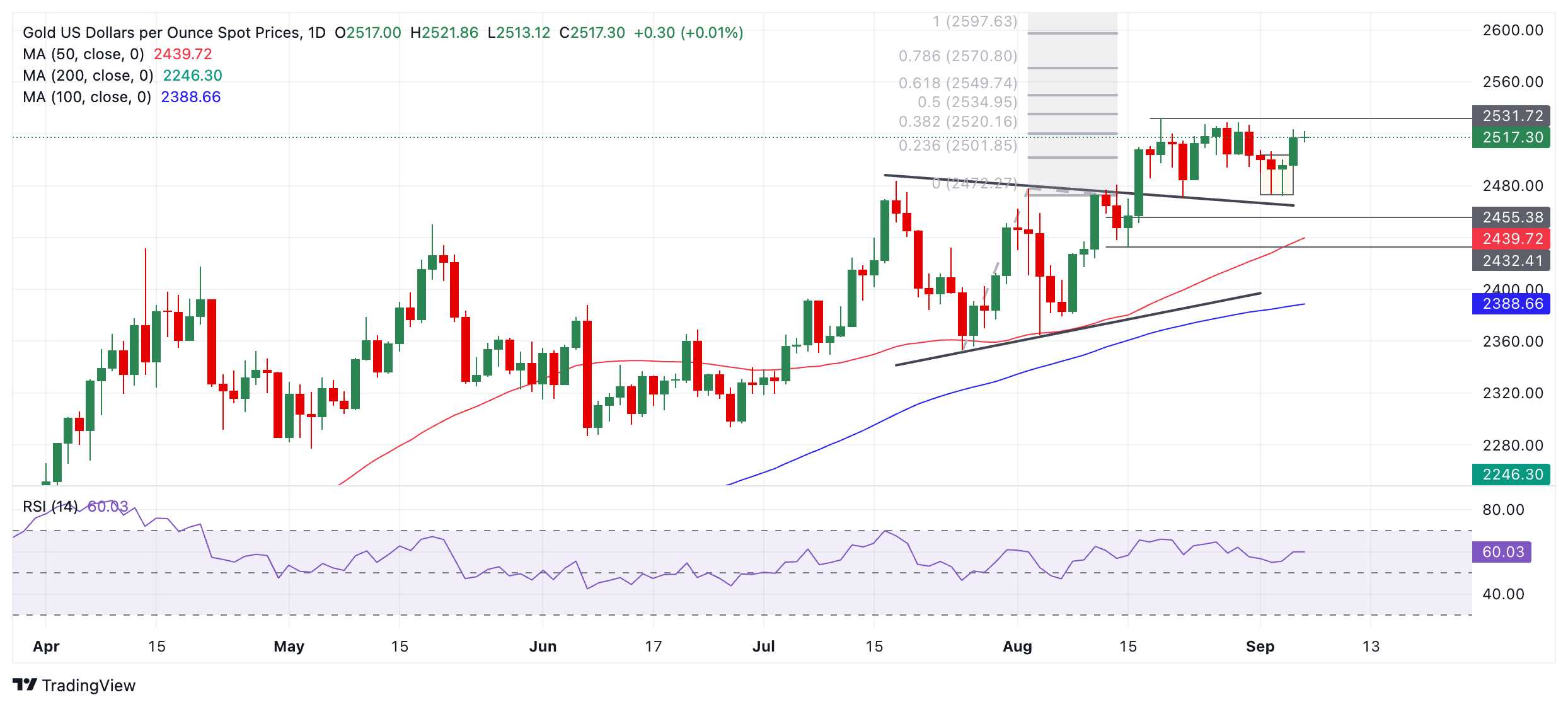
The yellow metal’s price looks poised to rebound to the $2,531 all-time high if it can keep up the bullish recovery momentum.
An upside target for Gold, which has not yet been reached, sits at $2,550 and remains active. The target was generated after the original breakout from the July-August range on August 14.
Gold’s medium and long-term trends also remain bullish, which, given “the trend is your friend,” means the odds still favor an eventual breakout higher materializing.
A break above the August 20 all-time high of $2,531 would provide more confirmation of a continuation higher toward the $2,550 target.
If Gold continues steadily weakening, however, it is likely to find the next support in the $2,470-$2,460 region. A decisive break below that level would change the picture for Gold and suggest that the commodity might be starting a more pronounced downtrend.
Recommended Articles


