


Gold trades higher on strong China data
- Gold ticks higher on Friday after strong data from China, the nation with the greatest demand for Gold.
- Economists caution Chinese growth is “uneven”, however, and government stimulus is key.
- XAU/USD is in a short-term uptrend and may start climbing again after pulling back.
Gold price (XAU/USD) is trading three-tenths of a percent higher on Friday, in the $2,380s, helped by positive data from China that brightened the prospects for the country with the world’s largest market for Gold.
In the US, meanwhile, a raft of secondary data released on Thursday came out mixed and Federal Reserve (Fed) officials repeated their mantra that inflation was still not coming down fast enough to contemplate cutting interest rates, with an overall neutralizing effect on Gold price.
Gold had been rallying after cooler US inflation data and weak US Retail Sales released on Wednesday suggested the Fed might be closer to cutting interest rates than previously thought. The expectation of lower interest rates increases the attractiveness of non-yielding Gold to investors.
Gold price rises after China data shows improvement
Gold got a shot in the arm on Friday after Chinese Industrial Production showed an expectation-beating 6.7% rise year-over-year in April, according to data from the National Bureau of Statistics of China. Economists had forecast a more modest 5.5%. The figure was substantially higher than the 4.5% reading registered in March.
Chinese growth “uneven”
Despite the positive data, some economists remain skeptical about Chinese growth, describing it as “uneven”.
“Activity data for April suggested growth remained uneven. Growth was supported by investment growth and exports, while consumption slowed,” said Tommy Wu, Senior Economist at Commerzbank.
Fiscal spending key
Wu says greater fiscal spending is required to keep growth momentum steady and points out that the Chinese government is starting to sell sovereign bonds in order to boost spending. Much of the country’s growth expectations depend on whether the government sticks to its spending plans, he adds.
The government is also working on comprehensive solutions to the housing crisis. A plan for local governments and state-owned enterprises (SOEs) to buy unsold homes should help absorb inventory and prop up the ailing sector. Further, the PBoC has loosened restrictions on first-time buyers by lowering the minimum deposit to 15% from 25% and “scrapping the mortgage rate floor for first and second home buyers.”
Impact of US tariffs minor
As far as US tariffs on EVs and solar panels goes, Wu says the effect is likely to be minor given China only exports a small percentage of its EVs to the US and most Chinese solar panels are sold through intermediate countries without high tariffs.
Technical Analysis: Gold price rising in channel
Gold price (XAU/USD) pulls back after rising to within a whisker of resistance at $2,400.
The precious metal has been rising in a channel since the May 2 lows, however, suggesting the short-term trend is bullish and more upside is eventually expected.
XAU/USD 4-hour Chart
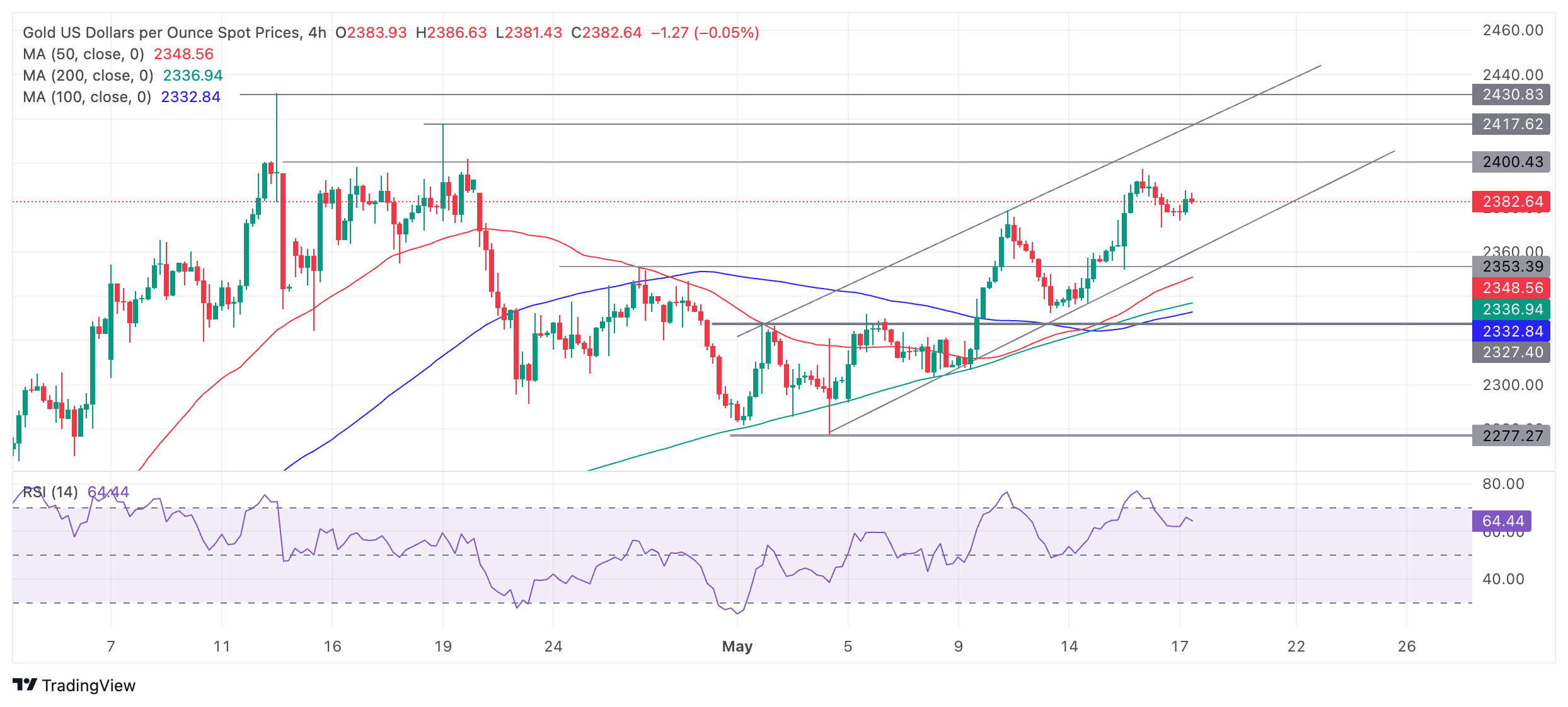
The Relative Strength Index (RSI) has fallen back out of the overbought zone, suggesting renewed potential for more upside.
A break above $2,400 would likely see it rally to the next resistance level at $2,417 (the April 19 high), followed by $2,430 – the all-time high.
The medium and long-term charts (daily and weekly) are also bullish, adding a supportive backdrop for Gold.
Gold FAQs
Gold has played a key role in human’s history as it has been widely used as a store of value and medium of exchange. Currently, apart from its shine and usage for jewelry, the precious metal is widely seen as a safe-haven asset, meaning that it is considered a good investment during turbulent times. Gold is also widely seen as a hedge against inflation and against depreciating currencies as it doesn’t rely on any specific issuer or government.
Central banks are the biggest Gold holders. In their aim to support their currencies in turbulent times, central banks tend to diversify their reserves and buy Gold to improve the perceived strength of the economy and the currency. High Gold reserves can be a source of trust for a country’s solvency. Central banks added 1,136 tonnes of Gold worth around $70 billion to their reserves in 2022, according to data from the World Gold Council. This is the highest yearly purchase since records began. Central banks from emerging economies such as China, India and Turkey are quickly increasing their Gold reserves.
Gold has an inverse correlation with the US Dollar and US Treasuries, which are both major reserve and safe-haven assets. When the Dollar depreciates, Gold tends to rise, enabling investors and central banks to diversify their assets in turbulent times. Gold is also inversely correlated with risk assets. A rally in the stock market tends to weaken Gold price, while sell-offs in riskier markets tend to favor the precious metal.
The price can move due to a wide range of factors. Geopolitical instability or fears of a deep recession can quickly make Gold price escalate due to its safe-haven status. As a yield-less asset, Gold tends to rise with lower interest rates, while higher cost of money usually weighs down on the yellow metal. Still, most moves depend on how the US Dollar (USD) behaves as the asset is priced in dollars (XAU/USD). A strong Dollar tends to keep the price of Gold controlled, whereas a weaker Dollar is likely to push Gold prices up.
Recommended Articles


