




Gold retreats from six-week highs with Fed cut bets limiting downside
- Gold slips as traders book profits after Monday’s surge to six-week highs.
- Fed rate-cut expectations remain supportive, with markets pricing an 87% chance of a 25 bps reduction next week.
- Short-term technicals soften, with momentum indicators cooling and price retreating toward the $4,150-$4,160 support zone.
Gold (XAU/USD) edges lower on Tuesday as traders lock in some profits following Monday’s surge to six-week highs. At the time of writing, XAU/USD is trading near $4,197, down nearly 0.95% on the day.
A modest uptick in the US Dollar (USD) and firmer Treasury yields are also weighing on the precious metal. At the same time, a cautious risk backdrop, with major global stock indices stabilizing after Monday’s sell-off, is tempering safe-haven demand and contributing to the pullback.
Despite the mild retreat, downside remains limited as Gold stays broadly supported by expectations that the Federal Reserve will lower interest rates at its upcoming monetary policy meeting next week.
With no major US economic releases due on Tuesday, Gold’s intraday moves may remain subdued, leaving price action largely driven by USD dynamics and shifts in the broader risk environment.
Market movers: Softer US data and rising Fed cut bets shape Gold’s outlook
- The US Dollar Index (DXY), which measures the Greenback's value against a basket of six major currencies, is staging a modest rebound after slipping to its lowest level in over two weeks on Monday. At the time of writing, the index is trading around 99.47, snapping a five-day losing streak.
- US economic data released on Monday painted a softer picture for the manufacturing sector. The ISM Manufacturing Purchasing Managers Index (PMI) slipped to 48.2 in November from 48.7, missing the 48.6 forecast and marking a ninth straight month in contraction. The details were also somewhat lacking. New Orders eased to 47.4 from 49.4, extending their recent losing streak, while the Employment Index fell to 44 from 46. The only firm spot came from Prices Paid, which stayed in expansion and inched up to 58.5 from 58.
- Delayed US data released last week pointed to softer economic momentum. Retail Sales rose just 0.2% MoMwhile inflation was mixed with headline Producer Price Index (PPI) rising 0.3% MoM in September and Core PPI rising only 0.1%. Consumer Confidence slipped to its lowest since April, and ADP figures showed private payrolls falling by an average of 13,500 jobs per week compared with 2,500 previously.
- Recent soft economic data, paired with dovish-leaning remarks from several Federal Reserve officials, pushed traders to ramp up rate-cut expectations. According to the CME FedWatch Tool, markets now assign around an 87% probability of a 25 basis point (bps) cut at next week’s meeting. Traders now turn their attention to this week’s key releases, including ISM Services PMI and ADP Employment Change on Wednesday, followed by Personal Consumption Expenditures (PCE) inflation on Friday.
- According to a new Goldman Sachs poll, almost 70% of global institutional investors expect prices to extend gains next year, with 36% anticipating a move above $5,000 by the end of 2026 and another third seeing a $4,500-$5,000 range. Other banks share a similar view. Bank of America projects Gold could reach $5,000, Deutsche Bank sees prices near $4,950 in 2026, while HSBC is more cautious, projecting Gold in the $3,600-$4,400 range.
Technical analysis: Bulls need a break above $4,250 to regain control
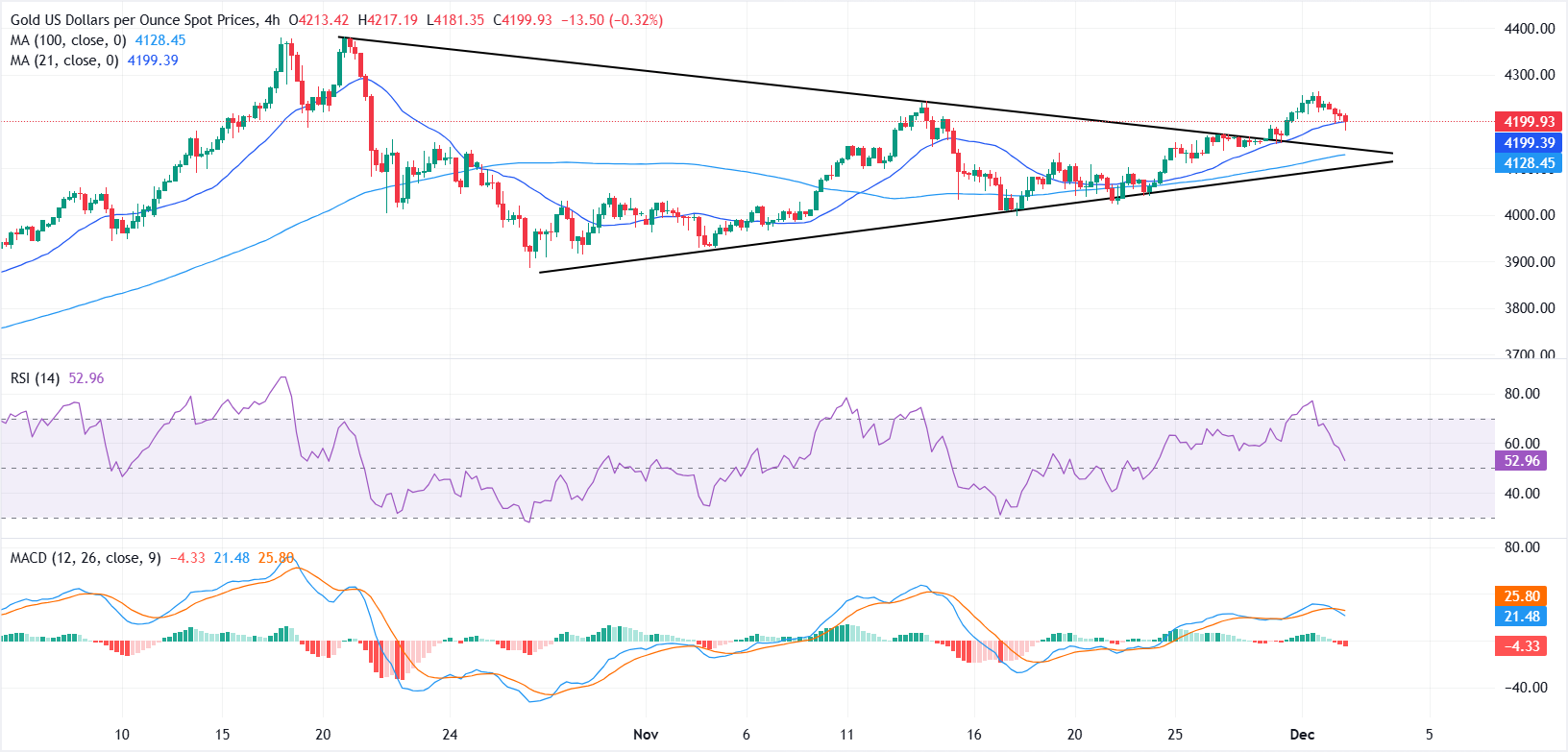
From a technical perspective, the short-term outlook tilts slightly to the downside on the 4-hour chart as momentum indicators cool after Monday’s breakout run above the symmetrical triangle pattern.
Price is now pulling back toward the breakout area, with XAU/USD hovering around the 21-period Simple Moving Average (SMA), which is offering initial support near $4,190-$4,200.
Momentum is losing traction. The Moving Average Convergence Divergence (MACD) turns negative after a bearish crossover, and the widening downside histogram reinforces fading momentum. The Relative Strength Index (RSI) sits at 48.84, neutral after pulling back from overbought levels.
If the pullback deepens, the next notable support lies at the upper boundary of the broken triangle pattern around $4,150-$4,160, which acts as a stronger downside pivot. On the upside, bulls need to reclaim the $4,250 zone to revive upward momentum.
Gold FAQs
Gold has played a key role in human’s history as it has been widely used as a store of value and medium of exchange. Currently, apart from its shine and usage for jewelry, the precious metal is widely seen as a safe-haven asset, meaning that it is considered a good investment during turbulent times. Gold is also widely seen as a hedge against inflation and against depreciating currencies as it doesn’t rely on any specific issuer or government.
Central banks are the biggest Gold holders. In their aim to support their currencies in turbulent times, central banks tend to diversify their reserves and buy Gold to improve the perceived strength of the economy and the currency. High Gold reserves can be a source of trust for a country’s solvency. Central banks added 1,136 tonnes of Gold worth around $70 billion to their reserves in 2022, according to data from the World Gold Council. This is the highest yearly purchase since records began. Central banks from emerging economies such as China, India and Turkey are quickly increasing their Gold reserves.
Gold has an inverse correlation with the US Dollar and US Treasuries, which are both major reserve and safe-haven assets. When the Dollar depreciates, Gold tends to rise, enabling investors and central banks to diversify their assets in turbulent times. Gold is also inversely correlated with risk assets. A rally in the stock market tends to weaken Gold price, while sell-offs in riskier markets tend to favor the precious metal.
The price can move due to a wide range of factors. Geopolitical instability or fears of a deep recession can quickly make Gold price escalate due to its safe-haven status. As a yield-less asset, Gold tends to rise with lower interest rates, while higher cost of money usually weighs down on the yellow metal. Still, most moves depend on how the US Dollar (USD) behaves as the asset is priced in dollars (XAU/USD). A strong Dollar tends to keep the price of Gold controlled, whereas a weaker Dollar is likely to push Gold prices up.
Recommended Articles


