


Mexican Peso stabilizes after run of US-inspired weakness
- The Mexican Peso stabilizes after weakening for three days in a row.
- Political changes across the border impacting Mexico have been the main driver of the Peso’s depreciation.
- USD/MXN closes in on November high after bouncing from the base of a rising channel.
The Mexican Peso (MXN) stabilizes on Wednesday after a three-day run of weakness spurred by a mixture of investor fears about the impact of President-elect Donald Trump’s trade and immigration agenda on Mexico, a generally risk-off tone to markets outside of the United States (US) (which tends to impact the risk-sensitive Peso disproportionately), and expectations that the Bank of Mexico (Banxico) will cut its main interest rate by 25 basis points (bps) (0.25%) at its up-and-coming meeting on Thursday. Lower interest rates are generally negative for a currency as they reduce foreign capital inflows.
Mexican Peso weakens as headwinds gather across the border
The Mexican Peso has depreciated as markets price in the impact of Donald Trump’s proposed policy agenda on the Mexican economy. Trump is expected to implement high tariffs on Mexican goods entering the US, especially Chinese electric vehicles that are manufactured across the border in Mexico. The appointment of Mike Waltz as National Security Advisor and Marco Rubio as Secretary of State in the US are particularly bad signs from this perspective because of their known tough stance on China. Tariffs are expected to reduce demand for foreign imports, which in turn is likely to lower demand for the Mexican Peso too.
The new Mexican government’s reforms to the judiciary also contravene the conditions of the existing free trade agreement between the US, Mexico and Canada, the USMCA. This could give Trump the opportunity to demand a renegotiation before the agreement officially expires in 2026, making the threat of tariffs more immediate.
Trump’s plan to deport millions of illegal immigrants, many of whom are probably Mexican, is another potentially negative factor for the Peso since demand from workers in the US sending remittances home to Mexico is a key driver of the currency.
The policy has also already drawn criticism from Mexico’s President Claudia Sheinbaum, who said the US needed immigrants for its economy and that “We will always defend Mexicans on the other side of the border.”
The increasing likelihood that the Republican party will win a majority in the US Congress, allowing them free reign to implement Trump’s radical policies after winning the Senate, might also impact MXN. The final seats are still being called, but as things stand, the Republican party has won 216 to the Democratic party’s 207 seats, with only 12 outstanding, according to the Associated Press. The threshold for a majority is 218.
According to forecasts by El Financiero, a Republican majority in Congress with Trump as President could lead the Peso to weaken even further against the USD. In such a scenario, they estimate a band of between 21.14 and 22.26 for USD/MXN.
Technical Analysis: USD/MXN closes in on November high
USD/MXN rallies for three consecutive days after finding a floor at the base of a rising channel. It appears to have renewed its short-term uptrend, and given the technical analysis saying that “the trend is your friend,” the odds favor a continuation higher.
USD/MXN Daily Chart
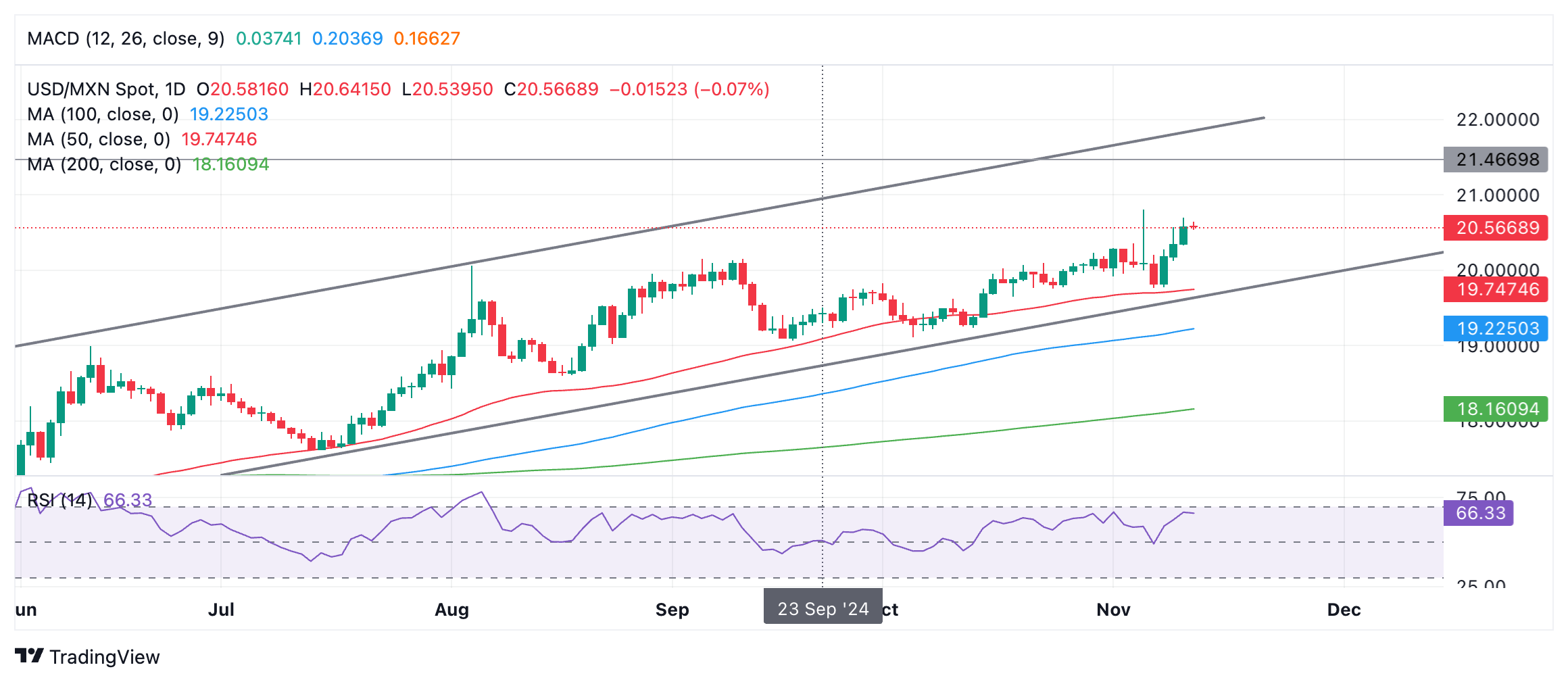
Further, USD/MXN is also in an uptrend on a medium and long-term basis, adding weight to the move higher. A break above 20.80 (November 6 high) would confirm a higher high and an extension of the bullish trend. The next upside target lies at 21.00 (round number, psychological support), where buyers could start to meet resistance.
Mexican Peso FAQs
The Mexican Peso (MXN) is the most traded currency among its Latin American peers. Its value is broadly determined by the performance of the Mexican economy, the country’s central bank’s policy, the amount of foreign investment in the country and even the levels of remittances sent by Mexicans who live abroad, particularly in the United States. Geopolitical trends can also move MXN: for example, the process of nearshoring – or the decision by some firms to relocate manufacturing capacity and supply chains closer to their home countries – is also seen as a catalyst for the Mexican currency as the country is considered a key manufacturing hub in the American continent. Another catalyst for MXN is Oil prices as Mexico is a key exporter of the commodity.
The main objective of Mexico’s central bank, also known as Banxico, is to maintain inflation at low and stable levels (at or close to its target of 3%, the midpoint in a tolerance band of between 2% and 4%). To this end, the bank sets an appropriate level of interest rates. When inflation is too high, Banxico will attempt to tame it by raising interest rates, making it more expensive for households and businesses to borrow money, thus cooling demand and the overall economy. Higher interest rates are generally positive for the Mexican Peso (MXN) as they lead to higher yields, making the country a more attractive place for investors. On the contrary, lower interest rates tend to weaken MXN.
Macroeconomic data releases are key to assess the state of the economy and can have an impact on the Mexican Peso (MXN) valuation. A strong Mexican economy, based on high economic growth, low unemployment and high confidence is good for MXN. Not only does it attract more foreign investment but it may encourage the Bank of Mexico (Banxico) to increase interest rates, particularly if this strength comes together with elevated inflation. However, if economic data is weak, MXN is likely to depreciate.
As an emerging-market currency, the Mexican Peso (MXN) tends to strive during risk-on periods, or when investors perceive that broader market risks are low and thus are eager to engage with investments that carry a higher risk. Conversely, MXN tends to weaken at times of market turbulence or economic uncertainty as investors tend to sell higher-risk assets and flee to the more-stable safe havens.
Recommended Articles


