


Japanese Yen slides back below 153.00 against USD amid BoJ rate-hike uncertainty
- The Japanese Yen weakened after the BoJ summary showed that policymakers were divided on rate hike timing.
- Japan's Prime Minister Ishiba faces a leadership vote, which adds another layer of uncertainty and weighs on the JPY.
- The Trump optimism continues to underpin the USD and further contributes to the USD/JPY pair’s move up.
The Japanese Yen (JPY) drifted lower against its American counterpart during the Asian session on Monday after the Bank of Japan (BoJ) Summary of Opinions from the October meeting showed that policymakers were divided on rate hike timing. This comes on top of the domestic political landscape, which is expected to make it difficult for the BoJ to tighten its monetary policy further and undermine the JPY. Apart from this, the prevalent risk-on environment and fear that US President-elect Donald Trump might again hit Japan with protectionist trade measures further dent demand for the safe-haven JPY.
Meanwhile, expectations that Trump's policies would boost inflation and restrict the Federal Reserve's (Fed) ability to ease policy aggressively act as a tailwind for the US Dollar (USD). This, in turn, is seen as another factor lending support to the USD/JPY pair. That said, the recent verbal intervention by Japanese authorities might hold back the JPY bears from placing aggressive bets and cap gains for the currency pair. Investors might also prefer to move to the sidelines ahead of this week's important US macro releases, including the latest consumer inflation figures, and Fed Chair Jerome Powell's scheduled speech.
Japanese Yen is pressured by domestic political uncertainty and doubts over further BoJ rate hikes
- The Summary of Opinions from the Bank of Japan's October 30-31 meeting revealed that members discussed the potential impact of changes in the US economy and policies as the central bank moves toward further interest rate increases.
- Japan's Prime Minister Ishiba faces a leadership vote in parliament today after the ruling Liberal Democratic Party (LDP) lost its lower house majority held since 2012 and might now be looking to form a government with the support of minor parties.
- Meanwhile, the prospect of a fragile minority government in Japan raises doubts about the BoJ's ability to hike interest rates further, which, along with the upbeat market mood, undermines the safe-haven Japanese Yen at the start of a new week.
- The US Dollar is seen consolidating its recent strong gains and remains well within the striking distance of a four-month high touched in the euphoric market reaction to Donald Trump's victory in the US presidential election last Wednesday.
- Federal Reserve Bank of Minneapolis President Neel Kashkari said that the central bank wants to have confidence and needs to see more evidence that inflation will return to the 2% target before deciding on another interest rate cut.
- Investors now look to this week's release of the US consumer inflation figures on Wednesday and the US Producer Price Index (PPI) on Thursday, which will be followed by the prelim Q3 GDP print from Japan and US Retail Sales figures on Friday.
- Apart from this, speeches by influential FOMC members, including Fed Chair Jerome Powell on Friday, will play a key role in influencing the USD price dynamics and determining the next leg of a directional move for the currency pair.
Technical Outlook: USD/JPY seems poised to appreciate further while above the 200-day SMA
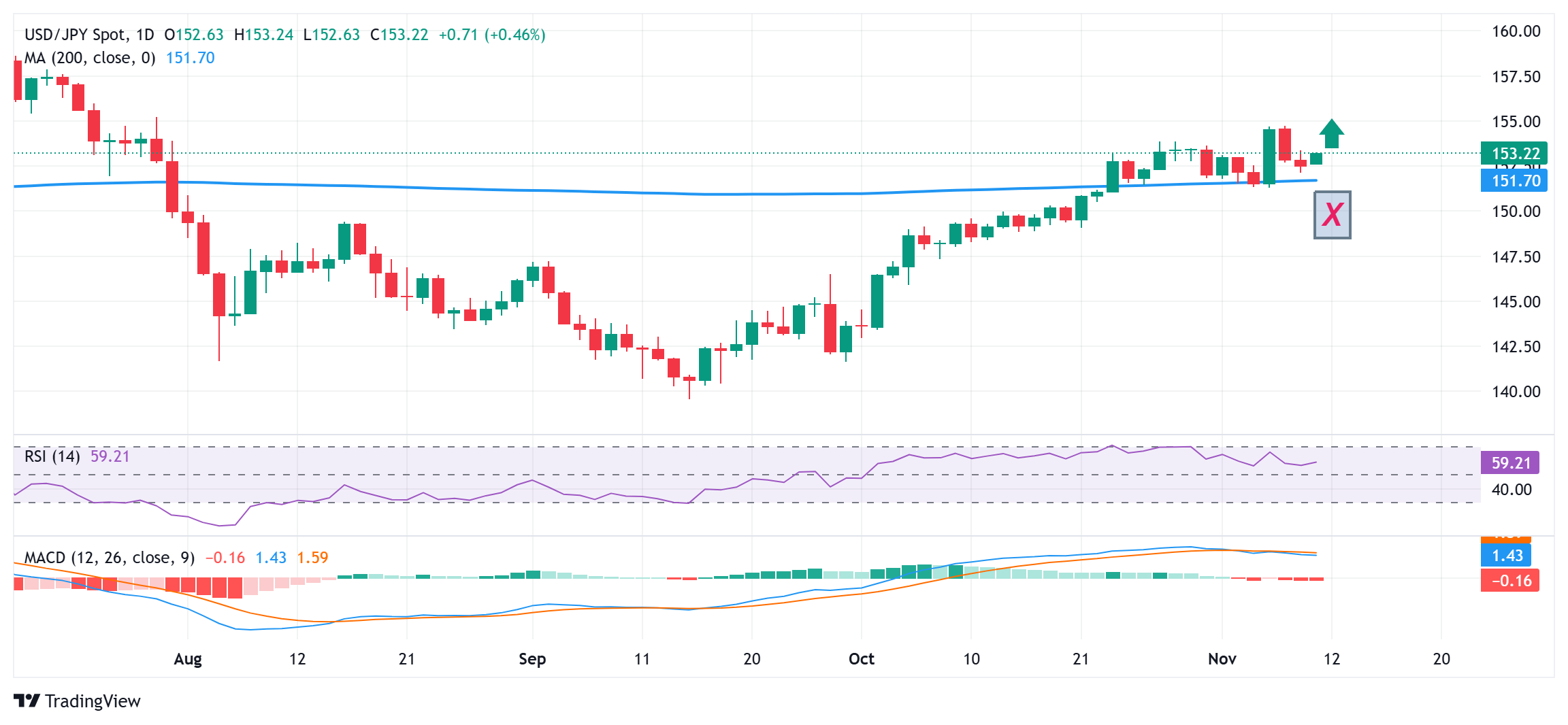
The USD/JPY pair, so far, has managed to hold above the very important 200-day Simple Moving Average (SMA) resistance breakpoint, which should act as a key pivotal point. This, along with positive oscillators on the daily chart, suggests that the path of least resistance for spot prices is to the upside. Any further move-up, however, is likely to confront some resistance ahead of the mid-153.00s. A sustained strength beyond could be seen as a fresh trigger for bulls and pave the way for a move towards reclaiming the 154.00 mark en route to the 154.70 area, or the multi-month top touched last week.
On the flip side, the Asian session low, around the 152.60 area, now seems to protect the immediate downside. Some follow-through selling could drag the USD/JPY pair below the 152.00 round figure, towards the 151.70 region (200-day SMA). A convincing break below the latter will suggest that the recent strong move up from the September low has run out of steam and shift the near-term bias in favor of bearish traders.
Japanese Yen FAQs
The Japanese Yen (JPY) is one of the world’s most traded currencies. Its value is broadly determined by the performance of the Japanese economy, but more specifically by the Bank of Japan’s policy, the differential between Japanese and US bond yields, or risk sentiment among traders, among other factors.
One of the Bank of Japan’s mandates is currency control, so its moves are key for the Yen. The BoJ has directly intervened in currency markets sometimes, generally to lower the value of the Yen, although it refrains from doing it often due to political concerns of its main trading partners. The BoJ ultra-loose monetary policy between 2013 and 2024 caused the Yen to depreciate against its main currency peers due to an increasing policy divergence between the Bank of Japan and other main central banks. More recently, the gradually unwinding of this ultra-loose policy has given some support to the Yen.
Over the last decade, the BoJ’s stance of sticking to ultra-loose monetary policy has led to a widening policy divergence with other central banks, particularly with the US Federal Reserve. This supported a widening of the differential between the 10-year US and Japanese bonds, which favored the US Dollar against the Japanese Yen. The BoJ decision in 2024 to gradually abandon the ultra-loose policy, coupled with interest-rate cuts in other major central banks, is narrowing this differential.
The Japanese Yen is often seen as a safe-haven investment. This means that in times of market stress, investors are more likely to put their money in the Japanese currency due to its supposed reliability and stability. Turbulent times are likely to strengthen the Yen’s value against other currencies seen as more risky to invest in.
Recommended Articles


