


Mexican Peso falls on deteriorating consumer confidence data, Trump’s comments
- Mexican Peso weakens 0.51% against the US Dollar with USD/MXN trading at 19.33 as Mexico’s Consumer Confidence falls.
- Fears over China’s economic slowdown weigh on emerging market currencies, boosting the Greenback.
- Former US President Donald Trump hints at 200% tariffs on Mexican vehicle imports, adding to market concerns.
The Mexican Peso depreciated against the Greenback during the beginning of the week and edged down over 0.51%. Weaker-than-expected data from Mexico, alongside fears of China’s economic slowdown, weighed on most emerging market currencies and propelled the US Dollar higher. The USD/MXN trades at 19.33, up by 0.44%.
The Instituto Nacional de Estadistica Geografia e Informatica (INEGI) revealed that Mexico’s Consumer Confidence in September worsened and edged lower compared to August’s data, which was the highest since February 2019.
In the meantime, China’s Finance Minister Lan Foan revealed that the government would continue to provide stimulus, support the property market, and replenish state bank capitals in efforts to boost the economy.
China faces intense deflationary pressures spurred by a sharp property market slowdown and deteriorating consumer confidence.
Former President Donald Trump suggested imposing tariffs of over 200% on vehicles imported from Mexico, he said in a Fox interview on Sunday.
In the US, a scarce economic docket left traders adrift, and Minneapolis Fed President Neel Kashkari's comments left them unsure. Kashkari said he expected “further modest reductions in our policy rate.” He added that recent jobs data shows a strong labor market and that the economy is in the final stages of bringing inflation back to 2%.
Ahead in the week, the US economic docket will remain scarce on the data front, yet Fed speakers will cross the wires during the week. The New York Empire State Manufacturing Index on Tuesday, followed by the Balance of Trade on Wednesday and a busy schedule on Thursday might dictate the direction of the USD/MXN pair.
Daily digest market movers: Mexican Peso on the defensive as USD/MXN surges
- Mexico’s Consumer Confidence in September deteriorated from 47.6 to 47.1. Most of the subcomponents dropped, except for the current conditions compared to a year ago. In addition, Mexican households revealed that they would be less likely to purchase durable goods, the data showed.
- According to Banxico’s poll, the central bank is projected to lower rates by 50 bps to 10% for the remainder of 2024. Meanwhile, the USD/MXN exchange rate will end near 19.69.
- Mexico’s economy is projected to grow by 1.45% in 2024, lower than August’s 1.57%.
- On Tuesday, the US economic docket will feature the New York Empire State Manufacturing Index for October, which is expected to drop from 11.3 to 2.3, via estimates.
- Federal Reserve officials, led by the San Francisco Fed’s Mary Daly, Board Governor Adriana Kugler, and Atlanta Fed’s Raphael Bostic, will cross the wires.
- Data from the Chicago Board of Trade via the December fed funds rate futures contract shows investors estimate 49 bps of easing by the Fed toward the end of 2024.
USD/MXN technical outlook: Mexican Peso falls as USD/MXN rises above 19.30
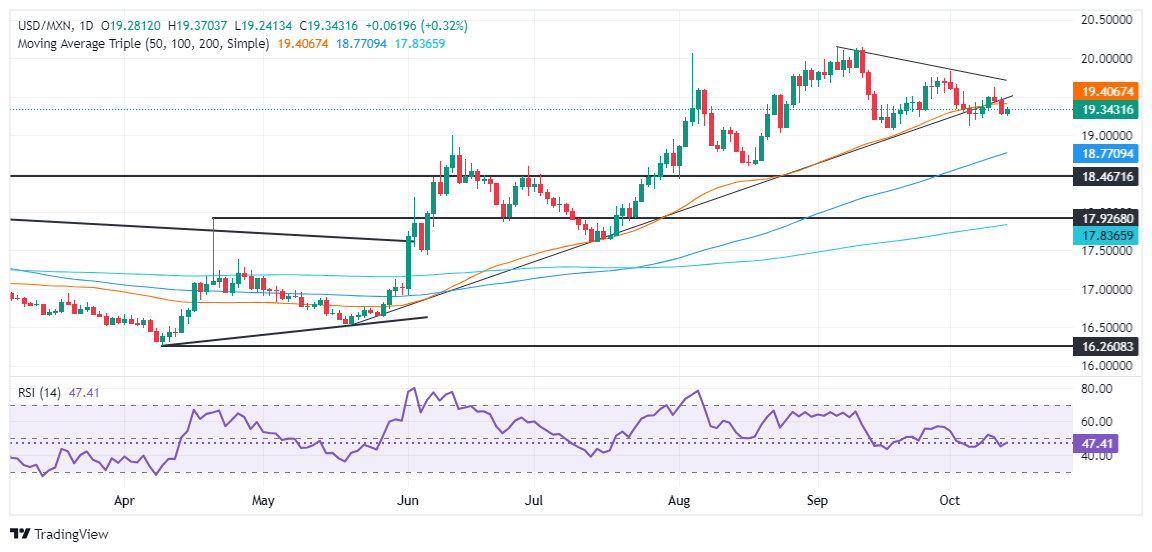
The USD/MXN uptrend remains intact, even though the pair has failed to clear the October 10 daily high of 19.61. At the time of writing, momentum backs buyers, as shown by the Relative Strength Index (RSI). Nevertheless, the rise in the pair could be short-lived unless the RSI clears the 50-neutral line.
If USD/MXN climbs above 19.50, that would expose the previously mentioned 19.61 level. If surpassed, the next resistance level would be the October 1 daily high of 19.82, ahead of 20.00. Up next would be the YTD peak of 20.22.
Conversely, if USD/MXN tumbles below the October 4 wing low of 19.10, the 19.00 figure will be exposed. Once broken, the next support would be the 100-day SMA at 18.75.
Mexican Peso FAQs
The Mexican Peso (MXN) is the most traded currency among its Latin American peers. Its value is broadly determined by the performance of the Mexican economy, the country’s central bank’s policy, the amount of foreign investment in the country and even the levels of remittances sent by Mexicans who live abroad, particularly in the United States. Geopolitical trends can also move MXN: for example, the process of nearshoring – or the decision by some firms to relocate manufacturing capacity and supply chains closer to their home countries – is also seen as a catalyst for the Mexican currency as the country is considered a key manufacturing hub in the American continent. Another catalyst for MXN is Oil prices as Mexico is a key exporter of the commodity.
The main objective of Mexico’s central bank, also known as Banxico, is to maintain inflation at low and stable levels (at or close to its target of 3%, the midpoint in a tolerance band of between 2% and 4%). To this end, the bank sets an appropriate level of interest rates. When inflation is too high, Banxico will attempt to tame it by raising interest rates, making it more expensive for households and businesses to borrow money, thus cooling demand and the overall economy. Higher interest rates are generally positive for the Mexican Peso (MXN) as they lead to higher yields, making the country a more attractive place for investors. On the contrary, lower interest rates tend to weaken MXN.
Macroeconomic data releases are key to assess the state of the economy and can have an impact on the Mexican Peso (MXN) valuation. A strong Mexican economy, based on high economic growth, low unemployment and high confidence is good for MXN. Not only does it attract more foreign investment but it may encourage the Bank of Mexico (Banxico) to increase interest rates, particularly if this strength comes together with elevated inflation. However, if economic data is weak, MXN is likely to depreciate.
As an emerging-market currency, the Mexican Peso (MXN) tends to strive during risk-on periods, or when investors perceive that broader market risks are low and thus are eager to engage with investments that carry a higher risk. Conversely, MXN tends to weaken at times of market turbulence or economic uncertainty as investors tend to sell higher-risk assets and flee to the more-stable safe havens.
Recommended Articles


