


Mexican Peso falls as safe-haven flows boost US Dollar
- Mexican Peso slumps after hitting a low of 19.18, driven by risk-on sentiment favoring the US Dollar.
- Mexico's economic docket highlights an increase in the Jobless Rate to 3.0%, with focus turning to upcoming inflation data and Banxico’s September meeting minutes.
- US Nonfarm Payrolls for September exceeded expectations last Friday, adding 254K jobs as the Unemployment Rate fell to 4.1%.
The Mexican Peso begins the week on the back foot and falls some 0.50% against the Greenback amid a risk-on impulse that keeps the US Dollar trading near seven-week highs. Last week’s outstanding US Nonfarm Payrolls (NFP) data boosted the Mexican currency, but fears of an escalation of the Middle East conflict spurred flows to safe-haven currencies. The USD/MXN trades at 19.33 after bouncing off daily lows at 19.18.
On Friday, the US Bureau of Labor Statistics (BLS) revealed that over 254K people were added to the workforce in September, crushing estimates of 140K and August’s upwardly revised figure of 159K. Consequently, the Unemployment Rate edged lower from 4.2% to 4.1%.
Following the data, the USD/MXN dropped to a new monthly low of 19.10, though it closed near last Friday's highs, opening the door for a recovery.
Money markets trimmed the odds for a 50-basis-point (bps) rate cut by the US Federal Reserve (Fed) at the upcoming November meeting. Data from the Chicago Board of Trade (CBOT) via the December fed funds rate futures contract shows investors estimate 49 bps of easing by the Fed toward the end of 2024.
Data-wise, Mexico’s docket revealed that the Jobless Rate increased from 2.9% to 3.0%, while Automobile Production and Exports improved.
On Thursday, Mexico’s Supreme Court voted eight to three “to consider a constitutional challenge to the controversial judicial overhaul enacted last month,” which would allow the election of judges and Supreme Court magistrates via electoral vote.
Ahead of the week, Mexico’s economic docket will feature the release of Inflation data on Wednesday and the meeting minutes from the Bank of Mexico’s (Banxico) September gathering.
In the US, the schedule will feature many speeches by Fed officials, inflation data on the consumer and producer sides, and the University of Michigan (UoM) Consumer Sentiment for October.
Daily digest market movers: Mexican Peso pressured by strong US Dollar, risk aversion
- Banxico’s September poll of analysts and economists revealed that inflation expectations were reviewed to the downside, with headline prices down from 4.69% to 4.48% YoY. Underlying inflation is expected to hit 3.84% from 3.94%.
- The same survey showed the USD/MXN exchange rate is projected to end 2024 at 19.69, while Banxico’s main reference rate is foreseen to end at 10%.
- Mexico’s economy is foreseen to grow by 1.45% in 2024, lower than August’s 1.57%.
- Chicago Fed President Austan Goolsbee said that more job reports like this “will make me more confident we are settling in at full employment.” He said most Fed officials expect rates to decrease heavily over the next 18 months.
- Citi added its name to JPMorgan and Bank of America and changed its November Fed call from a 50 to 25 bps cut.
- Market participants have disregarded a 50 bps cut. The odds of a 25 bps cut are 83.5%, while the chances for holding rates unchanged are at 16.5%, according to the CME FedWatch Tool data.
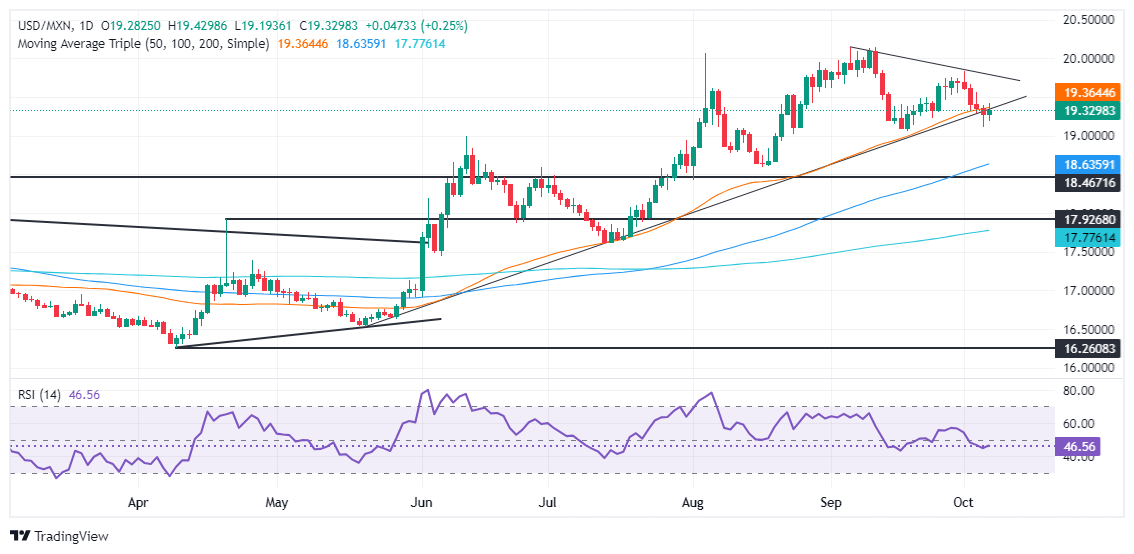
USD/MXN technical outlook: Mexican Peso drops as USD/MXN jumps above 19.30
On Friday, I wrote, "The USD/MXN uptrend is doubtful as the pair cleared the 50-day Simple Moving Average (SMA) at 19.34, with sellers gathering momentum.” The exotic pair remains below that area, which could pave the way for further downside, despite solid gains on Monday.
In the short term, the Relative Strength Index (RSI) shifted bullish, though it remains in bearish territory. This opens the door for a leg-up before resuming its downtrend.
Therefore, the USD/MXN first resistance would be the 50-day SMA, followed by the 19.50 mark. A breach of the latter will expose the October 1 daily high of 19.82, ahead of 20.00. Up next would be the YTD peak of 20.22.
On the flip side, the USD/MXN's first support would be the September 24 swing low of 19.23. Once surpassed, the next demand area will be the September 18 daily low of 19.06, ahead of the psychological 19.00 figure.
Mexican Peso FAQs
The Mexican Peso (MXN) is the most traded currency among its Latin American peers. Its value is broadly determined by the performance of the Mexican economy, the country’s central bank’s policy, the amount of foreign investment in the country and even the levels of remittances sent by Mexicans who live abroad, particularly in the United States. Geopolitical trends can also move MXN: for example, the process of nearshoring – or the decision by some firms to relocate manufacturing capacity and supply chains closer to their home countries – is also seen as a catalyst for the Mexican currency as the country is considered a key manufacturing hub in the American continent. Another catalyst for MXN is Oil prices as Mexico is a key exporter of the commodity.
The main objective of Mexico’s central bank, also known as Banxico, is to maintain inflation at low and stable levels (at or close to its target of 3%, the midpoint in a tolerance band of between 2% and 4%). To this end, the bank sets an appropriate level of interest rates. When inflation is too high, Banxico will attempt to tame it by raising interest rates, making it more expensive for households and businesses to borrow money, thus cooling demand and the overall economy. Higher interest rates are generally positive for the Mexican Peso (MXN) as they lead to higher yields, making the country a more attractive place for investors. On the contrary, lower interest rates tend to weaken MXN.
Macroeconomic data releases are key to assess the state of the economy and can have an impact on the Mexican Peso (MXN) valuation. A strong Mexican economy, based on high economic growth, low unemployment and high confidence is good for MXN. Not only does it attract more foreign investment but it may encourage the Bank of Mexico (Banxico) to increase interest rates, particularly if this strength comes together with elevated inflation. However, if economic data is weak, MXN is likely to depreciate.
As an emerging-market currency, the Mexican Peso (MXN) tends to strive during risk-on periods, or when investors perceive that broader market risks are low and thus are eager to engage with investments that carry a higher risk. Conversely, MXN tends to weaken at times of market turbulence or economic uncertainty as investors tend to sell higher-risk assets and flee to the more-stable safe havens.
Recommended Articles


