


Pound Sterling edges lower after UK employment data
- The Pound Sterling slides below 1.3000 against the US Dollar as UK Average Earnings decelerated in the three months ending in May.
- UK labor market reports the addition of fresh payrolls against a severe drawdown in the three months ending in April.
- Rising expectations for Fed rate cuts in September have weighed on the US Dollar.
The Pound Sterling (GBP) exhibits a subdued performance against its major peers in Thursday’s London session. The British currency drops as United Kingdom (UK) Average Earnings data, a key measure of wage growth that fuels inflation in the service sector and has been a major barrier to the Bank of England’s (BoE) confidence for interest rate cuts, decelerated as expectedly.
Annual Average Earnings (Including and Excluding bonuses) rose by 5.7% in the three months ending in May, below the 5.9% and 6%, respectively, from the previous month. Though the wage growth momentum slowed, it is still higher than what is needed to be consistent for achieving price stability.
Meanwhile, the Office for National Statistics (ONS) reported that employers hired 19K job-seekers in the three months ending in May, against a drawdown of 140K employees in the previous reading. In the same period, the ILO Unemployment Rate was recorded at 4.4%, remaining in line with estimates and the former release.
Expectations for the BoE to begin reducing interest rates from the August meeting have already diminished due to sticky core Consumer Price Index (CPI) data for June. UK’s core CPI grew steadily by 3.5% due to sticky service inflation data.
Daily digest market movers: Pound Sterling declines moderately against US Dollar
- The Pound Sterling edges lower near the psychological support of 1.3000 against the US Dollar (USD) in Thursday’s European session. The broader appeal of the GBP/USD pair remains firm as the Federal Reserve (Fed) is widely expected to start lowering its key borrowing rates from the September meeting.
- The scenario of higher expectations for Fed rate cuts is unfavorable for the US Dollar (USD). The US Dollar Index (DXY), which tracks the Greenback’s value against six major currencies, hovers near an almost four-month low at around 103.70.
- Firm speculation for Fed rate cuts has been prompted by meaningful signs from June’s Consumer Price Index (CPI) report that the disinflation process has resumed after stalling in the first quarter of the year. Annual headline and core CPI, which excludes volatile food and energy prices, decelerated at a faster-than-expected pace.
- Cooling inflationary pressures have also improved Fed officials’ confidence that price pressures are on track to return to the central bank’s target of 2%. On Wednesday, Richmond Fed Bank President Thomas Barkin cited broadening disinflation as “very encouraged.” Barkin added he is sure policymakers will debate at the July policy meeting whether it is still appropriate to describe inflation as elevated, Reuters reported.
Technical Analysis: Pound Sterling trades above all short-to-long-term EMAs
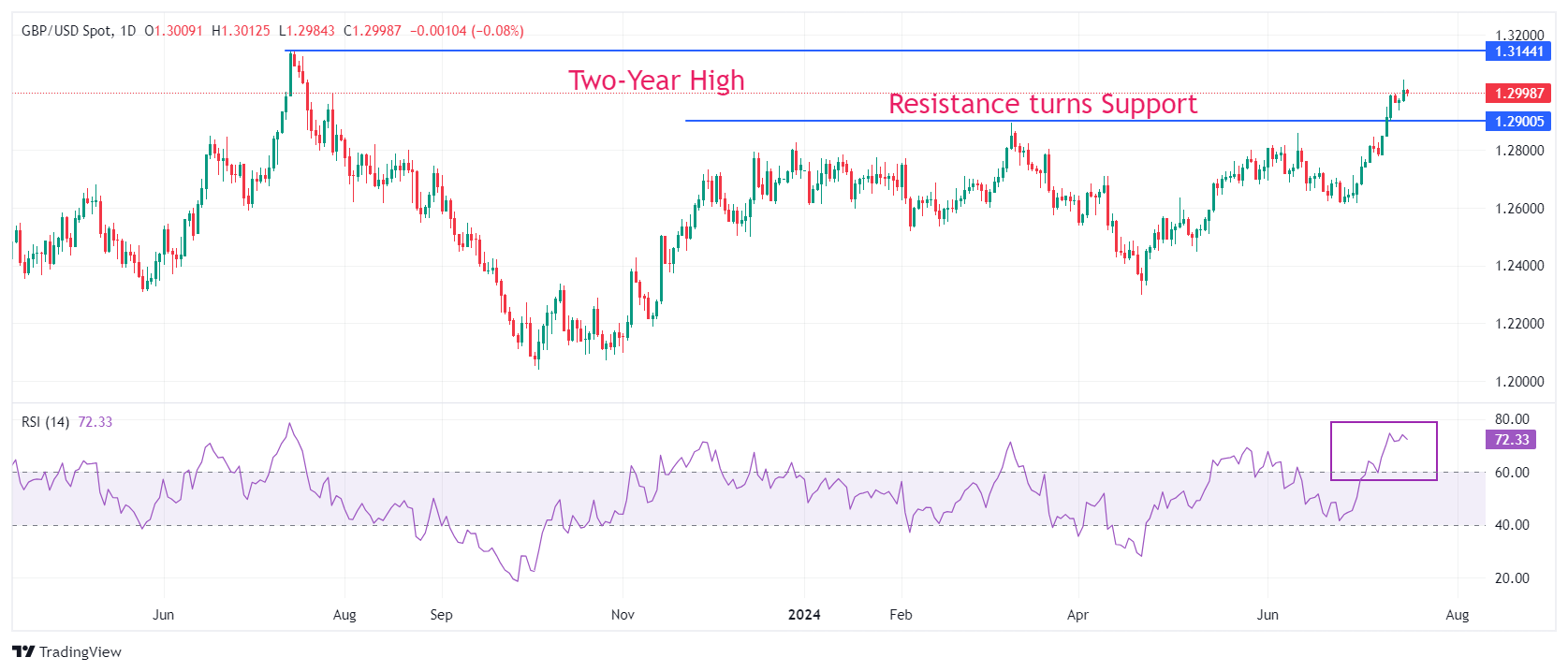
The Pound Sterling drops to near 1.3000 against the US Dollar on a steady decline in the UK wage growth measure. However, the overall trend remains firm as the GBP/USD pair trades close to a fresh two-year high of 1.3044 recorded on Wednesday.
All short-to-long-term Exponential Moving Averages (EMAs) are sloping higher, suggesting a strong bullish trend.
The 14-period Relative Strength Index (RSI) jumps to near 70.00 for the first time in more than a year, indicating strong momentum towards the upside.
The major is expected to extend its upside towards the two-year high near 1.3140. If the GBP/USD pair faces selling pressure after UK data, the March 8 high near 1.2900 will be a key support for the Pound Sterling bulls.
Pound Sterling FAQs
The Pound Sterling (GBP) is the oldest currency in the world (886 AD) and the official currency of the United Kingdom. It is the fourth most traded unit for foreign exchange (FX) in the world, accounting for 12% of all transactions, averaging $630 billion a day, according to 2022 data. Its key trading pairs are GBP/USD, aka ‘Cable’, which accounts for 11% of FX, GBP/JPY, or the ‘Dragon’ as it is known by traders (3%), and EUR/GBP (2%). The Pound Sterling is issued by the Bank of England (BoE).
The single most important factor influencing the value of the Pound Sterling is monetary policy decided by the Bank of England. The BoE bases its decisions on whether it has achieved its primary goal of “price stability” – a steady inflation rate of around 2%. Its primary tool for achieving this is the adjustment of interest rates. When inflation is too high, the BoE will try to rein it in by raising interest rates, making it more expensive for people and businesses to access credit. This is generally positive for GBP, as higher interest rates make the UK a more attractive place for global investors to park their money. When inflation falls too low it is a sign economic growth is slowing. In this scenario, the BoE will consider lowering interest rates to cheapen credit so businesses will borrow more to invest in growth-generating projects.
Data releases gauge the health of the economy and can impact the value of the Pound Sterling. Indicators such as GDP, Manufacturing and Services PMIs, and employment can all influence the direction of the GBP. A strong economy is good for Sterling. Not only does it attract more foreign investment but it may encourage the BoE to put up interest rates, which will directly strengthen GBP. Otherwise, if economic data is weak, the Pound Sterling is likely to fall.
Another significant data release for the Pound Sterling is the Trade Balance. This indicator measures the difference between what a country earns from its exports and what it spends on imports over a given period. If a country produces highly sought-after exports, its currency will benefit purely from the extra demand created from foreign buyers seeking to purchase these goods. Therefore, a positive net Trade Balance strengthens a currency and vice versa for a negative balance.
Recommended Articles


