


ECB meeting accounts are next for a Euro off its 19-month low
- EUR/USD rises for a second session, short of 1.1000 after Monday's 19-month low.
- ECB and Fed hikes are both priced for December, so the rate gap remains unchanged.
- The ECB's October meeting accounts are due Thursday, with US markets shut.
European Central Bank (ECB) Governing Council member Kocher said market pricing for a December rate hike isn't unreasonable, and the Euro didn't move on it. EUR/USD fell below 1.0950 before the US data, held there through the releases, and has since risen to just under 1.1000. It's on track for a second rising session after Monday's low just below 1.0900, its lowest since April 2025.
The ECB's deposit rate is 2.50% after two hikes in 2026, and a quarter-point rise on December 17 is widely expected. Kocher also said the ECB's inflation forecasts are likely to be revised up at that meeting. The Fed is priced to hike eight days earlier, so both sides of EUR/USD's rate gap rise together and the gap stays where it is.
US core inflation on the Personal Consumption Expenditures Price Index (PCE) came in at 3.3% for October, a tenth above forecast, and third-quarter growth was 4.3%. The priced chance of a December Fed hike fell to about 94%. Treasury yields fell as money left technology stocks, and EUR/USD turned higher as the Dollar gave back its gain.
On the calendar
The accounts of the ECB's October 28-29 meeting, where it left rates unchanged, will be released at 12:30 GMT on Thursday, and European Union leaders meet on Thursday and Friday. Friday has the Economic Sentiment Indicator at 10:00 GMT, forecast at 97.2 after 96.9, then Bundesbank President Nagel at 12:50 GMT and ECB Vice-President Vujcic at 14:15 GMT. All of it feeds the December 17 decision, the European side of the gap.
Thursday is Thanksgiving in the US, with markets shut, and US stocks stop trading at 18:00 GMT on Friday. Fed officials go quiet from Saturday ahead of their December 8-9 meeting, so Friday is their last chance to shift the US side.
On the charts
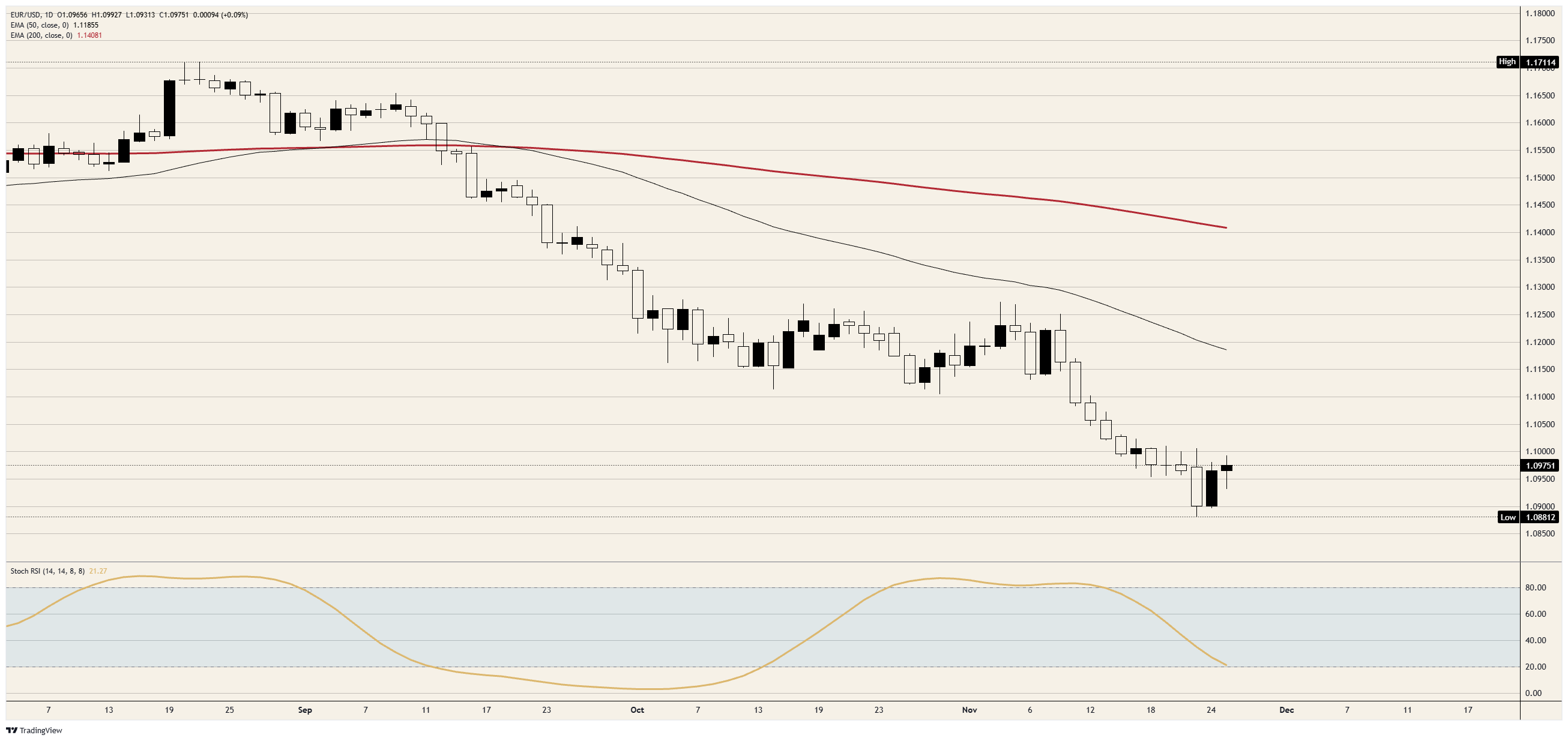
EUR/USD has recovered about a quarter of the fall from the November 5 high just under 1.1300. It has traded below the 50-day Exponential Moving Average (EMA), now near 1.1200, since mid-September, and the 200-day EMA is near 1.1400. Daily momentum is close to oversold and still falling.
EUR/USD daily chart
Euro FAQs
The Euro is the currency for the 20 European Union countries that belong to the Eurozone. It is the second most heavily traded currency in the world behind the US Dollar. In 2022, it accounted for 31% of all foreign exchange transactions, with an average daily turnover of over $2.2 trillion a day. EUR/USD is the most heavily traded currency pair in the world, accounting for an estimated 30% off all transactions, followed by EUR/JPY (4%), EUR/GBP (3%) and EUR/AUD (2%).
The European Central Bank (ECB) in Frankfurt, Germany, is the reserve bank for the Eurozone. The ECB sets interest rates and manages monetary policy. The ECB’s primary mandate is to maintain price stability, which means either controlling inflation or stimulating growth. Its primary tool is the raising or lowering of interest rates. Relatively high interest rates – or the expectation of higher rates – will usually benefit the Euro and vice versa. The ECB Governing Council makes monetary policy decisions at meetings held eight times a year. Decisions are made by heads of the Eurozone national banks and six permanent members, including the President of the ECB, Christine Lagarde.
Eurozone inflation data, measured by the Harmonized Index of Consumer Prices (HICP), is an important econometric for the Euro. If inflation rises more than expected, especially if above the ECB’s 2% target, it obliges the ECB to raise interest rates to bring it back under control. Relatively high interest rates compared to its counterparts will usually benefit the Euro, as it makes the region more attractive as a place for global investors to park their money.
Data releases gauge the health of the economy and can impact on the Euro. Indicators such as GDP, Manufacturing and Services PMIs, employment, and consumer sentiment surveys can all influence the direction of the single currency. A strong economy is good for the Euro. Not only does it attract more foreign investment but it may encourage the ECB to put up interest rates, which will directly strengthen the Euro. Otherwise, if economic data is weak, the Euro is likely to fall. Economic data for the four largest economies in the euro area (Germany, France, Italy and Spain) are especially significant, as they account for 75% of the Eurozone’s economy.
Another significant data release for the Euro is the Trade Balance. This indicator measures the difference between what a country earns from its exports and what it spends on imports over a given period. If a country produces highly sought after exports then its currency will gain in value purely from the extra demand created from foreign buyers seeking to purchase these goods. Therefore, a positive net Trade Balance strengthens a currency and vice versa for a negative balance.
Recommended Articles


