


Japanese Yen strengthens against weaker USD amid intervention fears; BoJ rate hike bets
- The Japanese Yen attracts fresh buyers amid intervention fears, reviving BoJ rate hike bets.
- Dovish Fed expectations drag the USD to an over one-week low and also weigh on USD/JPY.
- Fiscal concerns and a positive risk tone might cap any further upside for the safe-haven JPY.
The Japanese Yen (JPY) gains some positive traction during the Asian session on Thursday and stalls its modest pullback from a one-week top, touched against a broadly weaker US Dollar (USD) the previous day. Speculations that Japanese authorities would step in to stem any further weakness in the domestic currency offer some support to the JPY. Adding to this, expectations that the Bank of Japan (BoJ) could raise interest rates as soon as next month provide a modest lift to the JPY.
However, the prevalent risk-on environment, along with concerns about Japan's worsening fiscal position amid Prime Minister Sanae Takaichi’s pro-stimulus stance, acts as a headwind for the safe-haven JPY. The negative factor, to a larger extent, is offset by sustained USD selling, which continues to be undermined by bets for another interest rate cut by the US Federal Reserve (Fed) in December. This, in turn, should keep a lid on any meaningful recovery move for the USD/JPY pair.
Japanese Yen is backed by possibility of government intervention and hawkish BoJ bets
- The recent decline in the Japanese Yen prompted Finance Minister Satsuki Katayama to issue the strongest warning to date by specifically saying that the government would take appropriate action against excessive market volatility. Moreover, comments from Takuji Aida, a member of a key government panel, also explicitly raised the possibility of an intervention to counter the negative economic impact of a weak JPY.
- Reuters reported on Wednesday that the Bank of Japan over the past week has intentionally shifted messaging to highlight the inflationary risks of a persistently weak JPY, suggesting that a December rate hike remains a live option. This follows a meeting between Prime Minister Sanae Takaichi and BoJ Governor Kazuo Ueda last week, which appeared to remove political objections to rate hikes from the new administration.
- Moreover, data released on Wednesday showed that Japan's Services Producer Price Index, which tracks the price companies charge each other for services, rose 2.7% in October from a year earlier. This suggests that Japan was on the cusp of durably meeting its 2% inflation target and backs the case for a further BoJ policy tightening. This, in turn, assists the JPY to regain some positive traction following the overnight slide.
- Japan's cabinet approved a ¥21.3 trillion economic stimulus plan last Friday, marking the first significant policy initiative under PM Sanae Takaichi. This also represents the largest stimulus since the COVID pandemic, which fueled anxiety about the supply of new government debt and had been a key factor behind the recent steepening of Japan's yield curve. This, along with the risk-on mood, warrants caution for the JPY bulls.
- The US Dollar, on the other hand, drops to an over one-week low during the Asian session on Thursday amid the growing acceptance that the Federal Reserve (Fed) will lower borrowing costs again in December. Even a mixed set of US economic indicators released this week did little to alter the outlook, which continues to undermine the Greenback and contributes to the USD/JPY pair's intraday downfall to the 155.70 region.
- The prospects for lower US interest rates, along with hopes for a peace deal between Russia and Ukraine, remain supportive of the upbeat market mood. This keeps a lid on any further appreciation for the safe-haven JPY and helps limit the downside for the USD/JPY. Traders also seem reluctant to place aggressive directional bets and opt to wait on the sidelines amid thin trading volumes on the back of a holiday in the US.
USD/JPY bears have the upper hand while below the 100-hour SMA around 156.70
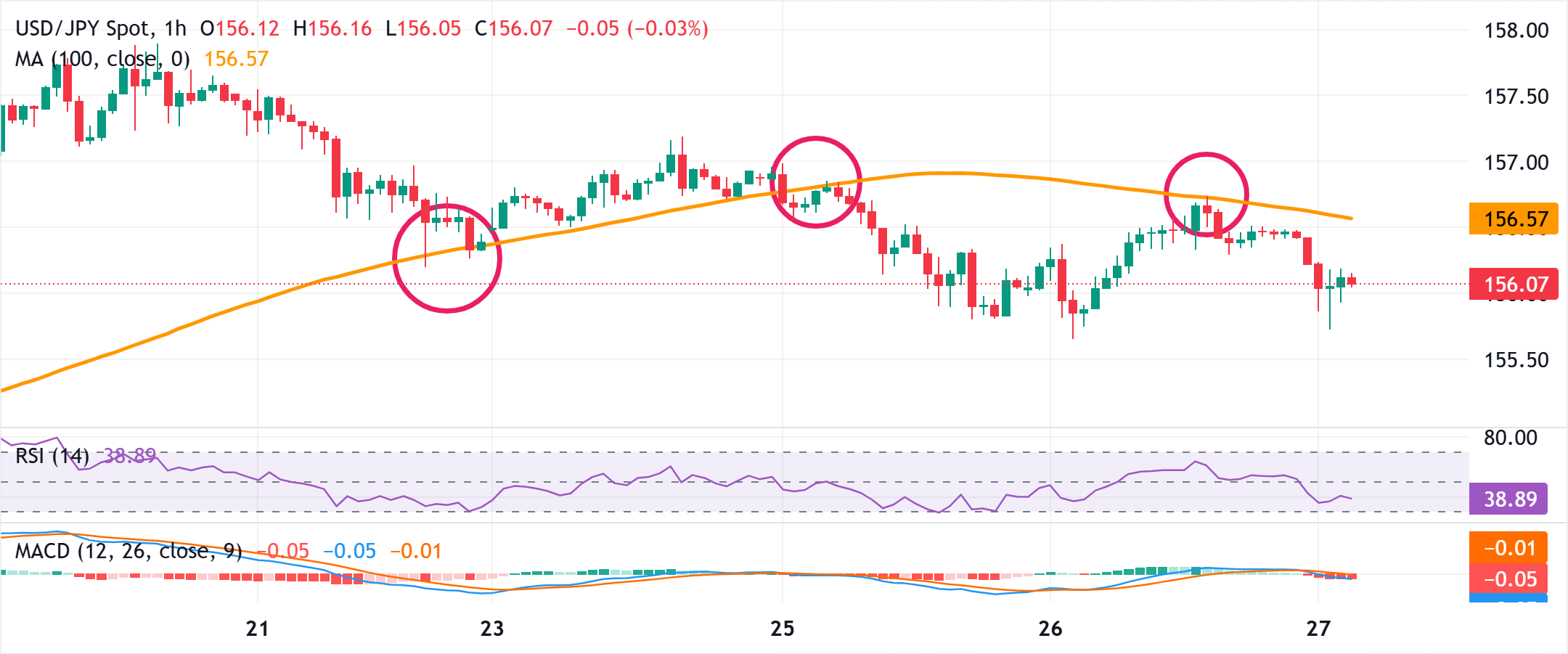
The overnight move up faced rejection near the 100-hour Simple Moving Average (SMA), which is currently pegged near the 156.70 region and should act as a key pivotal point for the USD/JPY pair. A sustained strength beyond should allow spot prices to reclaim the 157.00 mark and climb further toward the 157.45-157.50 intermediate hurdle en route to the 158.00 neighborhood, or the highest level since mid-January, touched last week.
On the flip side, weakness below the overnight swing low, around the 155.65 region, should pave the way for deeper losses and drag the USD/JPY pair to the 155.00 psychological mark. A convincing break below the latter will be seen as a fresh trigger for bearish traders and set the stage for an extension of a one-week-old downtrend from the vicinity of the 158.00 round figure.
Japanese Yen FAQs
The Japanese Yen (JPY) is one of the world’s most traded currencies. Its value is broadly determined by the performance of the Japanese economy, but more specifically by the Bank of Japan’s policy, the differential between Japanese and US bond yields, or risk sentiment among traders, among other factors.
One of the Bank of Japan’s mandates is currency control, so its moves are key for the Yen. The BoJ has directly intervened in currency markets sometimes, generally to lower the value of the Yen, although it refrains from doing it often due to political concerns of its main trading partners. The BoJ ultra-loose monetary policy between 2013 and 2024 caused the Yen to depreciate against its main currency peers due to an increasing policy divergence between the Bank of Japan and other main central banks. More recently, the gradually unwinding of this ultra-loose policy has given some support to the Yen.
Over the last decade, the BoJ’s stance of sticking to ultra-loose monetary policy has led to a widening policy divergence with other central banks, particularly with the US Federal Reserve. This supported a widening of the differential between the 10-year US and Japanese bonds, which favored the US Dollar against the Japanese Yen. The BoJ decision in 2024 to gradually abandon the ultra-loose policy, coupled with interest-rate cuts in other major central banks, is narrowing this differential.
The Japanese Yen is often seen as a safe-haven investment. This means that in times of market stress, investors are more likely to put their money in the Japanese currency due to its supposed reliability and stability. Turbulent times are likely to strengthen the Yen’s value against other currencies seen as more risky to invest in.
Recommended Articles


