




Japanese Yen strengthens on intervention fears, BoJ-Fed policy divergence
- Japanese Yen gains some positive traction on Tuesday amid renewed intervention fears.
- The divergent BoJ-Fed policy expectations further offer support to the lower-yielding JPY.
- Traders might opt to wait for the Fed and the BoJ decisions before placing directional bets.
The Japanese Yen (JPY) strengthens across the board during the Asian session on Tuesday and moves further away from an over two-week low touched against its American counterpart the previous day. Comments from Japan's Economics Minister Minoru Kiuchi fueled speculations about a possible government intervention to stem further JPY depreciation. This, in turn, prompts traders to lighten their JPY bearish bets ahead of this week's key central bank event risks – the start of a two-day FOMC meeting later today and the Bank of Japan (BoJ) policy update on Thursday.
Meanwhile, data released on Monday showed that Japan’s service-sector inflation rose for the second consecutive month in September and reinforced expectations for potential gradual interest rate hikes by the BoJ. In contrast, traders now seem to have fully priced in that the US central bank will lower borrowing costs two more times by the year-end. This, along with lingering uncertainty over US-China trade talks, benefits the JPY. However, expectations of aggressive fiscal spending under Japan's new Prime Minister Sanae Takaichi might keep a lid on any meaningful JPY gains.
Japanese Yen bears opt to lighten their bets after some verbal intervention
- Japan's Economics Minister Minoru Kiuchi said this Tuesday that it is important for foreign exchange (FX) moves to be stable and reflect fundamentals, adding that he will scrutinize its impact on Japan’s economy.
- Japan's Prime Minister Sanae Takaichi said that she wants to realise a new golden age of the Japan-US alliance. Moreover, US President Donald Trump said that we are signing a new deal with Japan, and it is a fair deal.
- Data released on Monday showed that Japan's Services Producer Price Index accelerated to 3.0% in September, reaffirming bets for further tightening by the Bank of Japan and also lending support to the Japanese Yen.
- This marks a significant divergence in comparison to the growing market acceptance that the US Federal Reserve will lower borrowing costs by 25-basis-points at the end of a two-day policy meeting on Wednesday.
- Moreover, traders have been pricing in a greater possibility of another rate reduction by the US central bank in December. This keeps the US Dollar bulls on the defensive and further exerts pressure on the USD/JPY pair.
- Meanwhile, Takaichi is known for her pro-stimulus stance and could resist early tightening by the BoJ. Hence, the BoJ policy update on Thursday will be looked at for guidance about a rate hike in December or early next year.
- Trump said ahead of his expected meeting with Chinese leader Xi Jinping that the US and China were poised to come away with a trade deal. Trump added that he could sign a final deal on TikTok as early as Thursday.
- The optimism remains supportive of the upbeat market mood and might contribute to capping any meaningful appreciating move for the safe-haven JPY, which, in turn, should help limit losses for the USD/JPY pair.
USD/JPY needs to weaken further below 152.00 to back the case for deeper losses
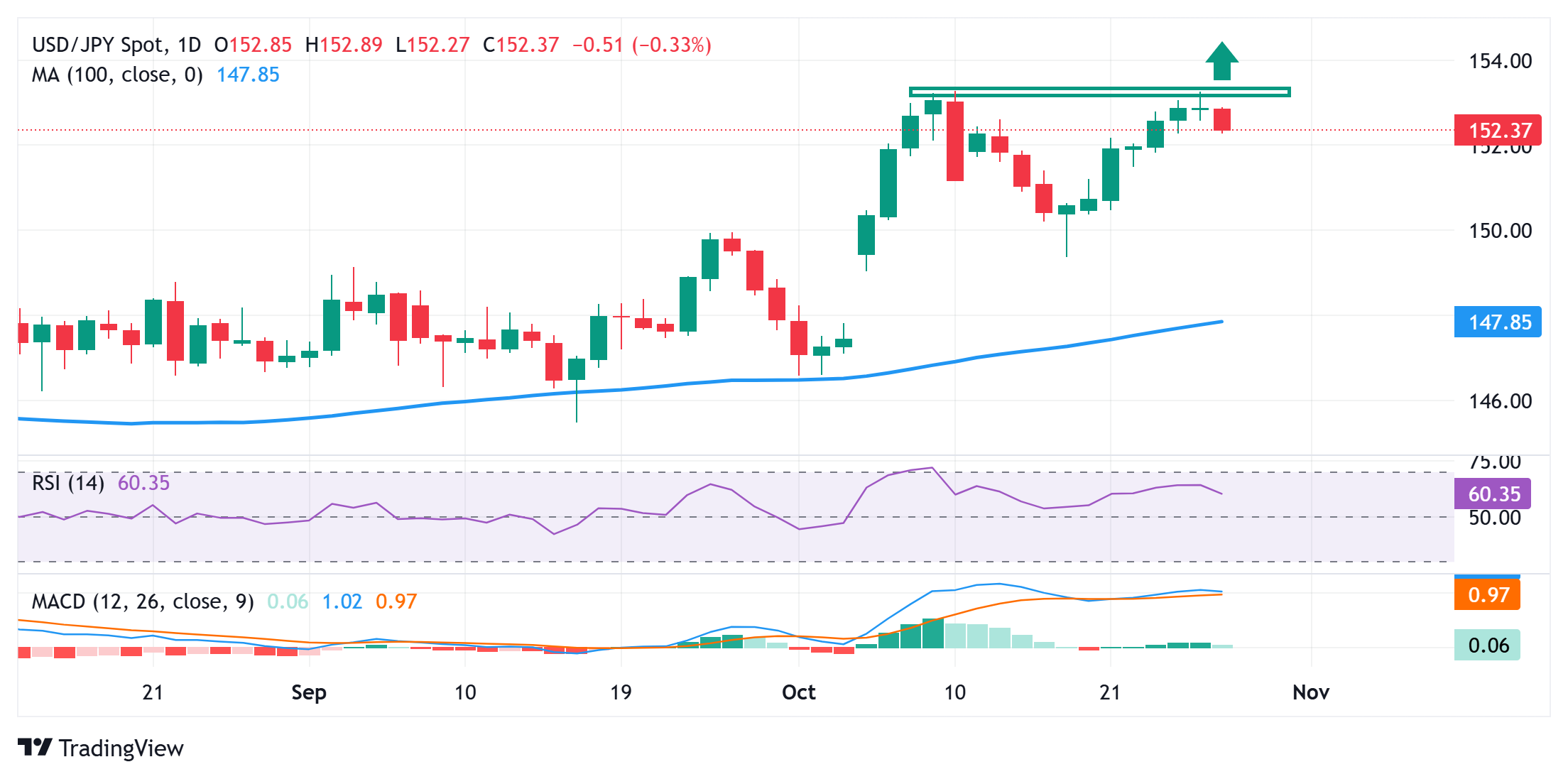
A failure near the monthly swing high, around the 153.25-153.30 region, and the subsequent fall warrant some caution for the USD/JPY bulls. However, positive oscillators on the daily chart back the case for the emergence of some dip-buyers near the 152.00 round figure. A convincing break below the latter could negate the positive outlook and pave the way for deeper losses towards the 151.10-151.00 zone with some intermediate support near the 151.50-151.45 area.
On the flip side, the 152.90-153.00 region now seems to act as an immediate hurdle ahead of the 153.25-153.30 zone, above which the USD/JPY pair could aim towards reclaiming the 154.00 round figure. The momentum could extend further towards the next relevant resistance near mid-154.00s en route to the 154.75-154.80 region and the 155.00 psychological mark.
Japanese Yen FAQs
The Japanese Yen (JPY) is one of the world’s most traded currencies. Its value is broadly determined by the performance of the Japanese economy, but more specifically by the Bank of Japan’s policy, the differential between Japanese and US bond yields, or risk sentiment among traders, among other factors.
One of the Bank of Japan’s mandates is currency control, so its moves are key for the Yen. The BoJ has directly intervened in currency markets sometimes, generally to lower the value of the Yen, although it refrains from doing it often due to political concerns of its main trading partners. The BoJ ultra-loose monetary policy between 2013 and 2024 caused the Yen to depreciate against its main currency peers due to an increasing policy divergence between the Bank of Japan and other main central banks. More recently, the gradually unwinding of this ultra-loose policy has given some support to the Yen.
Over the last decade, the BoJ’s stance of sticking to ultra-loose monetary policy has led to a widening policy divergence with other central banks, particularly with the US Federal Reserve. This supported a widening of the differential between the 10-year US and Japanese bonds, which favored the US Dollar against the Japanese Yen. The BoJ decision in 2024 to gradually abandon the ultra-loose policy, coupled with interest-rate cuts in other major central banks, is narrowing this differential.
The Japanese Yen is often seen as a safe-haven investment. This means that in times of market stress, investors are more likely to put their money in the Japanese currency due to its supposed reliability and stability. Turbulent times are likely to strengthen the Yen’s value against other currencies seen as more risky to invest in.
Recommended Articles


