


USD/INR inches lower due to potential market intervention by RBI
- The Indian Rupee holds ground, with the RBI’s frequent interventions keeping it above its record low of 88.87.
- India’s inflation is projected to ease to 1.7%, below the RBI’s 2–6% target, boosting expectations of interest rate cuts.
- The US government shutdown may continue until Tuesday due to the Columbus Day holiday on Monday.
The Indian Rupee (INR) remains steady against the US Dollar (USD) on Monday, after registering losses in the previous session. The USD/INR pair hovers around 88.70 during the Asian hours, with the Reserve Bank of India’s (RBI) frequent interventions preventing the INR from breaching its record low of 88.87, last seen on September 24.
Traders will be watching the annual India Consumer Price Index (CPI) data for September later in the day. The Indian Rupee could face pressure as September’s inflation is expected to ease to 1.7%, below the RBI’s 2–6% target, fueling expectations of rate cuts.
The INR gained ground in the previous session due to optimism surrounding India-US trade talks and steady foreign institutional inflows, as FIIs have been purchasing Indian equities in the cash segment since October 7.
US Dollar struggles amid ongoing government shutdown
- The US Dollar Index (DXY), which measures the value of the US Dollar (USD) against six major currencies, is remaining subdued and trading around 98.90 at the time of writing, after registering more than 0.5% losses in the previous session.
- The US Dollar lost ground as US President Trump said on Friday that there’s no need to meet China’s President Xi Jinping at the upcoming South Korea summit and threatened to impose 100% tariffs on Chinese imports. China also responded by warning to retaliate if Trump fails to back down on his threat to impose 100% tariffs on Chinese imports. However, US Trump shared some conciliatory remarks in his post on Truth Social on Sunday, noting that China’s economy “will be fine” and that the US wants to “help China, not hurt it.”
- The Greenback faces challenges amid the ongoing US government shutdown. The first US Federal paychecks for October were expected on Friday, but were delayed due to the government shutdown. The disruption is expected to continue at least until Tuesday, as the United States observes the Columbus Day holiday on Monday, with no resolution to the shutdown yet in sight.
- The preliminary University of Michigan's Consumer Sentiment Index edged lower to 55.0 for October, from 55.1 in September. This print came in better than the market expectation of 54.2. Meanwhile, the Current Conditions Index improved to 61.0 from 60.4, while the Expectations Index retreated to 51.2 from 51.7.
- Federal Reserve (Fed) Bank of St. Louis President Alberto Musalem said on Friday that inflation is running high. Musalem added that the labor market is showing signs of potential weakness and that a balanced approach to monetary policy only works if inflation expectations are anchored. Meanwhile, San Francisco Fed President Mary Daly said that inflation has come in much less than she had feared. Daly further stated that the US central bank is projecting additional cuts in risk management.
- The Federal Open Market Committee (FOMC) Minutes from the September meeting suggested policymakers are leaning toward further rate cuts this year. The majority of policymakers supported the September rate cut and signaled further reduction later this year. However, some members favored a more cautious approach, citing concerns about inflation.
- The CME FedWatch Tool suggests that markets are now pricing in nearly a 96% chance of a 25-basis-point Fed rate cut in October and an 87% possibility of another reduction in December.
Technical Analysis: USD/INR tests nine-day EMA support
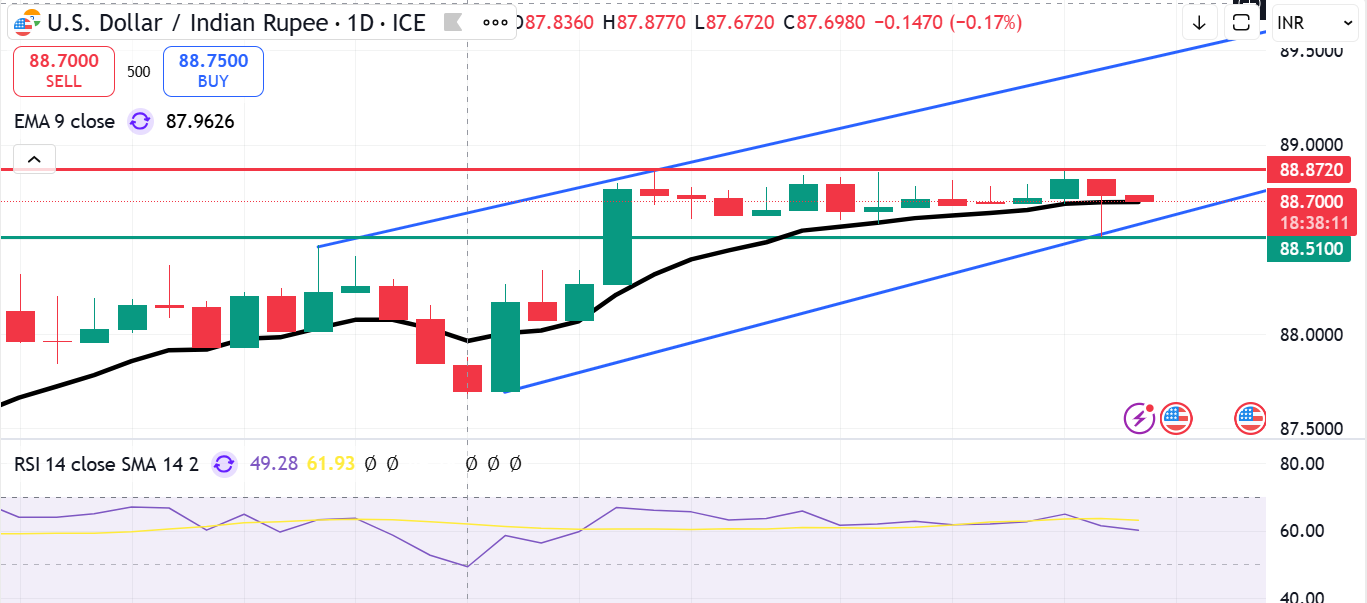
USD/INR stays muted at 88.70 during the Asian hours on Monday, with technical analysis suggesting bullish bias as the pair remains within the ascending channel pattern. Additionally, the 14-day Relative Strength Index (RSI) remains above the 50 level, strengthening the bullish bias.
The USD/INR pair may target the initial resistance at the all-time high of 88.87. A break above this level would support the pair to explore the region around the upper boundary of the ascending channel around 89.50.
On the downside, the USD/INR is testing the immediate support at the nine-day Exponential Moving Average (EMA) of 88.70. A break below this level would weaken the short-term price momentum and prompt the pair to test the ascending channel’s lower boundary, aligned with the monthly low of 88.51, which was recorded on October 10.
USD/INR: Daily Chart
Indian Rupee FAQs
The Indian Rupee (INR) is one of the most sensitive currencies to external factors. The price of Crude Oil (the country is highly dependent on imported Oil), the value of the US Dollar – most trade is conducted in USD – and the level of foreign investment, are all influential. Direct intervention by the Reserve Bank of India (RBI) in FX markets to keep the exchange rate stable, as well as the level of interest rates set by the RBI, are further major influencing factors on the Rupee.
The Reserve Bank of India (RBI) actively intervenes in forex markets to maintain a stable exchange rate, to help facilitate trade. In addition, the RBI tries to maintain the inflation rate at its 4% target by adjusting interest rates. Higher interest rates usually strengthen the Rupee. This is due to the role of the ‘carry trade’ in which investors borrow in countries with lower interest rates so as to place their money in countries’ offering relatively higher interest rates and profit from the difference.
Macroeconomic factors that influence the value of the Rupee include inflation, interest rates, the economic growth rate (GDP), the balance of trade, and inflows from foreign investment. A higher growth rate can lead to more overseas investment, pushing up demand for the Rupee. A less negative balance of trade will eventually lead to a stronger Rupee. Higher interest rates, especially real rates (interest rates less inflation) are also positive for the Rupee. A risk-on environment can lead to greater inflows of Foreign Direct and Indirect Investment (FDI and FII), which also benefit the Rupee.
Higher inflation, particularly, if it is comparatively higher than India’s peers, is generally negative for the currency as it reflects devaluation through oversupply. Inflation also increases the cost of exports, leading to more Rupees being sold to purchase foreign imports, which is Rupee-negative. At the same time, higher inflation usually leads to the Reserve Bank of India (RBI) raising interest rates and this can be positive for the Rupee, due to increased demand from international investors. The opposite effect is true of lower inflation.
Recommended Articles


