


AUD/USD (AUDUSD) Drops on Jul 13: Was It the Dollar, Rates, or Data?
AUD/USD (AUDUSD) is down 0.51% at Jul 13 15:40(ET), now at $0.69152, with a 7-day down of 0.56%.
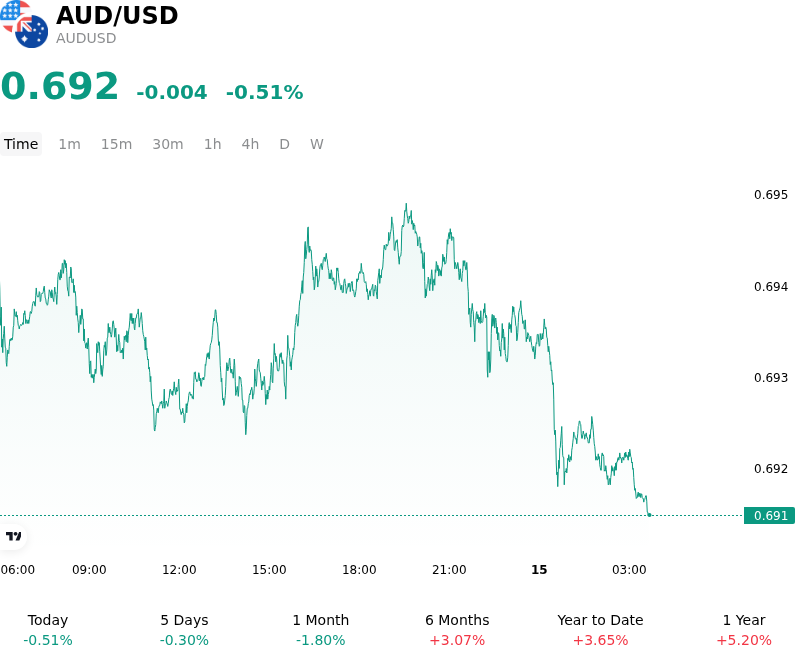
What is driving AUD/USD (AUDUSD)’s stock price down today?
The Australian Dollar faced significant downward pressure during the session, primarily driven by a deterioration in economic sentiment regarding the Chinese outlook. As a key liquid proxy for the Chinese economy, the AUD reacted to disappointing weekend data releases that signaled persistent weakness in manufacturing and a lack of meaningful fiscal stimulus. This has raised concerns among institutional investors about the sustainability of demand for Australia's primary commodity exports, particularly iron ore, which saw a corresponding decline in spot prices. The perceived cooling of Australia's largest trading partner effectively eroded the growth premium typically priced into the currency.
Simultaneously, the US Dollar strengthened as market participants recalibrated their expectations for the Federal Reserve’s policy trajectory. Recent hawkish rhetoric from Fed officials, combined with resilient domestic inflation data, has led to a repricing of the interest rate curve. US Treasury yields moved higher across the front end, widening the yield differential between the United States and Australia. This divergence in monetary policy expectations has redirected capital flows toward the greenback, as the Reserve Bank of Australia is increasingly seen as having less room for further tightening compared to the Fed's "higher-for-longer" stance.
Risk-off sentiment across global equity markets further exacerbated the decline in the AUDUSD pair. As a high-beta currency closely tied to global growth and risk appetite, the Australian Dollar is sensitive to shifts in investor confidence. Concerns over geopolitical stability and a cautious outlook for global corporate earnings prompted a defensive rotation into safe-haven assets, benefiting the US Dollar at the expense of pro-cyclical currencies. This risk aversion was compounded by technical selling as the pair broke through key psychological support levels, triggering a flurry of institutional stop-loss orders.
Looking ahead, the outlook for the pair remains tethered to the evolving interest rate environment in the United States and the effectiveness of any potential policy response from Beijing. While the Reserve Bank of Australia continues to monitor domestic wage growth and service-sector inflation, the immediate direction of the currency is being dictated by external macro drivers. Investors are maintaining a defensive posture, awaiting further clarity on US labor market data and official Chinese growth targets to determine if the current weakness in the Australian Dollar is part of a broader structural shift or a temporary reaction to shifting yield dynamics.
Technical Analysis of AUD/USD (AUDUSD)
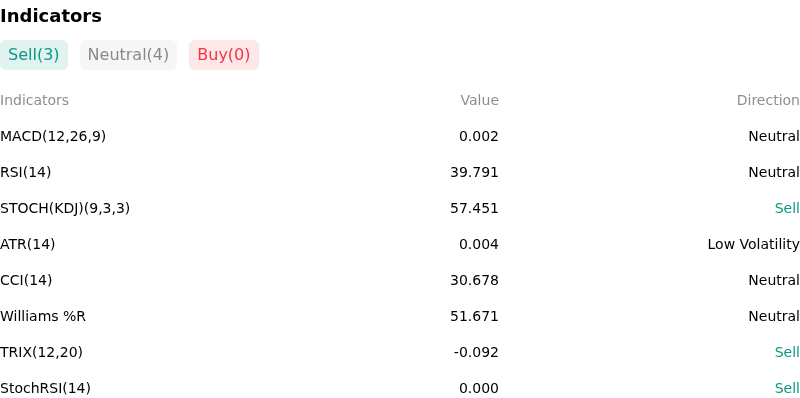
Technically, AUD/USD (AUDUSD) shows a MACD (12,26,9) value of 0.002, indicating a neutral signal. The RSI at 39.791 suggests neutral condition and the Williams %R at 51.671 suggests neutral condition. Please monitor closely.
More details about AUD/USD (AUDUSD)
Recent Events and Risks:
- Resilient US Inflation Expectations: Sustained strength in US Treasury yields following hawkish rhetoric from Federal Reserve officials has bolstered the USD, creating significant downward pressure on the AUD as the timeline for US rate cuts is pushed further into the future.
- Soft Chinese Economic Indicators: Disappointing industrial production and retail sales data from China over the last 48 hours have dampened the outlook for Australian commodity exports, triggering sell-offs in the AUD due to its role as a liquid proxy for Chinese growth risks.
- Iron Ore Price Correction: A sharp intraday decline in iron ore futures, driven by rising inventories at Chinese ports and concerns over steel demand, has directly undermined the Australian Dollar's fundamental support and weakened the terms of trade.
- Shift in RBA Policy Expectations: Recent commentary from Reserve Bank of Australia officials suggesting that current restrictive levels are sufficient to cool inflation has disappointed market participants who were positioned for further hawkish surprises, leading to a domestic yield compression.
Recommended Articles


