


Japanese Yen appreciates as Japan’s Services PPI hit fastest increase since March 2015


■The Japanese Yen gained ground amid improvement in Japan’s Services PPI released on Tuesday.
■Japan’s Corporate Service Price Index posted a reading of 2.8% YoY in April, marking its fastest increase since March 2015.
■The decline in US Treasury yields put pressure on the US Dollar.
The Japanese Yen (JPY) continues to strengthen for the second consecutive day on Tuesday, drawing support from Japan’s Corporate Service Price Index (CSPI). The index posted a year-over-year reading of 2.8% in April, surpassing expectations of 2.3% and marking its fastest rate of increase since March 2015.
The Japanese Yen could have received some support following remarks from Japan Finance Minister Shun'ichi Suzuki on Tuesday, suggesting a potential for verbal intervention. Suzuki emphasized the importance of currencies moving in a stable manner that reflects fundamentals, stating that he is closely monitoring foreign exchange (FX) movements. However, he refrained from commenting on whether Japan has conducted currency intervention.
The US Dollar (USD) continues to lose ground following the decline in the US Treasury yields. Traders are likely to await the Federal Reserve's preferred measure of inflation, the Personal Consumption Expenditures (PCE) Price Index data, which is due on Friday, to assess future US monetary policy.
Daily Digest Market Movers: Japanese Yen extends gains on remarks from BoJ officials
The 2024 BOJ-IMES Conference continues on Tuesday. Scheduled speakers include US Federal Reserve (Fed) officials such as Fed Governor Michelle Bowman and Cleveland Fed President Loretta Mester.
The Japanese Yen gained strength from the comments from Bank of Japan (BoJ) officials on Monday. BoJ Governor Kazuo Ueda remarked that progress has been made in moving away from zero and raising inflation expectations, but there is a need to re-anchor them, this time at the 2% target.
Additionally, BoJ Deputy Governor Shinichi Uchida stated that they have reverted to a conventional monetary policy framework, with the objective of achieving a 2% price stability target through adjustments of the short-term policy rate. Uchida also said that they have successfully navigated past the zero-lower bound.
The Japanese Cabinet Office stated in its report on Monday that the government maintained its view on the economy unchanged for the third consecutive month in May. It noted that the Japanese economy continues to recover at a moderate pace, although there are signs of a recent pause in growth.
UoM 5-year Consumer Inflation Expectations eased slightly to 3.0%, falling below the forecasted 3.1%. Despite the upward revision of the Consumer Sentiment Index to 69.1 from a preliminary reading of 67.4, it still indicated the lowest level in six months. These figures likely bolstered investors’ sentiment regarding potential rate cuts by the Federal Reserve.
Japan’s National Consumer Price Index (CPI) dropped to 2.5% YoY in April from 2.7% in the previous month, marking the second consecutive month of moderation but still staying above the Bank of Japan’s (BoJ) 2% target. This sustained inflationary trend exerts pressure on the central bank to contemplate policy tightening.
Technical Analysis: USD/JPY maintains its position above 156.50
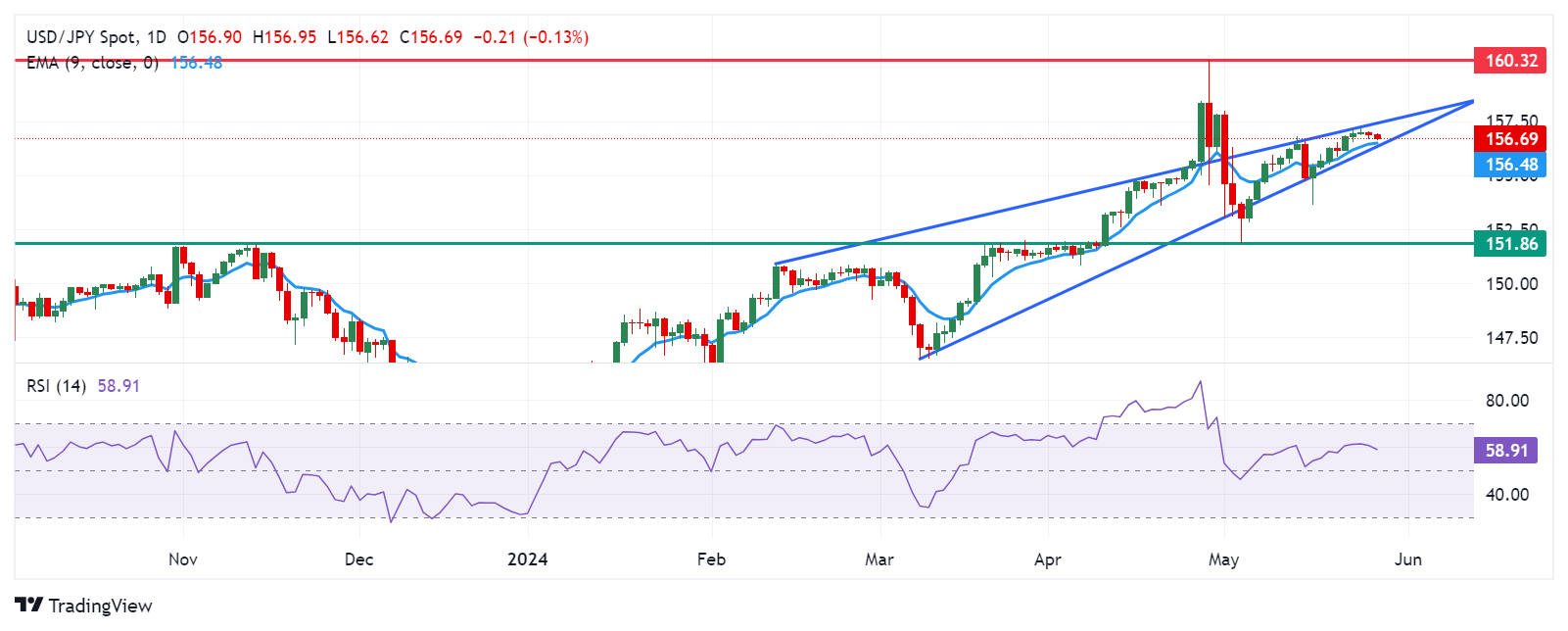
The USD/JPY pair trades around 156.70 on Tuesday. The daily chart shows a rising wedge pattern, indicating a potential bearish reversal as the pair approaches the wedge's apex. However, the 14-day Relative Strength Index (RSI) remains slightly above 50, still maintaining a bullish bias.
The pair might test the upper boundary of the rising wedge around 157.45. If it surpasses this level, the next target could be 160.32, representing its highest point in over thirty years.
On the downside, the nine-day Exponential Moving Average (EMA) at 156.48 serves as immediate support, followed by the lower edge of the rising wedge and the psychological level of 156.00. A breach of these levels could exert downward pressure on the USD/JPY pair, potentially leading it towards the throwback support at 151.86.
USD/JPY: Daily Chart
Japanese Yen price today
The table below shows the percentage change of the Japanese Yen (JPY) against listed major currencies today. Japanese Yen was the strongest against the US Dollar.
| USD | EUR | GBP | CAD | AUD | JPY | NZD | CHF | |
| USD | -0.16% | -0.08% | -0.08% | -0.25% | -0.11% | -0.14% | -0.18% | |
| EUR | 0.16% | 0.08% | 0.07% | -0.07% | 0.05% | 0.01% | 0.00% | |
| GBP | 0.08% | -0.08% | -0.01% | -0.18% | -0.02% | -0.07% | -0.08% | |
| CAD | 0.08% | -0.07% | -0.01% | -0.17% | 0.00% | -0.04% | -0.06% | |
| AUD | 0.25% | 0.07% | 0.16% | 0.17% | 0.15% | 0.11% | 0.10% | |
| JPY | 0.10% | -0.04% | 0.02% | 0.00% | -0.15% | -0.04% | -0.05% | |
| NZD | 0.15% | -0.01% | 0.07% | 0.07% | -0.08% | 0.04% | -0.01% | |
| CHF | 0.15% | -0.01% | 0.07% | 0.07% | -0.08% | 0.05% | 0.01% |
The heat map shows percentage changes of major currencies against each other. The base currency is picked from the left column, while the quote currency is picked from the top row. For example, if you pick the Euro from the left column and move along the horizontal line to the Japanese Yen, the percentage change displayed in the box will represent EUR (base)/JPY (quote).
Read more
* The content presented above, whether from a third party or not, is considered as general advice only. This article should not be construed as containing investment advice, investment recommendations, an offer of or solicitation for any transactions in financial instruments.


