

Trump vs. Powell: Bullish or Bearish for Bitcoin?

Mitrade
Trending Articles
coverImg
Source: DepositPhotos

Introduction


The clash between Donald Trump and Federal Reserve Chair Jerome Powell has become a major talking point in financial markets. As the U.S. president, Trump has had a significant influence on global markets through his trade and economic policies. Powell, as the head of the Fed Chair, steers U.S. monetary policy. This confrontation affects not only traditional financial markets but also Bitcoin  (BTC). This article will explore their policy differences and examine how these dynamics impact the Bitcoin market.


Policy Differences Between Trump and Powell


Since Trump was re-elected president in January 2025, he has repeatedly called on the Fed to lower interest rates and has even threatened to fire Powell. However, Powell has upheld the Fed's independence, resisting immediate rate cuts.


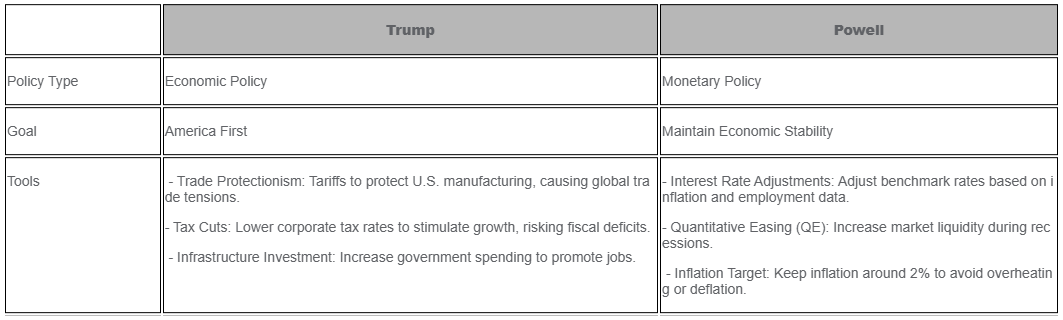
Trump has publicly criticized the Fed’s monetary policy on multiple occasions. During his first term, he blamed interest rate hikes for slowing economic growth and consistently pushed for rate reductions. At the heart of the Trump-Powell conflict is a fundamental clash between fiscal and monetary policy:

17455739601681


Possible Scenarios in the Trump-Powell Showdown


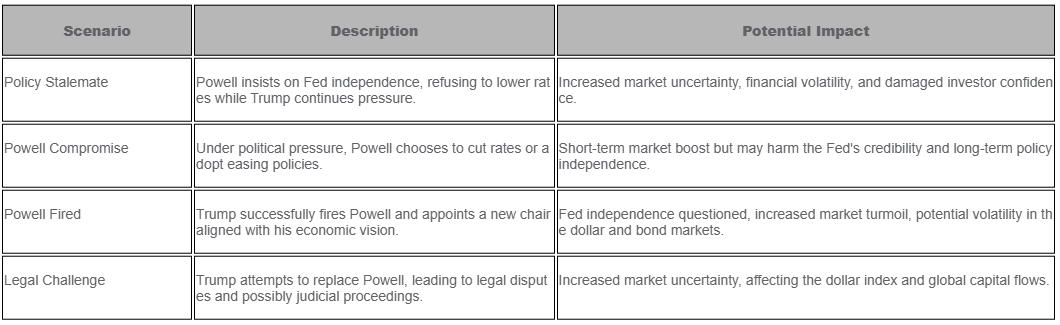
What might happen in the Trump-Powell showdown? While no one can predict the outcome, four scenarios could emerge:

17455739987805


How the Policy Clash Affects Bitcoin?


The core of the Trump-Powell clash revolves around interest rates. Trump wants the Fed to cut rates swiftly, while Powell remains cautious and is in no hurry to make adjustments. Changes in interest rates affect not only traditional financial products and but also alternative assets like Bitcoin.


Bitcoin in a Low-Interest Environment


In a low-interest environment, investors tend to seek higher-yielding assets to  offset reduced returns. Bitcoin, with its limited supply and decentralized nature, becomes particularly attractive. When markets anticipate low rates,  demand for Bitcoin typically rises, driving up its price.


Bitcoin in a High-Interest Environment


If Powell maintains rates or raises interest rates, capital tends to flow into fixed-income products, reducing demand for riskier assets like Bitcoin. In such scenario, high interest rates generally suppress Bitcoin prices as investors favor the stable returns of  traditional financial instruments.


Future Trends for Bitcoin Amidst Policy Struggles


On January 31, 2025, President Trump announced a 25% tariff on goods imported from Canada and Mexico. That same day, Bitcoin dropped 2% , nearing $100,000 mark. Since then, Trump has escalated tariffs while calling for interest rate cuts. He imposed equal tariffs on multiple countries and repeatedly raised tariffs on Chinese imports. These moves triggered market anxiety, with Bitcoin continuing to fall alongside U.S. equities.


On April 9, 2025, after Trump reiterated his commitment to  enforcing equal tariffs, Bitcoin plummeted to $75,000—its lowest level since November 2024—erasing  all gains made since his election. However, later that afternoon, Trump announced a 90-day delay on the tariffs, prompting a sharp rebound in Bitcoin.  His subsequent softening  on trade policy, including an April 21 statement that he had no intention of firing Fed Chair Powell, helped lift Bitcoin back to a key resistance level of $95,000.
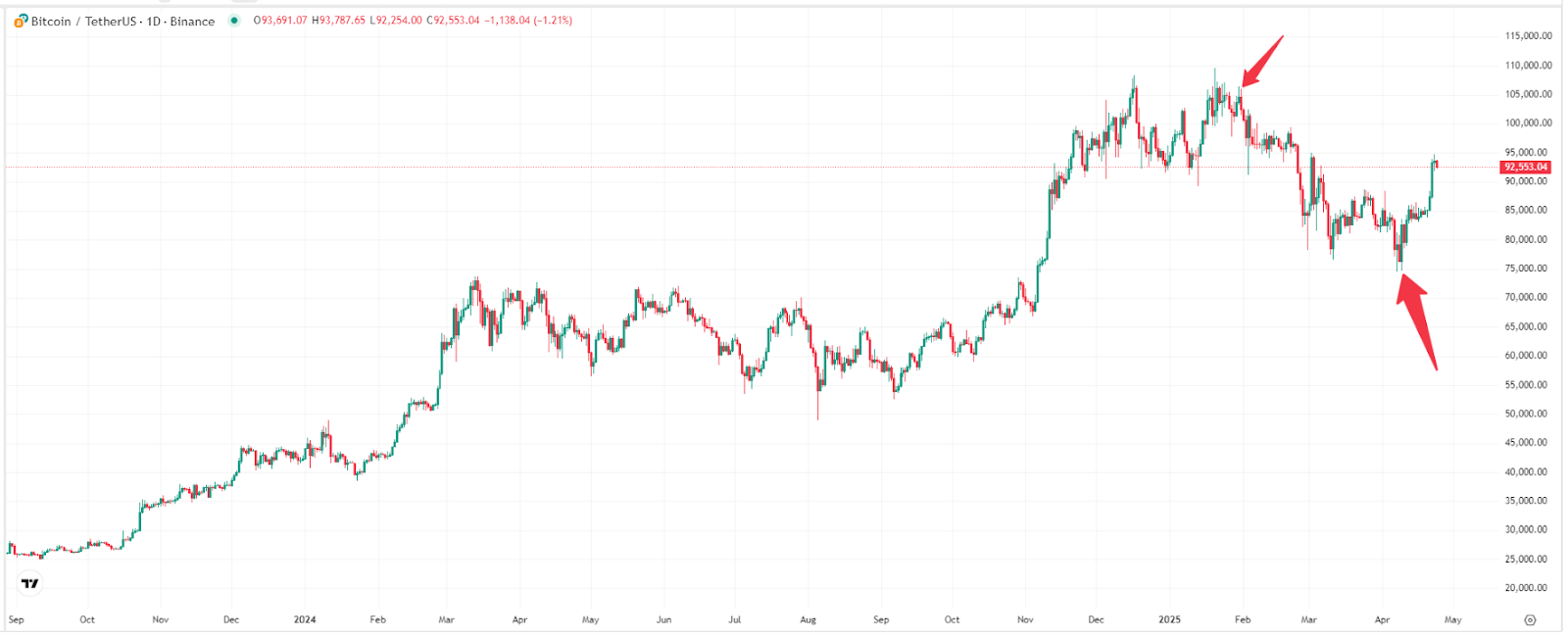

Bitcoin price trend chart, source: TradingView.


Bitcoin price trend chart, source: TradingView.


Despite Trump's more conciliatory tone, some analysts believe it may be a strategic move to gain Powell’s support and restore  market confidence. This does not signal an end to the conflict. 


If Trump fails to persuade Powell to cut rates, tight liquidity conditions may persist, potentially dragging Bitcoin  back to $75,000. On the other hand, if conditions ease, Bitcoin could rally to retest its previous high of $110,000—or even surpass it.


Geoffrey Kendrick, Head of Global Digital Assets Research at Standard Chartered Bank, maintains that  the Federal Reserve’s independence remains a critical concern. He forecasts that Bitcoin could rise to $200,000 by the end of 2025.


How to Respond to Policy Clash Impacts


The potential impact of the Trump-Powell confrontation is significant and unpredictable. Investors should be prepared with various strategies:


1. Monitor Market Dynamics 


Stay updated on Trump and Powell's statements and policy changes, especially during economic data releases and elections. Trump is very active on social media, so follow his account @realDonaldTrump.


2. Diversify Your Portfolio


Spread investments across different asset types, including Bitcoin, stocks, and bonds, to reduce single-market risk. Consider investing in traditional safe-haven assets like gold (XAUUSD) and silver (XAGUSD) during increased uncertainty.


3. Maintain a Long-Term Investment Perspective  


For those optimistic about Bitcoin's future, consider holding long-term and ignoring short-term fluctuations. Use dollar-cost averaging to spread investments over time and reduce risk.

4. Use Derivatives for Hedging  


When the market turns against your positions, consider using Bitcoin options or futures to hedge against risks, protecting your capital during volatility.


Conclusion


The ongoing showdown between Trump and Powell is set to have lasting implications for Bitcoin. Whether low rates attract capital  or high rates dampen demand, both scenarios will directly influence Bitcoin's price trajectory. Investors must adopt flexible and comprehensive strategies that mitigate risks while capturing potential upside. By closely monitoring market developments, diversifying portfolios, employing hedging instruments, and maintaining a long-term perspective, investors can aim for relatively stable returns amid an increasingly uncertain financial environment.


Read more

  • Tesla Stock Hits Record High as Robotaxi Tests Ignite Market. Why Is Goldman Sachs Pouring Cold Water on Tesla?
  • FX Today: US soft data maintains US Dollar under pressure
  • Pound Sterling slumps as UK inflation falls by more than expected to 3.2%
  • * The content presented above, whether from a third party or not, is considered as general advice only.  This article should not be construed as containing investment advice, investment recommendations, an offer of or solicitation for any transactions in financial instruments.

    goTop
    quote
    Related Articles
    placeholder
    Bitcoin-to-Gold Ratio Plummets 50% as Gold Breaks $4,000 in 2025In 2025, gold outpaced Bitcoin, slashing the BTC-to-gold ratio by half from 40 to 20 ounces per BTC.
    Author  Mitrade
    Yesterday 06: 01
    In 2025, gold outpaced Bitcoin, slashing the BTC-to-gold ratio by half from 40 to 20 ounces per BTC.
    placeholder
    Senate Delays Crypto Market Structure Hearings to Early 2026The Senate Banking Committee has postponed cryptocurrency market structure hearings until 2026, citing ongoing bipartisan negotiations.
    Author  Mitrade
    Dec 16, Tue
    The Senate Banking Committee has postponed cryptocurrency market structure hearings until 2026, citing ongoing bipartisan negotiations.
    placeholder
    Bitcoin Slides 5% as Sellers Lean In — Can BTC Reclaim $88,000?Bitcoin has dropped back below $88,000 after rolling over from $90,500, with price still trading under the 100-hour Simple Moving Average. The sell-off found a floor at $85,151, and BTC is now consolidating near that base, but rebounds are facing pressure from a bearish trend line around $89,000. Bulls need to retake $88,000–$89,000 to ease downside risk; failure to do so keeps $85,500–$85,000 and then $83,500 in play, with $80,000 as the deeper “line in the sand.” Bitcoin (BTC) is back in damage-control mode after a sharp pullback wiped out recent gains. The price failed to reclaim the $90,000–$90,500 band, rolled over, and slid through $88,500 before briefly dipping under $87,000. Buyers did show up around $85,000, but the rebound so far looks more like stabilization than a clear trend reversal. Bitcoin dips hard, finds a bid near $85,000(h3) BTC’s latest move lower began when it couldn’t build follow-through above $90,000 and $90,500. Once that upside stalled, sellers took control and pushed price down through $88,500. The slide accelerated enough to spike below $87,000, but the market didn’t free-fall. Bulls defended the $85,000 zone, printing a low at $85,151. Since then, Bitcoin has been consolidating below the 23.6% Fibonacci retracement of the drop from the $93,560 swing high to the $85,151 low — a clue that the bounce is still shallow and that sellers haven’t fully backed off yet. Structurally, BTC is still on the back foot: It’s trading below $88,000, and It remains below the 100-hour Simple Moving Average, keeping short-term trend pressure pointed downward. Resistance is layered, and $89,000 is the problem area(h3) If bulls try to turn this into a recovery, they’ll have to climb through multiple ceilings in quick succession. First, BTC faces resistance around $87,150, followed by a more meaningful barrier near $87,500. From there, the market’s attention snaps back to $88,000 — the level BTC just lost and now needs to reclaim. A close back above $88,000 would improve the tone, but it doesn’t solve the bigger issue: there’s a bearish trend line on the hourly BTC/USD chart (Kraken feed) with resistance near $89,000, which also lines up with the next technical hurdle. If BTC can push through $89,000 and hold, the rebound could extend toward $90,000, with follow-through targets at $91,000 and $91,500. But until price clears that $88,000–$89,000 zone, rallies are at risk of being sold rather than chased. If BTC fails to reclaim resistance, the downside path is clear(h3) The near-term bear case is simple: if Bitcoin can’t climb back above the $87,000 area and keep traction, sellers may attempt another leg lower. Support levels line up like this: Immediate support: $85,500 First major support: $85,000 Next support: $83,500 Then $82,500 in the near term Below that, the major “don’t break this” level is still $80,000. If BTC slips under $80,000, the risk of acceleration to the downside increases significantly — not because it’s magic, but because it’s the kind of psychological and structural level that tends to trigger forced de-risking. Indicators: momentum still leans bearish(h3) The intraday indicators aren’t offering much comfort yet: Hourly MACD is losing pace in the bearish zone. Hourly RSI remains below 50, suggesting sellers still have the upper hand on short timeframes. So while the $85,000 defense held for now, the market hasn’t flipped bullish — it’s just stopped bleeding.
    Author  Mitrade
    Dec 16, Tue
    Bitcoin has dropped back below $88,000 after rolling over from $90,500, with price still trading under the 100-hour Simple Moving Average. The sell-off found a floor at $85,151, and BTC is now consolidating near that base, but rebounds are facing pressure from a bearish trend line around $89,000. Bulls need to retake $88,000–$89,000 to ease downside risk; failure to do so keeps $85,500–$85,000 and then $83,500 in play, with $80,000 as the deeper “line in the sand.” Bitcoin (BTC) is back in damage-control mode after a sharp pullback wiped out recent gains. The price failed to reclaim the $90,000–$90,500 band, rolled over, and slid through $88,500 before briefly dipping under $87,000. Buyers did show up around $85,000, but the rebound so far looks more like stabilization than a clear trend reversal. Bitcoin dips hard, finds a bid near $85,000(h3) BTC’s latest move lower began when it couldn’t build follow-through above $90,000 and $90,500. Once that upside stalled, sellers took control and pushed price down through $88,500. The slide accelerated enough to spike below $87,000, but the market didn’t free-fall. Bulls defended the $85,000 zone, printing a low at $85,151. Since then, Bitcoin has been consolidating below the 23.6% Fibonacci retracement of the drop from the $93,560 swing high to the $85,151 low — a clue that the bounce is still shallow and that sellers haven’t fully backed off yet. Structurally, BTC is still on the back foot: It’s trading below $88,000, and It remains below the 100-hour Simple Moving Average, keeping short-term trend pressure pointed downward. Resistance is layered, and $89,000 is the problem area(h3) If bulls try to turn this into a recovery, they’ll have to climb through multiple ceilings in quick succession. First, BTC faces resistance around $87,150, followed by a more meaningful barrier near $87,500. From there, the market’s attention snaps back to $88,000 — the level BTC just lost and now needs to reclaim. A close back above $88,000 would improve the tone, but it doesn’t solve the bigger issue: there’s a bearish trend line on the hourly BTC/USD chart (Kraken feed) with resistance near $89,000, which also lines up with the next technical hurdle. If BTC can push through $89,000 and hold, the rebound could extend toward $90,000, with follow-through targets at $91,000 and $91,500. But until price clears that $88,000–$89,000 zone, rallies are at risk of being sold rather than chased. If BTC fails to reclaim resistance, the downside path is clear(h3) The near-term bear case is simple: if Bitcoin can’t climb back above the $87,000 area and keep traction, sellers may attempt another leg lower. Support levels line up like this: Immediate support: $85,500 First major support: $85,000 Next support: $83,500 Then $82,500 in the near term Below that, the major “don’t break this” level is still $80,000. If BTC slips under $80,000, the risk of acceleration to the downside increases significantly — not because it’s magic, but because it’s the kind of psychological and structural level that tends to trigger forced de-risking. Indicators: momentum still leans bearish(h3) The intraday indicators aren’t offering much comfort yet: Hourly MACD is losing pace in the bearish zone. Hourly RSI remains below 50, suggesting sellers still have the upper hand on short timeframes. So while the $85,000 defense held for now, the market hasn’t flipped bullish — it’s just stopped bleeding.
    placeholder
    Macro Analysts: Hawkish Japan Could Push Bitcoin Below $70KAnalysts predict Bitcoin may face further declines towards the $70,000 mark if the Bank of Japan raises interest rates as expected.
    Author  Mitrade
    Dec 15, Mon
    Analysts predict Bitcoin may face further declines towards the $70,000 mark if the Bank of Japan raises interest rates as expected.
    placeholder
    Fed Cuts Rates: Bitcoin Rallies Then Retreats - Bear Market Ahead?TradingKey - Fed Rate Cut Fails to Buoy Bitcoin, Signaling Bull Market's End?Early on December 11,the Federal Reserve delivered an expected 25 basis point rate cut.Bitcoin (BTC) briefly surged to $94,
    Author  TradingKey
    Dec 11, Thu
    TradingKey - Fed Rate Cut Fails to Buoy Bitcoin, Signaling Bull Market's End?Early on December 11,the Federal Reserve delivered an expected 25 basis point rate cut.Bitcoin (BTC) briefly surged to $94,

    Bitcoin Related Articles

    • Trading Chart Patterns:Ultimate Guide to Price Action
    • How to Day Trade Crypto? Simplest Day Trading Strategy Ever
    • Places that Provide Cheapest Ways to Buy Bitcoin In 2025
    • 10 Best Crypto With Most Potential to Buy and invest in 2025 - Top Picks from Expert Traders
    • Top 10 Bitcoin Mining Apps for Android & iOS During 2024
    • How To Buy Bitcoin In Malaysia? Top 7 Best Crypto Exchanges & Trading Apps

    Click to view more