




By Jason Tang, Petar Petrov, Viga Liu
As the Bitcoin market continues to mature, its 2025 outlook appears highly favourable, driven by institutional adoption and regulatory developments. The approval of Bitcoin spot ETFs in early 2024 marked a pivotal milestone, attracting significant institutional fund inflows and establishing Bitcoin as a mainstream asset. In 2025, these trends are expected to accelerate. Optimism around potential pro-crypto policies under a Trump administration adds another bullish layer.
Bitcoin Spot ETFs: A Milestone in Institutional Adoption
The approval of Bitcoin spot ETFs has paved the way for more institutional participation and ETF fund inflows have shown a positive correlation with Bitcoin’s price, meaning increased institutional involvement could further drive price growth. Traditional financial institutions are expected to increase their Bitcoin allocations in 2025. For example, insurance companies may begin small investments, while pension funds could test the waters with pilot programs. Family offices, known for their flexibility, are likely to expand their exposure to digital assets.
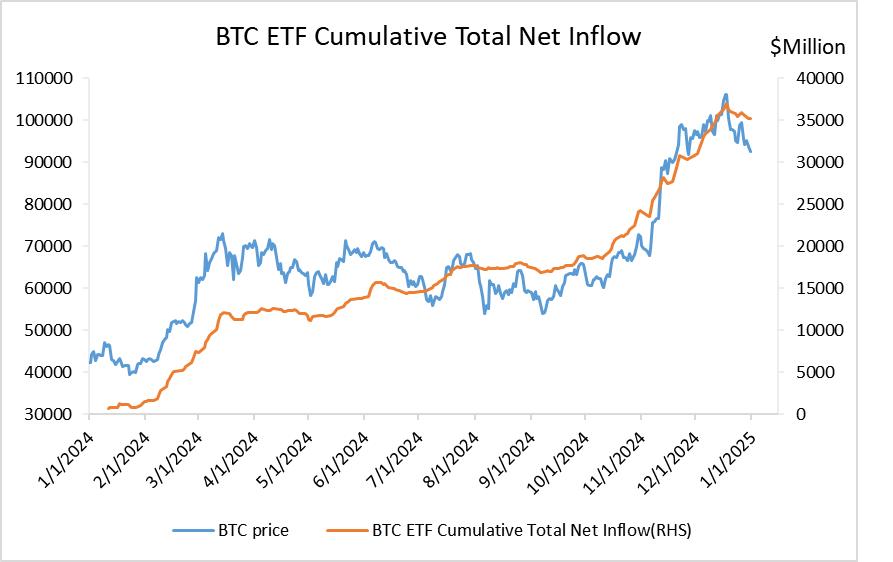
Source: SoSoValue, Tradingkey.com
Potential Pro-Crypto Policies Under Trump: Impact and Feasibility
Several pro-crypto policies were proposed by Trump during and after his campaign and they could significantly influence the cryptocurrency market if implemented. Below, we analyze some key proposals, their potential impact, possible timeline and feasibility.
1. Regulatory Overhaul
• Possible Timeline: January 20, 2025 – March 2025
• Difficulty: Moderate (Requires Senate confirmation, but Republican control of the Senate reduces resistance)
January 20, 2025, could mark a turning point for US cryptocurrency regulation. With the current chairs of the SEC (Gary Gensler) and the CFTC expected to step down upon Trump taking office, leadership changes at these key regulatory bodies will reshape the regulatory landscape. Under Gensler, the SEC’s strict enforcement has slowed industry innovation.
Trump’s administration nominated figures like pro-crypto former SEC Commissioner Paul Atkins as the new SEC chair and venture capitalist David Sacks as a potential “AI and Crypto Czar.” These candidates favour reforming securities laws to better accommodate the unique characteristics of digital assets. While Senate approval is needed, Republican control could speed up the process. These leadership changes could lower compliance costs and foster a more crypto-friendly environment.
2. Improving Banking Access for Crypto Businesses
• Possible Timeline: February 2025 – August 2025
• Difficulty: Moderately High (Requires coordination with multiple banking regulators, may face resistance from traditional financial institutions)
Under Trump, executive orders are expected to address the banking challenges faced by cryptocurrency businesses. From 2023 to 2024, Operation Choke Point 2.0 led to widespread "de-banking" of compliant crypto firms, stripping them of essential banking services such as account access and payment processing. This restricted industry growth and heightened systemic risks.
New policies are likely to legally prohibit financial institutions from denying services solely based on a company’s involvement in cryptocurrency. These measures, expected to be implemented through executive orders, will involve multiple regulatory bodies. Such reforms could significantly improve banking access for crypto businesses, fostering industry growth.
3. Opposition to Central Bank Digital Currencies (CBDCs)
• Possible Timeline: January 2025 – March 2025
• Difficulty: Low (Primarily relies on executive authority, easily implemented)
Trump has explicitly opposed the issuance of a US CBDC. Unlike decentralized cryptocurrencies like Bitcoin, CBDCs are centralized and fully controlled by central banks. Trump views CBDCs as tools for increased government financial surveillance, posing risks to individual privacy.
Trump’s stance is a positive signal for Bitcoin and other cryptocurrencies. A US CBDC could directly compete with cryptocurrencies in the digital payments space. By opposing CBDCs, Trump could reduce competitive pressures in this area.
4. National Bitcoin Reserve
• Possible Timeline: Proposed in Q2 2025 – Execution in 2026
• Difficulty: Extremely High (Requires Treasury and Federal Reserve coordination, likely to face strong political opposition)
One of Trump’s most ambitious and controversial proposals is the Bitcoin Reserve, aimed at incorporating Bitcoin into the US National Reserve system. With the dollar’s dominance as a global reserve currency increasingly challenged, adding Bitcoin to national reserves is seen to modernize monetary policy while reinforcing US financial leadership.
However, the policy faces major challenges. Political opposition—especially from Democrats—could prevent the use of public funds for what many view as a speculative and risky asset. Additionally, large-scale Bitcoin purchases risk triggering extreme price volatility, demanding careful strategies to minimize market disruptions.
Despite these challenges, the policy’s potential significance cannot be overstated. Since the collapse of the Bretton Woods system in 1971, this would represent one of the most transformative shifts in US monetary policy. If successful, it could elevate Bitcoin’s legal and institutional status, and encourage other nations to follow and reshape the global financial order.
5. Innovation Funding Initiative
• Possible Timeline: Launch in Q2 2025 – Full implementation by 2026
• Difficulty: Moderate (Primarily involves budget allocation and inter-agency coordination)
Trump proposed to establish a dedicated fund to support cryptocurrency innovation. This initiative would focus on critical areas such as expanding blockchain infrastructure, enhancing security measures to prevent cyberattacks and advancing cross-border payment solutions. Initial funding is expected to reach several billion dollars and will be managed through existing or newly created departments under the Treasury and Commerce Departments. While the funding scale is significant, the initiative falls largely within executive authority, making it relatively straightforward to implement.
6. Cross-Border Payment Reform
• Possible Timeline: Begins in Q3 2025 – Completion by 2027
• Difficulty: High (Requires international coordination and collaboration with multiple regulatory bodies)
To enhance US competitiveness in global payments, Trump has proposed promoting the use of cryptocurrencies like Bitcoin in cross-border transactions. This includes ideas such as establishing mutual regulatory recognition agreements with other nations, simplifying payment processes and reducing compliance costs. While promising, this proposal would require extensive international coordination and careful balancing of anti-money laundering and other regulatory concerns, making it a long-term objective.
7. Comprehensive Tax Reform
• Possible Timeline: Proposed in late 2025 – Implementation by the end of 2026
• Difficulty: Extremely High (Requires Congressional approval, involves federal tax code changes)
Trump’s tax reform proposals include crypto-friendly measures such as exempting small crypto transactions from capital gains taxes and offering tax incentives for US-issued cryptocurrencies. These changes could significantly boost the adoption of cryptocurrencies for everyday use and institutional investment. However, since tax reforms require legislative approval, implementation will depend on both parties’ support, making it one of the more challenging proposals.
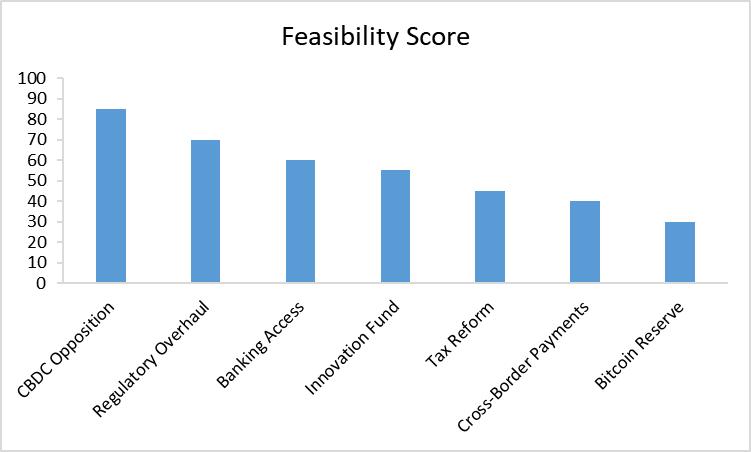
Based on 5 key criteria (0-20 points each): Executive Authority, Congressional Approval, Regulatory Complexity, Technical Requirements, and Stakeholder Resistance, the feasibility scores can be calculated based on our assumptions, with higher scores indicating more favourable conditions for implementation.
Source: Tradingkey.com
The most likely policies to be implemented by the Trump administration in 2025 are regulatory overhaul, opposition to CBDCs and improving banking access for crypto businesses. These policies would create a more crypto-friendly regulatory environment. Long-term, more ambitious policies like the National Bitcoin Reserve or Comprehensive Tax Reform face significant political and technical challenges, making their implementation uncertain, though not entirely impossible if political conditions align in later years.
Bitcoin Conclusion
Bitcoin’s 2025 outlook points to strong price growth, driven by institutional adoption, regulatory clarity, enhanced infrastructure and the effects of Bitcoin's 2024 halving. The Federal Reserve's pace of rate cuts and overall liquidity conditions in the market will play a crucial role in shaping Bitcoin's price. As the number of expected rate cuts decreases in 2025, shifts in liquidity could also influence Bitcoin's price movement. Long-term, while challenging, the possibility of more ambitious policies could further bolster Bitcoin’s role in reshaping the financial landscape.
Read more
* The content presented above, whether from a third party or not, is considered as general advice only. This article should not be construed as containing investment advice, investment recommendations, an offer of or solicitation for any transactions in financial instruments.


