


Nio's Premium Deliveries Are Surging. Is This Warning Sign Getting Overlooked?
Key Points
Nio's delivery gains in September need to be examined per the company's three brands.
The surge is likely positive news for margins.
Nio has posted impressive and consistent delivery growth and needs Onvo to regain its initial momentum.
- 10 stocks we like better than Nio ›
Sometimes a headline number tells investors annoyingly little about what's happening under the hood. Nio (NYSE: NIO), an expanding Chinese electric vehicle (EV) maker, offers investors an example. The EV maker increased September deliveries 7.7% year over year to 37,408 vehicles. Look closer, however, and its namesake premium brand increased deliveries 55.3% during that same month. So what's holding the company back from larger overall gains?
The answer is Onvo, one of Nio's two sub-brands, for which deliveries reversed sharply. But this isn't a story about a brand struggling throughout the year. It's about strong growth giving way to a recent loss of momentum. Can management turn that around?
Missed AI’s "Act 1"? Act 2 Could Be 15x Bigger. Most investors think they missed the AI boat because they didn't buy Nvidia in 2005. But according to our analysts, we’re only at the end of "Act 1"—the R&D phase. "Act 2" is the global rollout. Continue »

Onvo L90. Image source: Nio.
Two brands, two directions
Nio operates three vehicle brands: its namesake premium brand, family-oriented Onvo, and compact-car brand Firefly. September's results show why investors should at least examine them separately.
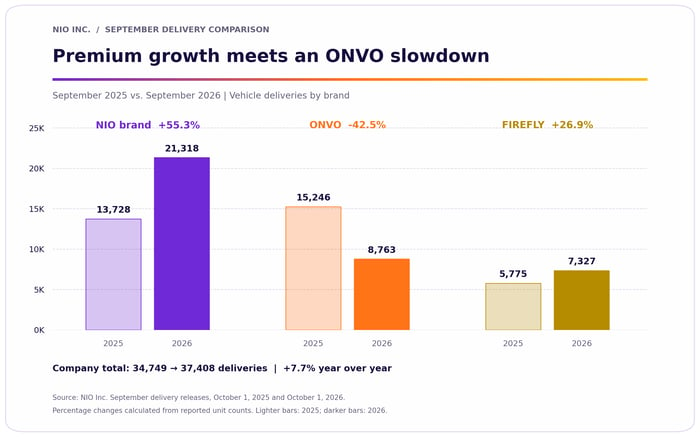
Data source: Nio September 2026 and 2025 delivery press releases; chart generated with ChatGPT by author.
As you can see, Nio's premium brand added 7,590 deliveries while Onvo lost 6,483. What's interesting is that Onvo hasn't been struggling throughout 2026; its second-quarter deliveries increased approximately 71% year over year to 29,124 vehicles. The concern is what happened afterward. Following its May high of 12,029 vehicles, Onvo recorded four consecutive monthly declines, dropping to 8,763 deliveries in September.
One thing to consider in Onvo's defense is that September's year-over-year comparison is challenging because the L90 began deliveries in August 2025, giving Onvo a new-product boost heading into last September. That helps put this September's decline in context, but it doesn't explain Onvo's four consecutive monthly delivery declines since May 2026.
What's management's plan of attack?
During Nio's second-quarter earnings call on Sept. 1, CEO William Li acknowledged that Onvo faces more intense competition from brands and models than the company's other two businesses. He also identified limited brand awareness as a challenge, comparing Onvo's recognition with Nio's five or six years earlier. The proposed response includes marketing, community engagement, and store expansion to introduce Onvo to more customers, including those in lower-tier cities. But execution could prove easier said than done. Still, it gives investors something concrete to watch: whether reaching more potential buyers translates into sustained near-term orders.
What it all means
There's also reason to keep September in perspective. Across the full third quarter -- July through September -- Nio's deliveries increased 25.4% compared to the prior year, and while September's 7.7% growth was slower, one month doesn't define the business. Four consecutive monthly declines at Onvo, however, might suggest that the brand has lost momentum following its strong second quarter.
For long-term investors, the question is whether that slowdown will prove temporary or become a more persistent hurdle to Nio's delivery growth. Nio's premium-brand rebound is encouraging, and a product mix favoring new and premium Nio deliveries could support its bottom line. But to sustain delivery growth and scale, management needs to get Onvo moving in the same direction.
Should you buy stock in Nio right now?
Before you buy stock in Nio, consider this:
The Motley Fool Stock Advisor analyst team just identified what they believe are the 10 best stocks for investors to buy now… and Nio wasn’t one of them. The 10 stocks that made the cut could produce monster returns in the coming years.
Consider when Netflix made this list on December 17, 2004... if you invested $1,000 at the time of our recommendation, you’d have $337,166!* Or when Nvidia made this list on April 15, 2005... if you invested $1,000 at the time of our recommendation, you’d have $1,339,143!*
Now, it’s worth noting Stock Advisor’s total average return is 904% — a market-crushing outperformance compared to 213% for the S&P 500. Don't miss the latest top 10 list, available with Stock Advisor, and join an investing community built by individual investors for individual investors.
See the 10 stocks »
*Stock Advisor returns as of October 29, 2026.
Daniel Miller has no position in any of the stocks mentioned. The Motley Fool has no position in any of the stocks mentioned. The Motley Fool has a disclosure policy.
Recommended Articles


