

Microsoft passed the free-cash-flow test. Alphabet failed it by $9 billion — and Amazon is next

coverImg
Source: DepositPhotos

Mitrade Insights — The test was set on October 26: with hyperscaler AI capex running near $800 billion a year, does cloud growth and contracted backlog pay for the buildout? Microsoft and Alphabet reported after the close on October 28, and the scorecard is unusually clean. Microsoft's Azure grew 48% and free cash flow was positive $18.6 billion. Alphabet's cloud grew 103% — faster — but free cash flow was negative $9.07 billion, and the stock fell about 9.3% after hours, from a regular close of 321.89 to 291.85. Amazon reports tonight, and it is the third referee.
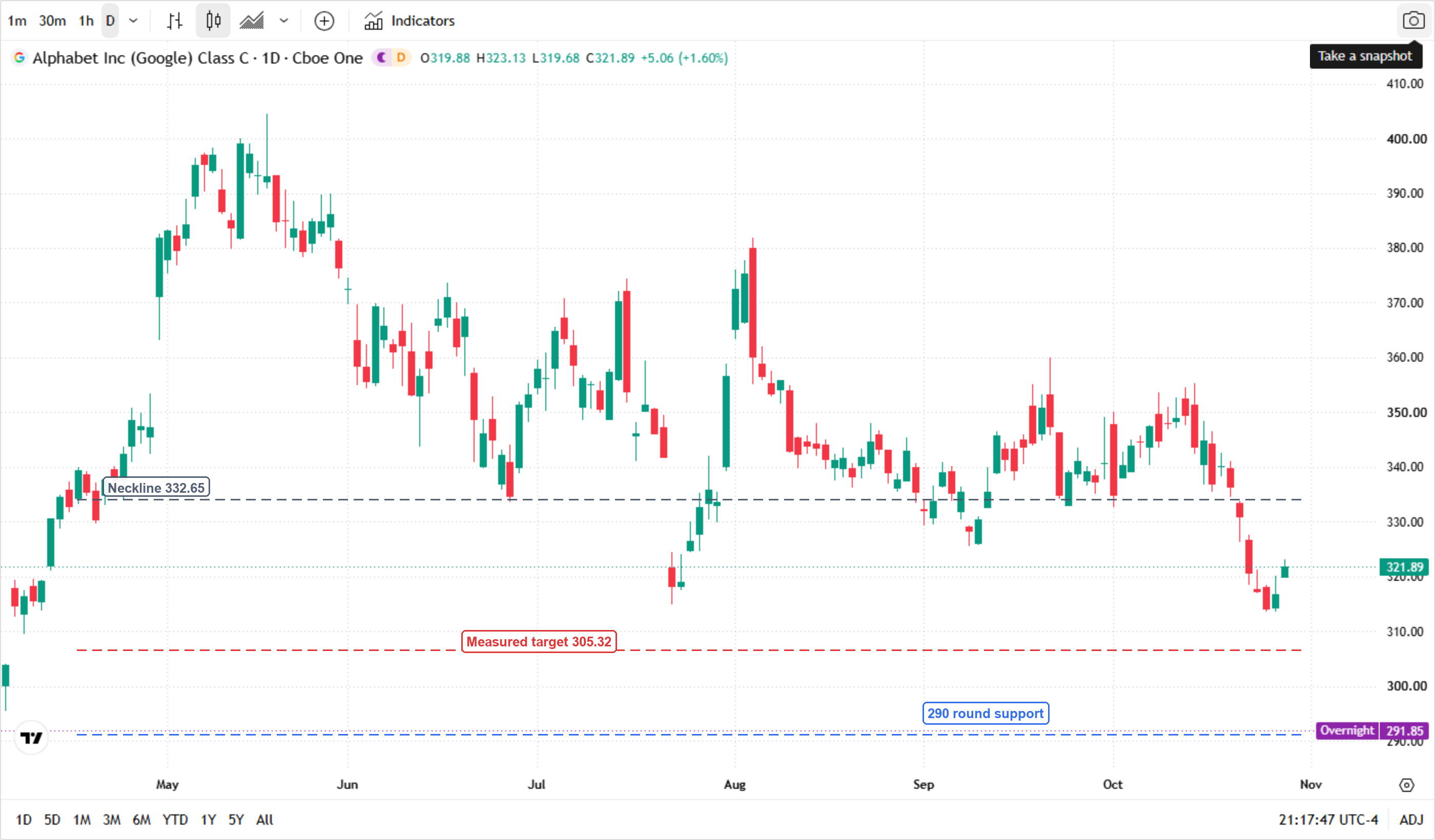
Alphabet Class C (GOOG) daily chart from May to October 2026 on Nasdaq. The regular close on October 28 was 321.89, up 1.60%; the after-hours line is 291.85. A gray dashed line marks the double-top neckline at 332.65, a red dashed line marks the measured target at 305.32, and a blue dashed line marks 290 round-number support. The chart shows a May high near 400, a September high near 380, and a lower high near 360 in October.

* Chart source: TradingView (Alphabet Class C, Nasdaq: GOOG).

Microsoft's $45.2 billion capex bought a 48% Azure quarter

Microsoft spent $45.2 billion on capex in the quarter, below its own roughly $50 billion forecast because some third-party capacity arrived late. The market did not punish the shortfall; it rewarded the output. Azure revenue was $33.17 billion, up 48%, and management guided next-quarter Azure growth to 49%–50%. Commercial remaining performance obligations — the backlog — remain the cushion.

The $18.6 billion cushion

Free cash flow was positive $18.6 billion, well above the roughly $8.54 billion consensus. That is the number that matters. Microsoft is still spending heavily — FY2027 capex is projected above $190 billion — but it is generating cash while doing so. In a market with the 10-year Treasury at 5.045%, a company that can fund its own capex is worth a different multiple from one that cannot.

Alphabet's $9.07 billion hole

Alphabet's cloud revenue was about $30.7 billion, up 103%, more than double a year earlier. That is faster than Azure. But capex was $51.4 billion, 2026 capex is expected above $200 billion, and free cash flow was negative $9.07 billion — its second consecutive negative quarter. Revenue of $127.58 billion and EPS of $2.12 missed consensus. The market looked at the growth, then looked at the cash, and sold the stock.

Oracle added 10.6% after lifting its FY2030 revenue target to $225 billion and capping additional fundraising at $20 billion; Micron rose 5.9%. The market is not abandoning AI infrastructure. It is paying for the parts of the chain that produce cash today — and punishing the parts that cannot yet.

Amazon is the third referee

Amazon reports after the close tonight. AWS growth, retail margins and capex guidance decide whether the third hyperscaler confirms the spending story or joins the de-rating that started with Meta. Amazon closed at 254.60 on October 28; it is above its 200-day average and testing its 20- and 50-day averages near 254–256. The bar is no longer "did capex go up?" The bar is "did free cash flow survive it?"

CompanyCloud growthCapexFree cash flowMarket reaction
MicrosoftAzure +48%$45.2B+$18.6BRose after hours
AlphabetGoogle Cloud +103%$51.4B-$9.07BFell about 9% after hours
AmazonAWS (tonight)Guided higher—The swing factor

What would make the second leg real

Three things would change the story from "AI capex is a cost" to "AI capex is an investment". First, Amazon's AWS growth has to beat the slowdown implied by its capex guide. Second, Alphabet's free cash flow has to turn positive in the next quarter; a third negative quarter would confirm the de-rating. Third, Microsoft's Azure guide of 49%–50% has to hold; a miss there would remove the last cushion.

The de-rating case is wrong if all three happen at once: Amazon's AWS accelerates, Alphabet's free cash flow turns positive, and Microsoft's Azure holds 49%–50%. Until then, the market will keep paying for cash, not growth — and the 10-year at 5.045% is the discount rate that makes the difference.

Read more

  • US Sept. PCE Preview: Inflation May Heat Up Again, How Will US Stocks, the Dollar, and Gold React?
  • Gold rises above $4,050 ahead of Fed rate decision
  • Note: If you want to share the article 《Microsoft passed the free-cash-flow test. Alphabet failed it by $9 billion — and Amazon is next》, make sure you retain the original link. For more information, please visit Insights or browse www.mitrade.com.

    * The content presented above, whether from a third party or not, is considered as general advice only.  This article should not be construed as containing investment advice, investment recommendations, an offer of or solicitation for any transactions in financial instruments.

    goTop
    quote
    Related Articles
    placeholder
    US Sept. PCE Preview: Inflation May Heat Up Again, How Will US Stocks, the Dollar, and Gold React?This Thursday (October 29), the US will release the September Personal Consumption Expenditures (PCE) price index. However, since the PCE report will be released after the Federal Reserve
    Author  TradingKey
    19 hours ago
    This Thursday (October 29), the US will release the September Personal Consumption Expenditures (PCE) price index. However, since the PCE report will be released after the Federal Reserve
    placeholder
    Fed October Rate Decision Preview: Rate Hike Pause Has Become Consensus, How Will US Stocks, Dollar, and Gold React?The Federal Reserve will announce its October interest rate decision at 14:00 Eastern Time on October 28, and Fed Chair Warsh will hold a press conference at 14:30. Markets currently wide
    Author  TradingKey
    Oct 27, Tue
    The Federal Reserve will announce its October interest rate decision at 14:00 Eastern Time on October 28, and Fed Chair Warsh will hold a press conference at 14:30. Markets currently wide
    placeholder
    Anthropic files for a $2 trillion IPO — the $80.7 billion loss is the decoy, the $450 billion compute bill is the riskAnthropic publicly filed its S-1 on October 26, revealing $16.29 billion of first-half revenue (+1,304% year over year) and a $80.7 billion net loss — of which $72.4 billion is a non-cash convertible-note charge. The real number is the $450 billion of signed, mostly non-cancelable compute commitments. Here is what the filing says, why NVDA, ARM and MU are the tradeable read-through, and the conditions that decide whether the AI trade passes its first public valuation test.
    Author  Irene Q.
    Oct 27, Tue
    Anthropic publicly filed its S-1 on October 26, revealing $16.29 billion of first-half revenue (+1,304% year over year) and a $80.7 billion net loss — of which $72.4 billion is a non-cash convertible-note charge. The real number is the $450 billion of signed, mostly non-cancelable compute commitments. Here is what the filing says, why NVDA, ARM and MU are the tradeable read-through, and the conditions that decide whether the AI trade passes its first public valuation test.
    placeholder
    Tesla jumps 5% as Barclays puts a $450 target on the SpaceX merger — the chart was already pointing to 431Tesla closed at $391.62 on October 26, up 5.21%, after Barclays upgraded the stock to Overweight and lifted its target to $450 from $370, citing a sharp inflection in Robotaxi miles and a potential SpaceX merger. The move also completed a double bottom at $345.88 and $349.33, with a neckline at $388.56 and a measured target of $431.24. Here is what the upgrade actually says, why the chart and the analyst now point the same way, and what would break the target.
    Author  Irene Q.
    Oct 27, Tue
    Tesla closed at $391.62 on October 26, up 5.21%, after Barclays upgraded the stock to Overweight and lifted its target to $450 from $370, citing a sharp inflection in Robotaxi miles and a potential SpaceX merger. The move also completed a double bottom at $345.88 and $349.33, with a neckline at $388.56 and a measured target of $431.24. Here is what the upgrade actually says, why the chart and the analyst now point the same way, and what would break the target.
    placeholder
    Big Tech's $800 billion AI bill faces its first real test — free cash flow is the judgeAlphabet and Microsoft report after the close on October 28, Amazon on October 29, with hyperscaler AI capex running near $800 billion a year. Meta's negative free cash flow and 9.40% drop on October 22 was the warning; this week's prints decide whether cloud growth and backlog can pay for the buildout. Here are the consensus numbers, the free-cash-flow table and the two-sided test.
    Author  Irene Q.
    Oct 26, Mon
    Alphabet and Microsoft report after the close on October 28, Amazon on October 29, with hyperscaler AI capex running near $800 billion a year. Meta's negative free cash flow and 9.40% drop on October 22 was the warning; this week's prints decide whether cloud growth and backlog can pay for the buildout. Here are the consensus numbers, the free-cash-flow table and the two-sided test.
    Live Quotes
    Name / SymbolChart% Change / Price
    MSFT
    MSFT
    0.00%0.00
    GOOG
    GOOG
    0.00%0.00

    US Stocks Related Articles

    • 10 Best Day Trading Platforms for Beginners and Active Traders in 2026: A Practical Guide
    • How To Invest in SpaceX Stock in 2026? Everything Investors Need to Know
    • Practice Trading Us Stocks? These Are 10 Best Stock Trading Demo Apps For Beginners
    • ​5 Best Paper Trading Platforms for 2026 (Free Demo Accounts for Beginners & Traders)
    • Wall Street’s Top 10 US Stocks for 2026 vs What Reddit Is Actually Buying
    • Is Mitrade Right for You? A Complete Guide on How to Start Trading CFDs in 5 Steps

    Click to view more