



If you’ve ever wanted to trade gold without buying physical bars or coins, Gold CFDs (Contracts for Difference) might be exactly what you’re looking for. They’re flexible, beginner-friendly, and let you make a profit whether gold prices rise or fall.
In this guide, you’ll discover what Gold CFDs are, how they work, the best times to trade, the costs to watch out for, and a step-by-step walkthrough using Mitrade. Now, let’s get into the details.
Different Ways On Gold Trading

Here are some of the major ways that you can trade on gold.
1 Trading physical gold
This involves buying and selling a touchable form of gold. For instance, you can invest in jewelry that is the most common form of physical gold asset. About 50% of the demand is made up of gold jewelry.
Trading physical gold is not a one-day business. it requires you to buy and hold the asset for a while as you watch the market movements. Knowing the right time to sell is the key to profitability.
2 Trading gold exchange-traded funds (ETFs)
This is similar to the trading of ordinary stocks. It requires you to trade ETFs on the stock exchange platforms. However, in ETFs, the fund portfolio does not change because it is pre-fixed. In order to make trading profitable, it requires you to buy an investment portfolio, and just when the time is right, you sell it off for a good profit margin.
3Trading gold CFDs
Trade Gold CFD is more flexible than the other ways. CFD(Contract for difference) is a popular form of derivative trading. You can trade any financial markets with CFD, such as shares, commodities, crypto, forex. Gold is also not exceptional.
This type of trading involves speculating the price of gold spots. You have options to go long or go short the gold price. The profit you earned is the difference between the buying and selling prices.
The biggest advantage of gold CFDs is that it has no expiration date. The contract is closed when there is a reverse trade made and the trader realizes his/her profit or loss.

- Open a Short( Sell) position on Mitrade Webtrader -
Next, you may want to learn about how gold CFD trading works.
Margin And Leverage Trading
CFDs are traded on a margin. Every trader is required to maintain a given minimum level. The deposits made to their accounts should not fall below this minimum level, otherwise, there will be margin calls made or the trader positions will be liquidated.
Normally, the margin ranges from 0.5% to 30% thus enabling the trader to take advantage of the leverage by magnifying the potential profits or losses in a trade. Therefore, CFD trading is considered margin or leverage trading.
High risks are along with high profits. If you are interested in gold trading on CFD, remember that it should not be used as a hold strategy. It is feasible to use as a short-term or medium-term strategy as long as you own proper money, risk management, and use stop losses.
Gold Trading On CFDs Example
This represents a daily gold trading example. Suppose the gold market has been very active and the traders and speculators are pushing its price higher every day. According to your speculation, you believe the price will rise further in the coming days.
Let’s take that the quote from your broker for Gold CFDs is 826.3 – 832.7. The lot size provided by your CFD broker contains 10 gold contracts, so as a trader, you decide to buy 4 lots at a price of 829.8.
In the next couple of days, you realize that the markets are moving upwards quite well and you make up your mind to close your position at gold’s price of 874.6
Take Note:
▲ The tick size (this is the minimum movement in the price of a commodity or a stock) for spot gold is 0.1. If the price increases by $1, it will equate to 10 ticks.
▲ The base currency is USD.
How much profit do you get from your trade?
The total profit will be calculated as:
| (Closing price – Opening price) X no. of ticks X number of lots purchased X Number of contracts per lot |
So,
(874.6 – 829.8) 10 ticks x 4 lots X 10 contracts per lot = $17,920.
In this sample, we have not considered the daily financing costs in order to make it as simple as possible. When we include all the costs that come with the trade, the profitability will be lower than $17,920.
Want To Join The Gold Market? >> Finding opportunities in their rising value OR their drop with trading Gold derivatives - contracts that track their change in value (CFDs)!



Why Do So Many Traders Choose Gold CFDs?
From trading communities online to even your crypto friends around, you’ve probably seen how popular gold is among traders. Here’s why many of them choose Gold CFDs:
They’re simple to get into: No serious entry barrier because you only need a phone or a laptop.
No minimum amount of physical gold needed: Unlike trading real gold, you can trade with small amounts by investing in tiny contract sizes.
You can hedge your portfolio: If you already trade currencies or stocks, you are exposed to high risks. Gold CFDs can act as a hedge against high volatility.
It’s one of the most liquid markets: You can buy and sell the CFD in seconds because of its deep liquidity.
And the biggest reason for many traders is the possibility of profiting whether gold prices rise or fall. This isn’t the situation when trading physical gold.
The Risks Of Trading Gold CFDs
Trading gold CFDs has its advantages as well as risks. Here are some of the high risks exposed to traders.
● The Market risk
Gold CFDs are basically contracts that pay traders for the difference between the opening/entry price and the closing/exit price. Since they are traded on a margin, leverage increases the risks involved as much as they present potential profits.
● The risk of premature liquidation in the market
The markets are very volatile and sometimes there may be unfavorable price movements. During this time, a trader needs to add a variation margin in order to maintain the required margin level. The gold CFD trader may be asked to deposit some more money within very short notice. Regardless of the short notice, the trader should provide the money in time. Otherwise, the CFD provider may close the position at a loss.
● The counterparty risk.
While this is not a common risk, the trader may also lose a position if the trader does not meet the financial obligation and/or is insolvent. The Exchange Traded CFDs have less counterparty risk.
How to Start Trading Gold CFDs?
Gold CFDs trading can be traded at any regulated CFD broker. Before you start your trading journey with a given broker, it is important that you should understand the details of the broker. For instance, the fees that you may be charged. Mitrade is one of the most recommended CFD brokers.
Investing in gold CFDs at Mitrade
Trading gold CFDs at Mitrade is easy to understand and implement. As much as all types of trading involve a lot of risks, Mitrade has gone a step further to ensure that all traders have a conducive and superior environment for trading.
At Mitrade, you can invest as little as 0.01lot in gold derivatives( CFD).
And since you’re not actually owning the physical gold, you can invest in their rising value OR their drop.
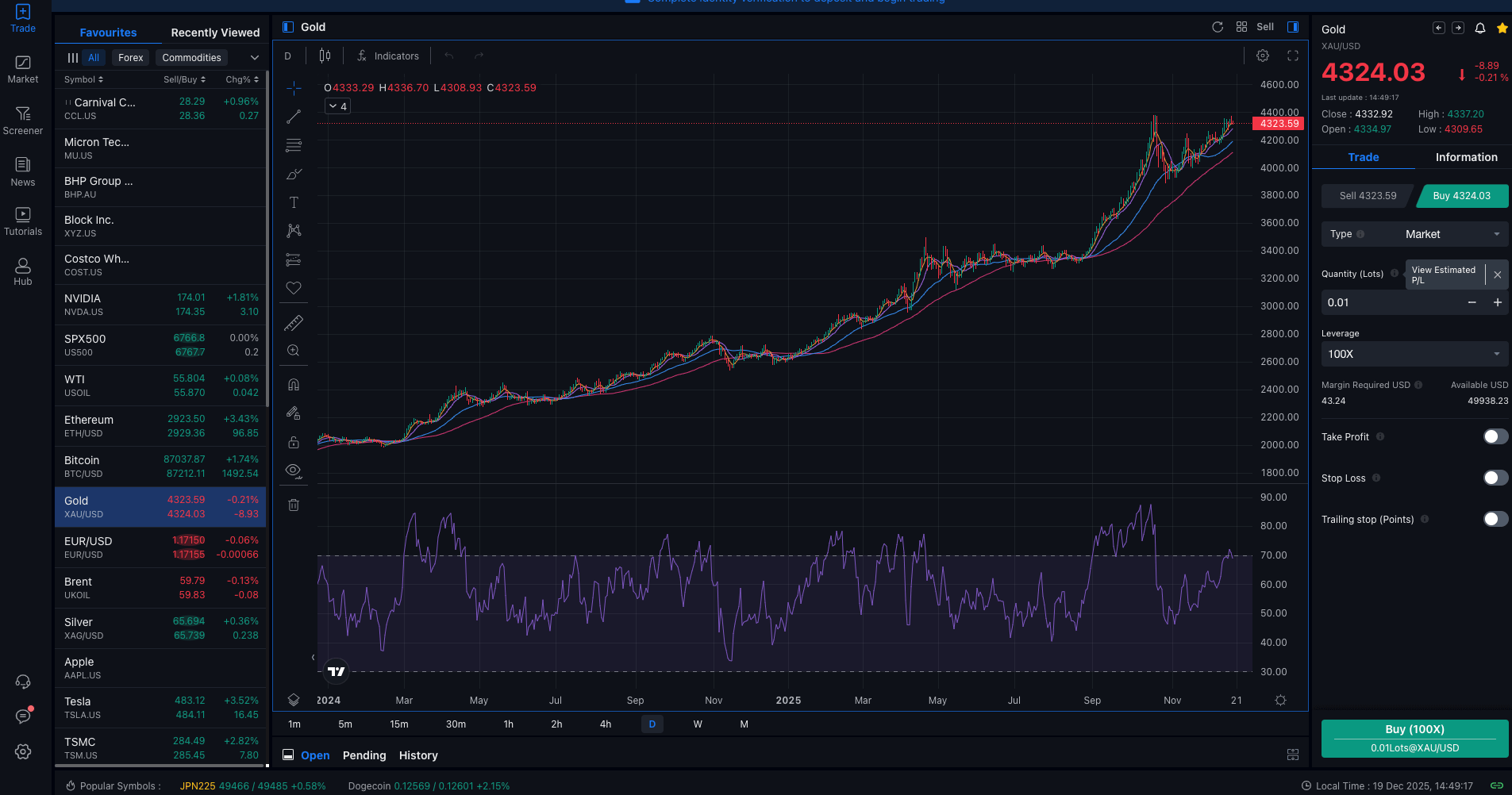
Step 1: Create a Mitrade Account
Visit the Mitrade site or download the mobile app and click “Trade Now.” Provide your email address or choose the alternative sign-up options like using your Google, Facebook, or Apple account.
Afterwards, create a new password and verify your email to complete the registration process.
Step 2: Complete Identity Verification
Next up is the broker’s KYC process. Enter the required information, including your country of residence and ID issuing country.
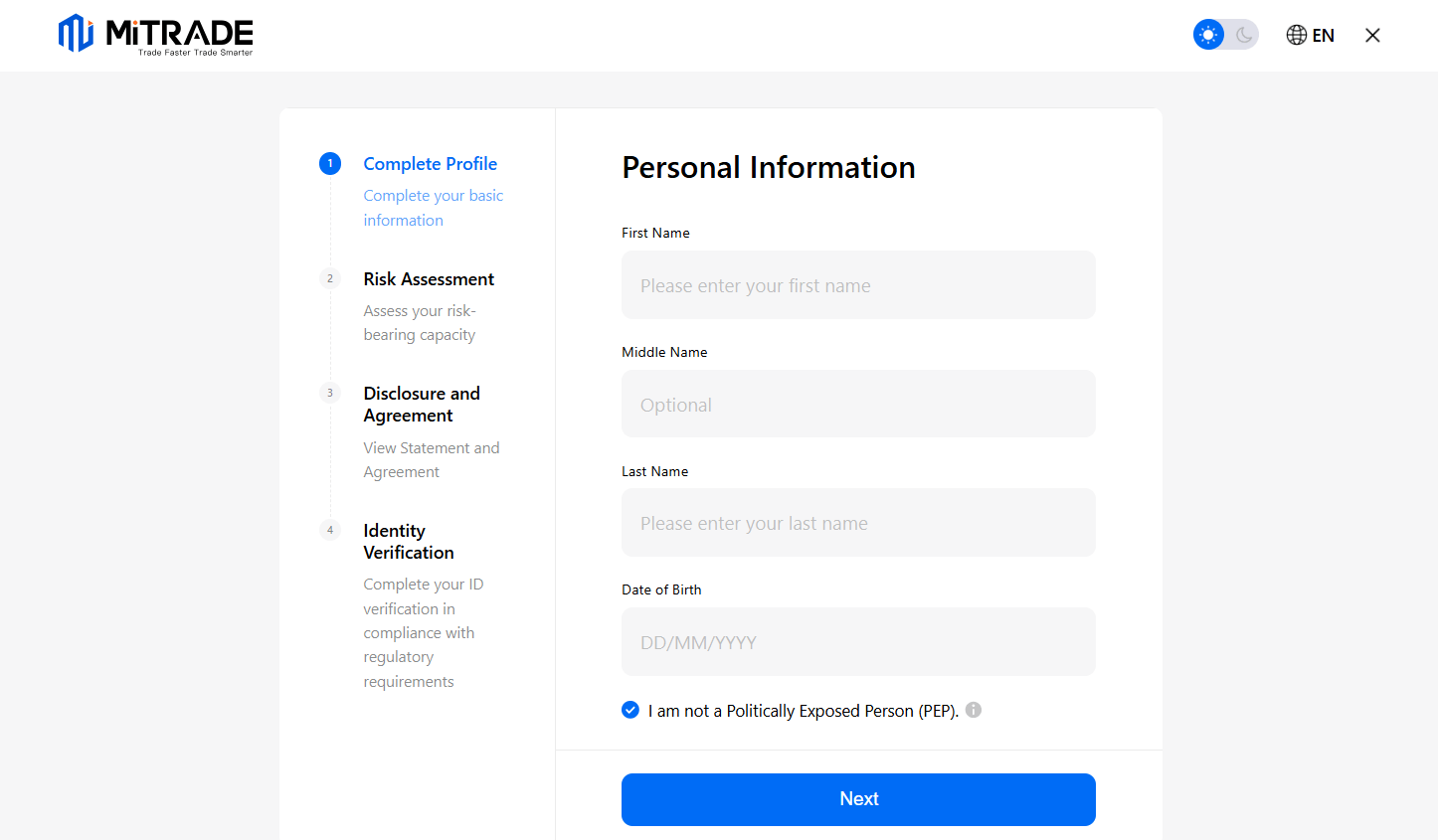
Complete the verification by providing other details, including your full name, date of birth, risk assessment questions, and submit your proof of identity.
Tip: While your ID is under review, you can check out the demo trading option on Mitrae to get familiar with the platform and build a trading plan.
Step 3: Deposit Funds
After ID verification is completed, deposit funds using your preferred payment method. Options include credit/debit cards, bank transfers, e-wallets, Apple Pay, and Google Pay. The minimum deposit ranges from $20 to $50, depending on your country of residence.
Step 4: Buy or Sell Gold
Once you have your trading strategy intact and are ready to dive in, switch to live trading mode and open your first gold trade.
Once your trade is live, ensure you employ risk management measures like constant market monitoring, using stop-loss, and keeping your position sizes reasonable.
*Start with a risk-free demo or fund instantly.
The Cost of Gold CFD
When speaking of what a Gold CFD costs, it goes beyond the quantity of the derivative you are purchasing. It also includes what you pay, even if you don’t realise it. That’s because CFDs may feel simple on the surface, but unknown costs can eat into your capital or profits.
Before opening your first trade, here are the costs to consider:
The Spread or Trading Fee
The spread is the difference between the buy and sell prices of digital assets, such as CFDs, on an online brokerage. You pay it automatically whenever you open a trade because it’s already added to the overall cost of completing the transaction.
Think of it as the toll fee you pay to the brokerage (a gate) that lets you enter the market to find financial instruments.
For example, if the buy price of an asset is $2300.50 and the sell price is $2300.20, the spread is 0.30, meaning you start your trade slightly at a loss, so the trade must move in your favour for you to profit.
This is why it’s good to choose a brokerage like Mitrade with tight spreads and zero commission fees to get the best value for your trades.
Overnight Fees
Unlike the cryptocurrency market, which runs 24/7, you can only trade CFDs 24/5. That means the trading window is open for five days a week, but if you hold your position past market closing times on these weekdays, your broker may charge you an overnight financing fee.
For example, Mitrade charges overnight funding when traders hold positions beyond 22:00 GMT (winter). If you’re planning to day trade gold, you can avoid such extra costs by closing your positions before the end of the trading day. If you're a swing trader, you’ll need to factor this cost into your plans.
Margin Requirements
Margin is the amount of money you must deposit to open a leveraged position. This kind of position lets you increase your lot with extra funds, similar to a loan from your broker, and you pay a margin (interest on the loan).
For every leverage trade, there’s a margin to consider. High leverage attracts a small margin requirement, while low leverage comes with a bigger margin requirement.
Broker Fees
Most CFD brokers don’t charge direct commissions for Gold CFDs, but spreads, swaps, and other fees still apply. These include:
Inactivity fee
Currency conversion
Deposit or withdrawal fees
Always check your broker’s cost page before trading to be sure you have the accurate fee details.
What Is the Best Time to Trade Gold CFDs?
Gold doesn’t move the same way as some digital assets do all day. Some hours are quiet, while others are full of activities. That means timing your trading activities with gold’s most active periods is crucial.
The London–New York Overlap
When London and New York trade at the same time, that’s your cue to trade gold. This is typically around 1:00 PM to 5:00 PM GMT (or 8 AM to 12 PM EST). Over 37% of the daily volume is traded during this prime period, making the asset extremely volatile because big whales are active, volumes are high, and spreads are tighter.
These factors make it perfect for traders who like to capitalise on its price movement. If you only trade gold for a few hours per day, this is often the best window to enter the market.
The First Hours of the US Session
Gold loves reacting to US-related news, which typically trends during the early U.S. session and is accompanied by intense volatility. These reports include:
Inflation data
Interest rate announcements, like cuts from the Federal Reserve
Employment reports
President Trump’s speeches
Some traders still buy and sell Gold CFDs during the “Dead Hours,” when the markets are rather quiet. These include the late Asian session and mid-day market lulls. However, these are statistically not the best times to trade, as the market feels slow.
Final Thoughts: Is Gold CFD Trading Right for You?
Australia’s gold exports have soared by double digits. However, not every Aussie can buy and sell physical gold. For many traders, trading gold CFDs gives them exposure to the global derivative markets, where they can potentially profit from their activities.
With tools like leverage, margin trading, and the ability to go long or short, CFDs can deliver opportunities for profit in both rising and falling markets. Brokers like Mitrade make this accessible through a beginner-friendly platform, low minimum deposit, and a zero-commission fee structure.
However, trading CFDs is risky and requires a solid plan and skill. Ensure you have the best risk management strategies in place to minimise losses and make the most of your experience when you start trading Gold CFDs on Mitrade.
* The content presented above, whether from a third party or not, is considered as general advice only. This article should not be construed as containing investment advice, investment recommendations, an offer of or solicitation for any transactions in financial instruments.


