


Neither hawkish Fed bets nor Mideast risks: This AI capex plans are hurting Silver
- Silver falls to a fresh 11-month low near $52.60 as US hyperscalers signal acceleration in AI spending.
- Alphabet said on Wednesday that it expects capex to increase significantly in 2027.
- The Federal Reserve is almost certain to raise interest rates in December.
Silver price (XAG/USD) posts a fresh 11-month low near $52.60 during the European trading session on Thursday. The white metal faces intense selling pressure due to multiple headwinds, including hawkish Federal Reserve (Fed) expectations for the December meeting, risks of fresh escalation in Middle East conflicts, and a fresh upgrade in Alphabet’s Artificial Intelligence (AI) spending plans.
A view on Fed’s outlook
Analysts at MUFG/BTMU note that the Fed left the fed funds rate unchanged at 3.75–4.00%, a widely anticipated pause following September’s hike, but stress that the decision "included two dissents in favour of another rate increase," underscoring lingering hawkishness on the committee. They highlight that Fed Chair Kevin Warsh "reiterated the Fed’s commitment to returning inflation to 2%".
MUFG/BTMU add that "markets continue to price around an 87% probability of a December rate hike," indicating that investors still expect further action this year.
Technically, higher interest rates by the Fed bode poorly for non-yielding assets, such as Silver.
However, financial markets have been confident about the central bank’s December rate hike for weeks, which defies the likelihood of an immediate negative impact on the Silver price.
US-Israel prepares for fresh attacks on Iran
Strategists at Deutsche Bank said in a note that "the Wall Street Journal (WSJ) reported the United States (US) President Donald Trump’s administration warning Gulf states to be prepared for a new operation against Iran after the midterms.” Adding to the geopolitical bid, Danske Bank’s research team highlights that, in his post-election speech, Israel Prime Minister (PM) Benjamin Netanyahu raised the prospects of “renewed joint action with President Trump against Iran”.
Fears of fresh escalation in Middle East risks have bolstered hopes of a bullish oil price outlook. However, the WTI Oil price is 0.5% down at the time of writing to near $100.74, ruling out expectations of an immediate bearish impact on Silver.
Upgraded AI capex plans by hyperscalers seem to be hurting Silver price in real time
On Wednesday, Alphabet maintained its full-year capital expenditures forecast after lifting guidance to between $195 billion and $205 billion during the second quarter (Q2) from $190 billion in its Q3 earnings call. Annual capex is expected to top $200 billion before exceeding $300 billion in 2027. “We continue to expect our capex to increase significantly in 2027, and will provide further details on our Q4 call,” Alphabet finance chief Anat Ashkenazi told analysts during an earnings call, CNBC reported.
An upgrade to AI spending plans by US hyperscalers will likely improve yields on government-backed securities. Such a scenario would diminish the appeal of non-yielding assets, like Silver.
Last week, Meta also reiterated significant spending plans for AI infrastructure. Deutsche Bank said in a note that Meta has “slightly boosted its 2026 capex plan from a $130bn-145bn range to $135bn-145bn,” underscoring its continued commitment to AI-related investment.
Silver Technical Analysis
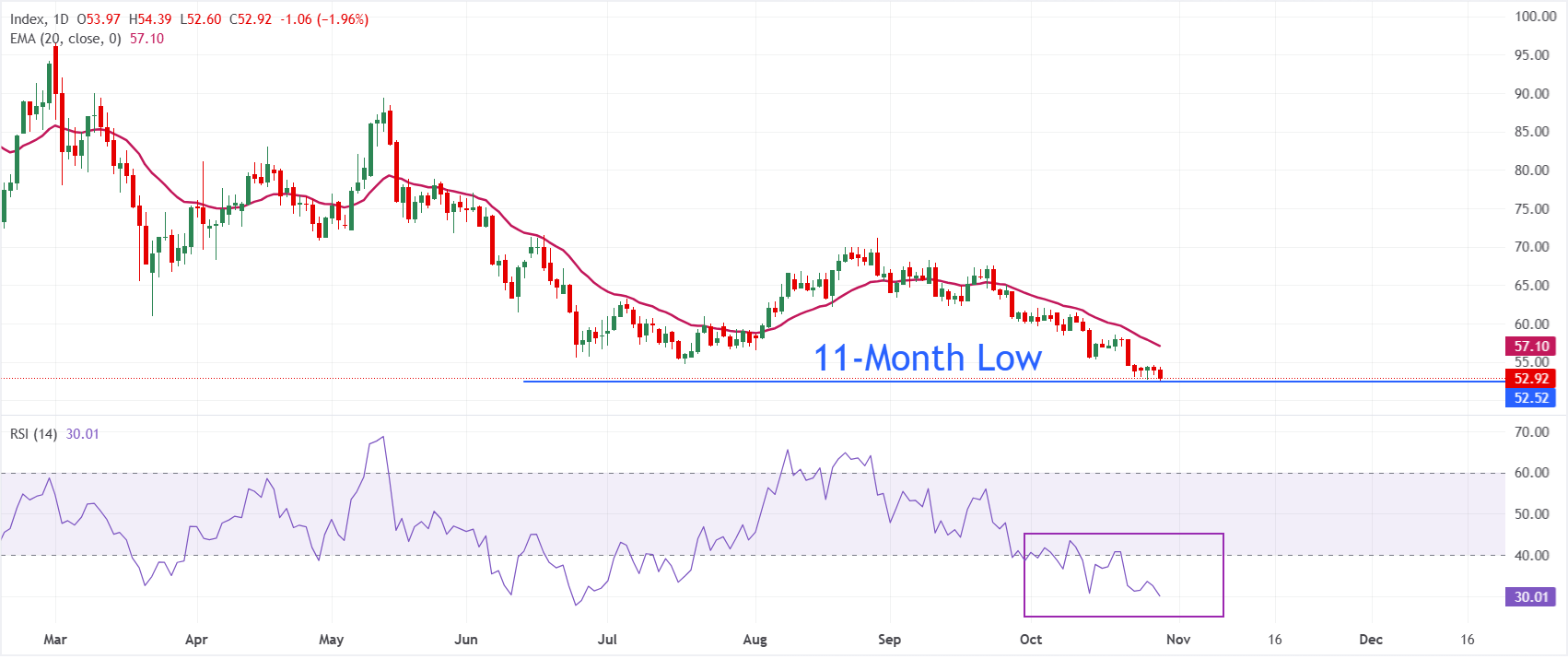
On the daily chart, XAG/USD trades at $52.91, extending a bearish near-term bias as spot remains clearly below the 20-day Exponential Moving Average (EMA) at $57.10. The location of the price under this short-term trend gauge suggests rallies are still likely to be capped, while the Relative Strength Index (RSI) at 30.01 slips into oversold territory, hinting that downside momentum is stretched but not yet reversed.
On the topside, initial resistance is located at the 20-day EMA at $57.10, where any recovery is likely to face selling pressure unless buyers can secure a sustained daily close above this barrier. On the downside, as previously mentioned, the RSI hovering near 30 signals an oversold condition that could provide some temporary cushioning to the bearish trend, but until XAG/USD reclaims the $57 area, the technical tone will continue to favor further weakness on corrective bounces.
(The technical analysis of this story was written with the help of an AI tool. Know more.)
Silver FAQs
Silver is a precious metal highly traded among investors. It has been historically used as a store of value and a medium of exchange. Although less popular than Gold, traders may turn to Silver to diversify their investment portfolio, for its intrinsic value or as a potential hedge during high-inflation periods. Investors can buy physical Silver, in coins or in bars, or trade it through vehicles such as Exchange Traded Funds, which track its price on international markets.
Silver prices can move due to a wide range of factors. Geopolitical instability or fears of a deep recession can make Silver price escalate due to its safe-haven status, although to a lesser extent than Gold's. As a yieldless asset, Silver tends to rise with lower interest rates. Its moves also depend on how the US Dollar (USD) behaves as the asset is priced in dollars (XAG/USD). A strong Dollar tends to keep the price of Silver at bay, whereas a weaker Dollar is likely to propel prices up. Other factors such as investment demand, mining supply – Silver is much more abundant than Gold – and recycling rates can also affect prices.
Silver is widely used in industry, particularly in sectors such as electronics or solar energy, as it has one of the highest electric conductivity of all metals – more than Copper and Gold. A surge in demand can increase prices, while a decline tends to lower them. Dynamics in the US, Chinese and Indian economies can also contribute to price swings: for the US and particularly China, their big industrial sectors use Silver in various processes; in India, consumers’ demand for the precious metal for jewellery also plays a key role in setting prices.
Silver prices tend to follow Gold's moves. When Gold prices rise, Silver typically follows suit, as their status as safe-haven assets is similar. The Gold/Silver ratio, which shows the number of ounces of Silver needed to equal the value of one ounce of Gold, may help to determine the relative valuation between both metals. Some investors may consider a high ratio as an indicator that Silver is undervalued, or Gold is overvalued. On the contrary, a low ratio might suggest that Gold is undervalued relative to Silver.
Recommended Articles


