


Brent's $115 front month sits $4.6 above January — the $14 spread to WTI is the supply-risk premium


Three numbers explain Brent this morning. December Brent trades at $115.29. January Brent trades at $110.71. And December Brent costs $14.2 more than December WTI, against a normal $3-5 gap. The first two numbers are a roll; the third is the supply-risk premium, and it has not gone away.
The $14 gap is the premium
Start with the spread, because it is the cleanest read. Brent and WTI are both light sweet crude, but Brent prices waterborne barrels that must transit the Strait of Hormuz; WTI prices barrels sitting in Oklahoma. When the market prices a supply disruption, the premium shows up in Brent first.
At $14.2, the December Brent-WTI spread is roughly three times its normal $3-5 range. Even the January spread — $110.71 minus $99.07 — is $11.6. That is not a rounding error. It is the market saying that the risk is physical, and that it is concentrated in the front of the curve.
$14.2 today, $11.6 in January
The decay from $14.2 to $11.6 matters. If the premium were a permanent re-rating of waterborne crude, the spread would be flat across months. Instead it slopes downward, which means traders expect the risk to fade with time — but not disappear. UBS still sees Brent around $110 at year-end, roughly where the January contract is now.
$4.6 versus $2.0: the curve says the risk is in the water
The second comparison is inside Brent itself. December Brent is $4.58 above January Brent. For WTI, the same December-January gap is only $1.99.
That difference — $4.58 versus $1.99 — is the term-structure version of the same story. Backwardation of this size means buyers of prompt cargoes are paying up, while buyers of later cargoes are not. The physical tightness is in the water, not in the ground.
The talks knocked the back, not the front
On October 26, senior officials from Saudi Arabia, Turkey and Pakistan met Iranian leaders in Tehran and agreed to continue talks on regional security. December Brent settled at $113.88 on October 27, down 1.67%, and WTI at $99.90, down 1.83% — a headline-driven dip, not a structural break.
Today both contracts are higher again. December Brent is up about 1.2%, WTI about 1.2%. The January contract is up 0.89%.
The roll will cut the headline by $4.6 on October 30
Here is the part that is easy to misread. The December Brent contract expires on October 30. After that, the continuous Brent series rolls to January, and the headline price will drop by roughly $4.6 overnight — without a single barrel moving, and without any diplomatic progress.
If you see "Brent falls $4.6" on October 31, that is the roll, not the risk premium. The spread to WTI is the number to watch, because it is roll-adjusted.
The counter-evidence: 28 attacks in October. The strongest argument against the "premium is fading" view is physical, not verbal. Shipping disruptions near the Strait of Hormuz reached 28 incidents in October, the highest since 2017, according to reports compiled this week. A fire at Saudi Arabia's Ras Tanura refinery, the country's largest, has also kept supply concerns alive.
Diplomacy can lower the expected premium. It cannot reopen a refinery or clear a shipping lane. That is why the front month keeps holding above $110 even as the headlines turn constructive.
Three triggers, and the 108.81 line
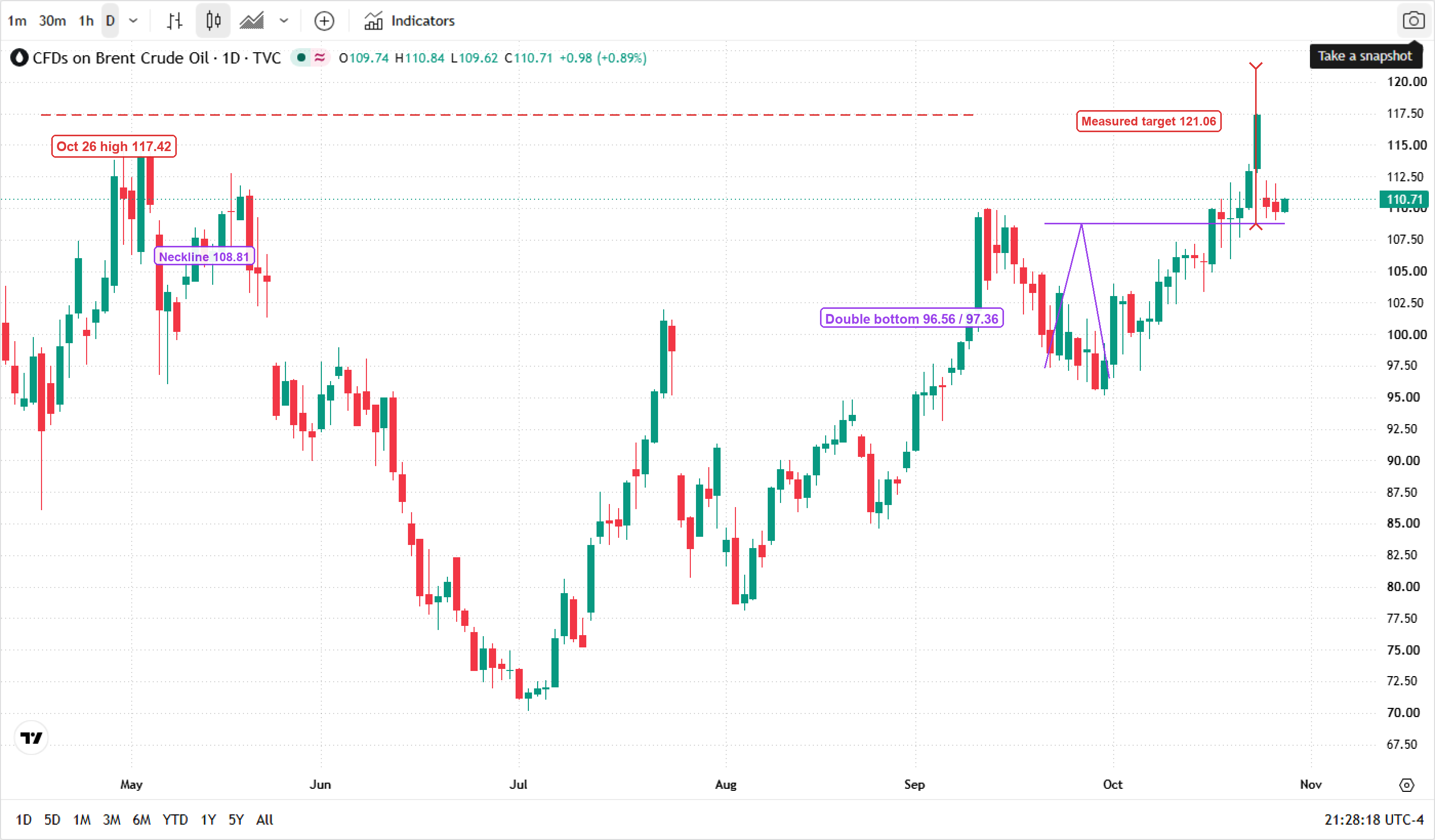
The chart adds one more layer. January Brent completed a double bottom at $96.56 (October 1) and $97.36 (September 22), broke the $108.81 neckline, and reached $117.42 on October 26 before pulling back. The measured target is $121.06. At $110.71, the January contract is 1.7% above the neckline — a retest, not a breakdown.
| Trigger | Direction | What it targets |
|---|---|---|
| January holds above $108.81 | Base case | $117.42 retest, then $121.06 measured target |
| January closes below $108.81 | Risk case | $100.00, then the $96.56 double-bottom low |
| December-January spread widens above $5 | Physical tightness persists | Front-month premium stays; Brent-WTI holds above $12 |
| December-January spread compresses below $3 | De-escalation gets priced | Brent-WTI slides toward $8; $108.81 becomes the line to defend |
The bear case is simple and should not be dismissed: if the talks produce a credible de-escalation, the $14.2 Brent-WTI spread can compress toward $5. That is roughly $9 of downside on Brent without any change in global demand. The bull case is equally simple: 28 attacks in a month and a fire at Saudi Arabia's largest refinery are not de-escalation.
What the curve says today is that neither side has won. The front month is still paid up; the back of the curve is already discounting peace. That is a market pricing a probability, not a conclusion.
Read more
* The content presented above, whether from a third party or not, is considered as general advice only. This article should not be construed as containing investment advice, investment recommendations, an offer of or solicitation for any transactions in financial instruments.


