


Kioxia Earnings Preview: Market Expects 447% YoY Revenue Growth, Highest Wall Street Target Around $422
TradingKey - Kioxia Holdings will announce its second-quarter financial results for fiscal year 2026 at 18:45 Tokyo time on October 30. As of the close on October 29, Kioxia shares were quoted at 14,505 yen (approximately $91.8), up 1.15%.
The market is focused on whether price increases in NAND flash memory will continue to boost revenue and operating profit, and whether the boost from AI data center demand to the enterprise SSD business can be sustained.
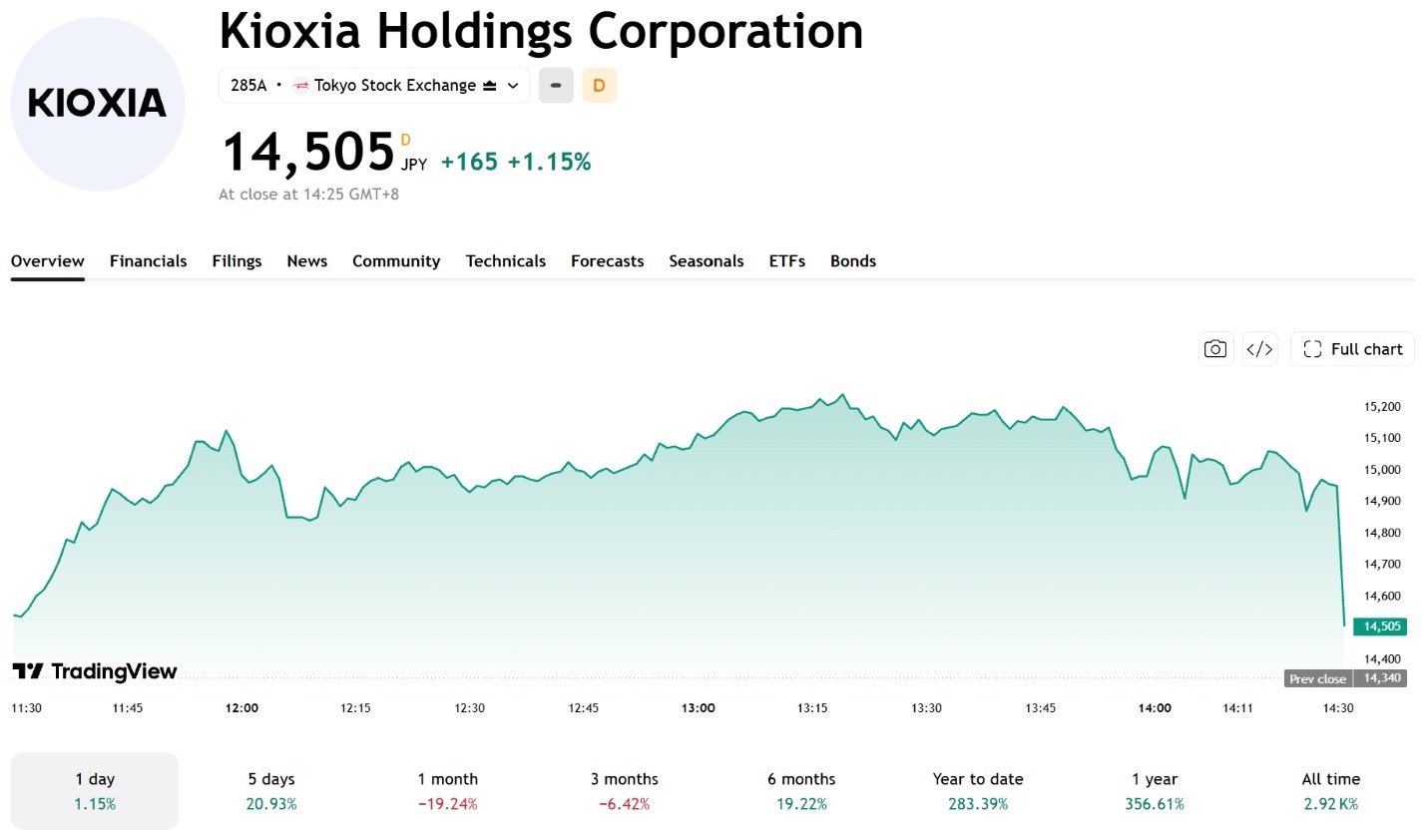
[Source: TradingView]
Market Expectations: Revenue May Reach 2.45 Trillion Yen
According to data from Investing.com, analysts expect Kioxia's second-quarter revenue to reach approximately 2.45 trillion yen (about $15.5 billion), higher than the company's previous guidance of 2.39 trillion yen.
The company previously estimated second-quarter IFRS operating profit of 1.89 trillion yen and non-GAAP operating profit of 1.90 trillion yen. Management expects that higher average selling prices for memory products will contribute approximately 70% of the incremental revenue, with the remainder driven mainly by low single-digit bit shipment growth.
The key focus of this earnings report will be whether actual revenue and profit can meet or exceed company guidance, as well as management's outlook on subsequent memory prices and demand.
Last Quarter Review: Rising Memory Prices Drive Profit Growth
Kioxia's revenue for the first quarter of fiscal year 2026 reached 1.767 trillion yen, with operating profit at 1.270 trillion yen. Demand from generative AI-related data centers drove up average selling prices for memory products, boosting both revenue and profit growth.
During the quarter, stock-based compensation expenses of 19.4 billion yen and provisions for litigation losses of 36.6 billion yen weighed on operating profit. Excluding these items, the company's non-GAAP operating profit stood at 1.326 trillion yen.
Kioxia primarily operates in NAND flash memory and solid-state drives (SSDs), differing from Micron (MU), Samsung, and SK Hynix (SKHY), which also operate DRAM and HBM businesses.
In the first quarter, revenue from the company's SSD and storage business was approximately 1.175 trillion yen, accounting for about 66.5% of total revenue. Key focus areas in this earnings report should be the changes in revenue from this business and average selling prices for memory products.
Core Highlights: Enterprise SSD Demand and Expansion Plans
AI data center construction is driving growth in high-capacity storage demand, and enterprise SSDs are expected to benefit. However, the NAND market is cyclical; if customer demand slows, supply increases, or product average selling prices decline, Kioxia's profit growth may come under pressure.
On the capacity front, Kioxia and SanDisk announced in August plans to jointly invest over $31 billion in Japan by 2032 for equipment, infrastructure, and technology upgrades at their Yokkaichi and Kitakami production facilities. This plan is contingent on receiving government support and is not an investment borne by Kioxia alone.
Kioxia also plans to construct Fab 3 in Kitakami, targeting the start of operations in fiscal year 2029. The added capacity will help boost future NAND supply capabilities, but the return on investment will still depend on market demand, product prices, and capacity utilization rates.
Wall Street Sees Price Target as High as 66,700 Yen
According to data from StockAnalysis, 16 analysts have an average price target of approximately 36,233 yen for Kioxia, implying a 149.8% upside from current prices, with a peak target price of 66,700 yen (about $422).
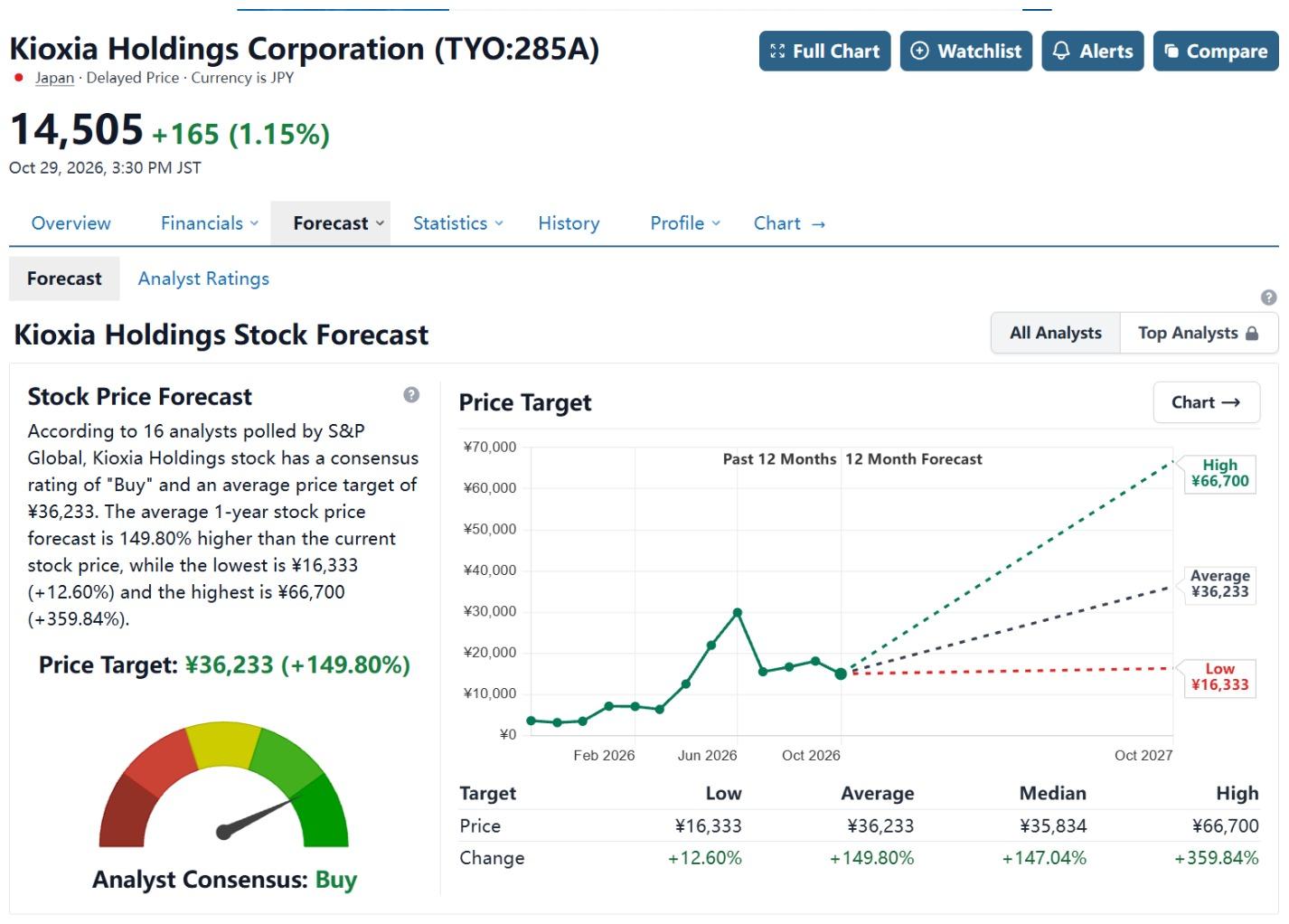
[Source: StockAnalysis]
Goldman Sachs maintained a Buy rating with a target price of 39,000 yen, while UBS lowered its target price from 42,000 yen to 33,000 yen while maintaining its Buy rating.
Analysts hold divergent views on Kioxia's valuation, with NAND price trends, enterprise SSD demand, and returns on capacity expansion serving as key factors influencing earnings expectations.
This earnings release requires close attention to revenue, operating profit, and operating cash flow. If performance beats company guidance and management takes a positive stance on memory prices and enterprise SSD demand, earnings expectations could be supported; if prices fall back, customer demand slows, or capacity expansion spending increases, the company's profit margins and cash flow could come under pressure.
Recommended Articles


