




How to Trade Copper Commodities in 2026: A Beginner's Guide as Copper Prices Surge on AI Demand
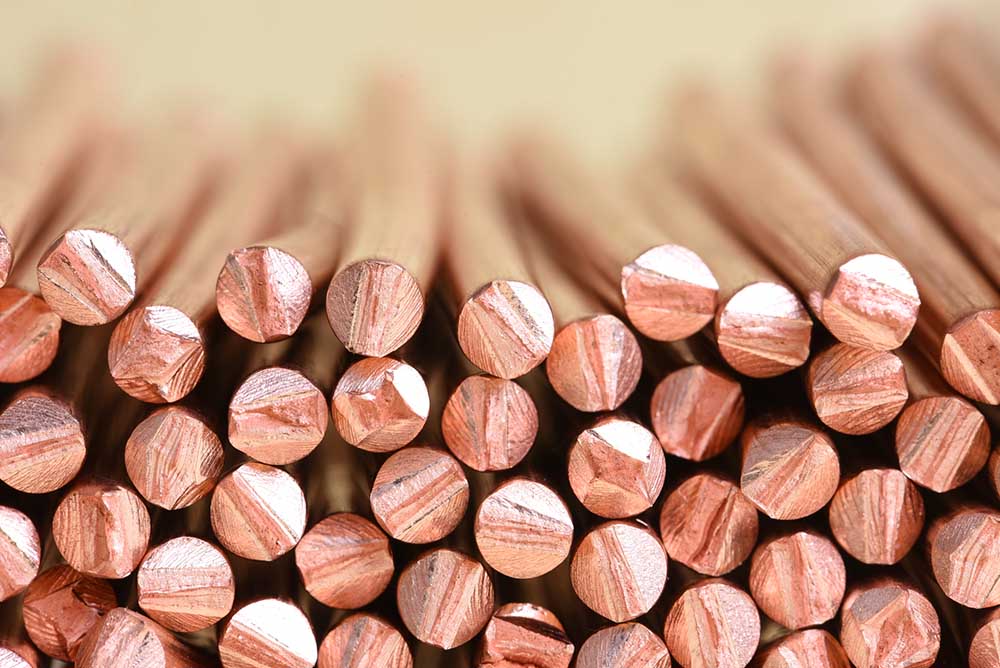
Copper has become one of the world's most closely watched commodities in 2026. While gold often dominates headlines during periods of economic uncertainty, copper is increasingly viewed as a barometer of global industrial growth and the AI revolution. Surging investment in artificial intelligence (AI), data centres, renewable energy, electric vehicles (EVs), and power grid upgrades has pushed copper demand to record levels, keeping prices elevated despite ongoing macroeconomic uncertainty. Analysts also expect supply constraints from limited mine expansions and declining ore grades to provide additional long-term support for the market.
For Australian investors, copper offers more than just long-term investment potential—it also creates attractive short-term trading opportunities. Copper prices are highly sensitive to economic data, central bank policy, geopolitical events, and supply disruptions, making the metal one of the most actively traded commodities worldwide.
In this guide, you'll learn what copper commodities are, why copper prices are rising, how to trade copper step by step, and why Copper CFDs have become a popular choice for traders looking to profit from both rising and falling markets.
Why Copper Prices Are Surging in 2026
Today's Copper Price
Copper has earned the nickname "the metal of electrification", and in 2026, several powerful trends are converging to drive demand higher than ever before.
Market Snapshot
| Driver | Impact on Copper | Why It Matters |
|---|---|---|
| 🤖 AI Data Centres | Massive demand for electrical wiring, cooling systems and power infrastructure | |
| ⚡ Power Grid Upgrades | Governments are investing billions to modernise electricity networks | |
| 🚗 Electric Vehicles | EVs require significantly more copper than conventional vehicles | |
| 🌞 Renewable Energy | Solar panels and wind turbines consume large amounts of copper | |
| ⛏️ Supply Constraints | Limited new mines and declining ore grades restrict supply | |
| 🌍 Global Manufacturing Recovery | Improving industrial activity supports broader copper consumption |
1. AI Infrastructure Is Creating a New Source of Copper Demand
Artificial intelligence has evolved from a software story into an infrastructure story. Every new AI data centre requires enormous quantities of copper for power cables, transformers, switchgear, cooling systems and networking equipment. Major mining companies, including Rio Tinto, have highlighted AI-driven infrastructure investment as a structural growth driver, with copper now contributing a larger share of earnings than in previous years.
2. The Global Energy Transition Continues
Governments worldwide continue to invest heavily in renewable energy projects and electricity grid expansion. Compared with fossil-fuel systems, renewable energy installations require substantially more copper due to extensive wiring and transmission infrastructure. As countries pursue decarbonisation goals, copper demand is expected to remain structurally strong over the coming decade.
3. Copper Supply Remains Tight
While demand continues to accelerate, supply growth has struggled to keep pace. New mining projects typically require many years of development, and existing mines face challenges such as declining ore grades, labour shortages and permitting delays. Several industry outlooks suggest that supply tightness—not just stronger demand—will continue to underpin copper prices through 2026.
4. Higher Volatility Creates More Trading Opportunities
Copper is among the most volatile industrial metals because its price reacts quickly to:
US Federal Reserve interest rate decisions
China's manufacturing and construction activity
Global PMI reports
US dollar movements
Mining disruptions in Chile and Peru
Inventory changes on the London Metal Exchange (LME) and COMEX
For active traders, this volatility can create opportunities in both bullish and bearish market conditions—especially when trading leveraged Copper CFDs.
What Are Copper Commodities?
Copper commodities are financial or physical products that allow investors to gain exposure to the price of copper. Depending on your investment goals and experience, you can trade copper through several different markets.
Different Ways to Invest in Copper
| Investment Type | Own Physical Copper? | Leverage Available | Best For |
|---|---|---|---|
| Physical Copper | ✅ Yes | ❌ No | Industrial users and long-term holders |
| Copper Futures | ❌ No | ✅ Yes | Professional and institutional traders |
| Copper ETFs | Indirect | ❌ Usually No | Long-term investors |
| Copper Mining Stocks | Indirect | ❌ No | Equity investors |
| Copper CFDs | ❌ No | ✅ Yes | Active retail traders |
1. Physical Copper
Buying physical copper means owning the metal itself, usually in industrial quantities such as cathodes, bars or scrap. This approach is generally unsuitable for retail investors because of storage, transportation and insurance costs.
2. Copper Futures
Copper futures are standardised contracts traded on commodity exchanges such as COMEX. They allow traders to speculate on future copper prices using leverage but involve contract expiries, margin requirements and larger position sizes, making them better suited to experienced traders.
3. Copper ETFs
Copper exchange-traded funds (ETFs) provide indirect exposure to copper prices by holding futures contracts or investing in copper-related companies. ETFs are a convenient option for investors seeking longer-term exposure without trading futures directly.
4. Copper Mining Stocks
Instead of trading copper itself, investors can buy shares in major mining companies such as BHP, Rio Tinto or Freeport-McMoRan. While these companies often benefit from rising copper prices, their share prices are also influenced by operational performance, costs and broader equity market sentiment.
5. Copper CFDs
Copper Contracts for Difference (CFDs) allow traders to speculate on copper price movements without owning the underlying commodity. CFDs offer several advantages for active traders:
Trade rising and falling markets
Access leverage with lower initial capital
No contract expiry
Real-time pricing
Suitable for short-term trading strategies
For beginners and active traders alike, Copper CFDs provide one of the most accessible ways to participate in the copper market while taking advantage of the price volatility created by AI-driven demand, global economic developments and supply disruptions.
“Trade Copper CFDs with an ASIC-regulated broker. Fast AUD funding via PayID. ”
Copper CFDs vs Copper Futures: Which Is Better?
Both Copper CFDs and Copper Futures allow traders to speculate on copper price movements without owning the physical metal. However, they are designed for different types of traders. Futures are exchange-traded contracts commonly used by institutions, producers and professional traders, while CFDs offer a more flexible and accessible way for retail investors to trade copper with lower capital requirements.
For most beginner and intermediate traders in Australia, Copper CFDs provide a simpler trading experience, whereas futures are generally better suited to experienced traders who require direct access to regulated commodity exchanges.
Copper CFDs vs Copper Futures
| Feature | Copper CFDs | Copper Futures |
|---|---|---|
| Minimum Capital | Low | Higher |
| Leverage | Available | Available |
| Contract Expiry | No expiry | Fixed expiry dates |
| Position Size | Flexible | Standardised contract size |
| Go Long or Short | Yes | Yes |
| Overnight Holding | Financing charges may apply | No overnight financing, but contract rollover required |
| Best For | Retail & beginner traders | Professional & institutional traders |
Which Is Better for Beginners?
For most retail traders, Copper CFDs are generally the more practical choice because they offer:
Lower barriers to entry
Greater flexibility in trade size
Easier risk management
The ability to trade both bullish and bearish markets
No need to manage futures contract expiries
Copper futures remain an excellent choice for experienced traders, institutional investors and businesses seeking to hedge physical copper exposure. However, if your goal is to speculate on short- to medium-term copper price movements, CFDs typically provide a more straightforward and accessible solution.
“Trade Copper CFDs with an ASIC-regulated broker. Fast AUD funding via PayID. ”
Best Copper Trading Strategies for Beginners
Copper is one of the world's most actively traded industrial commodities. Its price responds quickly to economic data, supply disruptions, Chinese manufacturing activity and AI-related infrastructure investment. Choosing a simple, disciplined trading strategy can help beginners navigate this volatility.
1. Trend Following Strategy ⭐⭐⭐⭐⭐
Best for: Medium-term traders
Trend following is one of the easiest strategies for beginners. Instead of trying to predict market reversals, traders identify the prevailing trend and trade in the same direction.
Example
Copper breaks above a key resistance level.
The 50-day moving average crosses above the 200-day moving average.
AI infrastructure spending continues supporting bullish sentiment.
Trade idea
Buy on pullbacks during an uptrend.
Place a stop-loss below the previous swing low.
Ride the trend until momentum weakens.
Why it works
Copper often experiences sustained trends during periods of strong industrial demand or supply shortages.
2. Breakout Trading
Best for: Active traders
Copper prices frequently consolidate before making sharp moves following major economic announcements.
Watch for breakouts around:
Previous weekly highs
Major support and resistance levels
Trendlines
Consolidation ranges
Common breakout catalysts include:
US inflation (CPI)
Federal Reserve meetings
China PMI data
Copper inventory reports
Major mining disruptions
Once price breaks through resistance with strong volume or momentum, traders look to join the move while managing risk with predefined stop-loss levels.
3. News Trading
Best for: Traders who closely follow economic events
Copper is extremely sensitive to macroeconomic news because it reflects expectations for global industrial activity.
Key events to monitor include:
Federal Reserve interest rate decisions
US Dollar strength
China manufacturing PMI
Global GDP forecasts
Mine production updates
LME and COMEX inventory reports
Government infrastructure spending announcements
AI investment trends have become another major catalyst in 2026, as demand for data centres, electricity grids and advanced electronics continues to support long-term copper consumption.
4. Swing Trading
Best for: Part-time traders
Swing traders hold positions for several days or weeks, aiming to capture medium-term price movements rather than reacting to every intraday fluctuation.
A typical swing trading process involves:
Identify the broader market trend.
Wait for a pullback toward a support level.
Enter once bullish momentum returns.
Set a realistic profit target based on recent resistance.
This approach is less demanding than day trading and suits traders who cannot monitor the market continuously.
5. Risk Management Strategy (Most Important)
Even the best strategy can fail without proper risk management.
Successful copper traders typically:
Risk no more than 1–2% of trading capital on a single trade.
Always use a stop-loss order.
Aim for a risk-to-reward ratio of at least 1:2.
Avoid excessive leverage during highly volatile market conditions.
Keep an eye on the economic calendar before opening new positions.
Consistent risk management is often more important than accurately predicting every market move, particularly in a volatile commodity such as copper.
Copper Price Outlook for 2026–2027: Is Copper Entering a New Supercycle?
Copper remains one of the most closely watched industrial commodities heading into 2026 and beyond. Driven by artificial intelligence infrastructure, renewable energy expansion, electric vehicle adoption and global power grid upgrades, copper demand is expected to remain structurally strong. At the same time, supply growth continues to face challenges due to declining mine grades, long project development timelines and operational disruptions.
However, copper's outlook is not without risks. Short-term price movements could be influenced by global economic growth, China's manufacturing activity, US interest rates, currency movements and geopolitical uncertainty. For traders, this combination of strong long-term fundamentals and short-term volatility creates potential opportunities in the copper market.
Copper Price Forecast Scenarios (2026–2027)
| Scenario | Key Drivers | Potential Impact |
|---|---|---|
| 🟢 Bull Case | Strong AI investment, faster electrification, supply shortages | Copper could test new highs |
| 🟡 Base Case | Stable global growth, steady demand, gradual supply improvement | Prices remain elevated |
| 🔴 Bear Case | Global slowdown, weaker China demand, stronger USD | Copper correction possible |
Some forecasts expect copper prices to remain historically high in 2026, supported by tight supply and strong structural demand. Chile's copper commission Cochilco raised its 2026 average copper price forecast to around US$5.55 per pound and expects prices to remain elevated in 2027.
At the same time, some analysts highlight macroeconomic risks. J.P. Morgan expects weaker global growth scenarios and geopolitical risks could create downward pressure on copper prices in certain periods, showing why traders should monitor both bullish fundamentals and short-term market conditions.
Why Trade Copper CFDs with Mitrade?
Copper's combination of strong fundamentals and frequent price swings makes it attractive for active traders. Instead of buying physical copper or managing futures contracts, traders can use Copper CFDs to speculate on price movements through a flexible online trading platform.
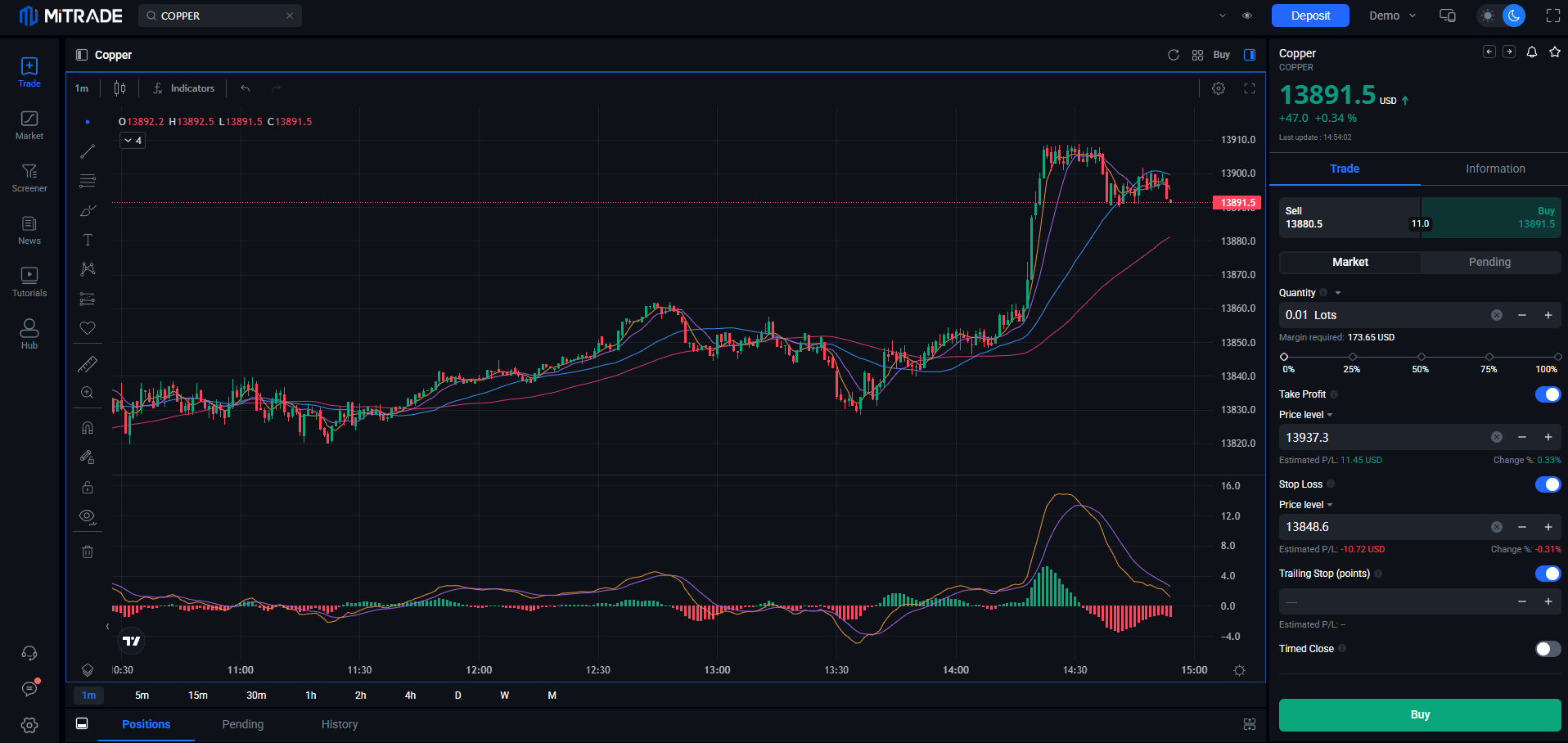
1. Trade Rising and Falling Copper Prices:Copper markets can move in both directions.
With Copper CFDs, traders can:
Open a buy position if they expect copper prices to rise.
Open a sell position if they expect copper prices to fall.
This allows traders to respond to different market conditions, including economic slowdowns, supply disruptions or commodity rallies.
2. Access Copper Trading with Lower Capital:Unlike physical copper investment or traditional futures contracts, CFDs allow traders to gain exposure to copper price movements without purchasing the underlying commodity.
Benefits include:
Lower initial capital requirements
Flexible position sizes
Easier portfolio diversification
3. Use Leverage to Maximise Market Exposure:Mitrade provides leveraged CFD trading, allowing traders to control larger market exposure with a smaller initial deposit.
However, leverage can increase both potential profits and losses. Traders should always apply proper risk management, including:
Stop-loss orders
Position sizing
Risk limits
4. Trade Copper Anytime on Web and Mobile Platforms:Copper prices can react quickly to:
US economic data
China manufacturing reports
Fed interest rate decisions
Mining supply news
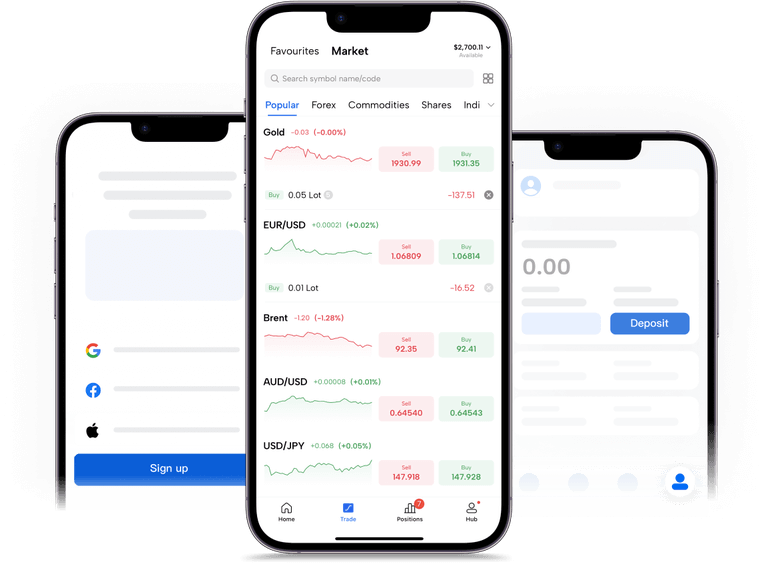
With Mitrade's online trading platform, Australian traders can monitor markets and manage positions conveniently across desktop and mobile devices.
📌 Editor's Pick: Trade Copper CFDs with Mitrade
As AI infrastructure, electrification and supply constraints continue shaping the copper market in 2026, copper remains one of the most exciting commodities to watch.
With Mitrade, Australian traders can access Copper CFDs, trade both rising and falling markets, use advanced charting tools, and manage positions without owning physical copper.


1. How do you trade copper commodities?
You can trade copper through several methods, including copper futures, ETFs, mining stocks and Copper CFDs. For retail traders, Copper CFDs provide a flexible way to speculate on copper price movements without owning the physical metal.
2. Is copper a good investment in 2026?
Copper has strong long-term demand drivers, including AI infrastructure, renewable energy, EV adoption and electricity grid expansion. However, copper prices can be volatile and are affected by economic conditions, interest rates and global demand.
3. What is the best way to trade copper in Australia?
Many Australian traders choose Copper CFDs because they offer:
Flexible trade sizes
Ability to go long or short
No need for physical storage
Access to leverage
Always choose a regulated broker and understand the risks involved before trading.
4. Can beginners trade Copper CFDs?
Yes. Beginners can trade Copper CFDs, but they should first learn:
How commodity markets work
Technical analysis basics
Risk management
How leverage affects trading outcomes
Using a demo account can help beginners practise before trading with real money.
5. Will copper prices continue rising in 2027?
Copper may continue receiving support from electrification, AI infrastructure and limited supply growth. However, price movements will depend on global economic conditions, China demand and whether new mining capacity comes online.
Disclaimer: The content presented above, whether from a third party or not, is considered as general advice only. CFD trading involves significant risk of loss. Past performance does not guarantee future results. This article serves informational purposes only and does not constitute financial advice. Consider your risk tolerance before trading.


