




Understanding the Pros and Cons of Commodities Trading: What CFD Traders Should Know
Trading commodities such as gold, oil, wheat, and soybeans form the bedrock of global trade and industrial development. Traditionally, access to these markets has been dominated by large financial institutions due to high capital requirements and complex infrastructure.
However, with the advent of Contract for Difference (CFD), a wider range of participants can now gain exposure to these markets without owning physical assets.
Before considering commodities trading, it's important for new traders to weigh both the potential advantages and the associated challenges.
Why Commodities trading Captures Attention
Commodities trading operates on different principles compared to equities or bonds. Instead of reacting to corporate earnings or monetary policy alone, commodity prices are driven by tangible factors like supply constraints, geopolitical developments, and natural conditions such as droughts or hurricanes.
For example, trade gold may rise in value during periods of financial uncertainty due to its traditional role as a value preservation asset. Oil prices are sensitive to geopolitical tensions and production quotas, while agricultural commodities are influenced by seasonal cycles, weather disruptions, and global demand trends. These distinct drivers can offer trading commodities opportunities that market participants can find easier to interpret.
Pros of Trading commodities via CFDs
1. Reduced Entry Barriers for Commodities trading
Traditional commodity futures contracts often require a significant margin. For instance, trade gold on COMEX may demand an initial margin in excess of $3,313.70 ( gold futures contract for June 2025).
By contrast, CFDs provide a leveraged way to access the same underlying price movements with significantly lower capital outlay. This means individual traders can trade commodities online in markets that were once financially out of reach, though this also introduces increased risk exposure.
2. Flexibility in trading commodities
CFDs enable traders to speculate on both rising (long) and falling (short) prices without owning the underlying asset. This dual-direction flexibility is particularly useful in commodities trading, where prices can be cyclical or reactive to sudden events.
For example, advancements in extraction technology may lead to sustained price declines in certain energy commodities. CFDs allow traders to engage with these movements regardless of the broader market trend on commodities trading platforms.
3. No Physical Settlement When Trading commodities
One logistical challenge in traditional commodity markets is the possibility of physical settlement. Futures contracts, if held to expiration, may require delivery of actual commodities, such as barrels of oil or tons of wheat—clearly impractical for most individuals.
CFDs avoid this altogether. As purely derivative instruments, they are settled in cash, meaning online trading commodities are concerned solely with price changes, not storage or transportation.
Challenges of Commodities trading with CFDs
1. Leverage Risks When Trading commodities
While leverage lowers the barrier to entry, it also increases potential losses. Even small price fluctuations in volatile commodities like natural gas or gold trade can significantly impact a trader's capital if positions are not appropriately sized.
For instance, natural gas futures can experience daily price movements exceeding 5%, and similar volatility can be seen in spot trade gold during macroeconomic uncertainty. As a result, risk management is critical when trading commodities.
2. Financing Costs for Online trading commodities with CFDs
Unlike futures contracts with set expiry dates, CFDs incur overnight financing charges. These fees accumulate daily and may impact trading results if positions are held for extended periods. Therefore, trade commodities strategies are more suitable for short-to-medium-term approaches unless the expected price movement significantly outweighs the cost of carry.
3. Market Dynamics on CFDs Commodities trading platforms
Retail CFD traders generally do not influence market direction. In contrast, large institutional players—such as commodity producers, hedge funds, or multinational corporations—can impact price flows and may have access to deeper data sources or hedging tools.
Retail participants must therefore rely heavily on careful analysis and execution on their commodities trading platform, often reacting rather than setting market trends.
Popular Markets for Trading commodities
1. Gold: Understanding the Market
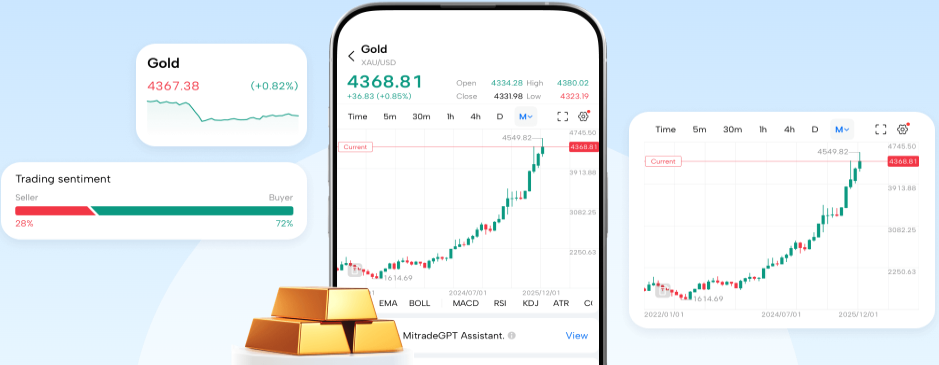
Gold trade remains a widely traded commodity among CFD users, valued for its liquidity and diverse role in financial markets. It often responds to global inflation data, interest rate expectations, and currency fluctuations—particularly movements in the US dollar.
Additionally, trade gold activity continues around the clock, making it appealing for traders in various time zones who use online trading commodities platforms.
2. Energy Markets on Commodities trading platform
Crude oil and natural gas attract attention due to their inherent volatility and sensitivity to economic and geopolitical developments. Price movements can be driven by OPEC+ decisions, inventory levels, or changes in global demand forecasts.
This volatility creates both risk and opportunity, requiring disciplined risk controls and awareness of relevant market events when you trade commodities online.
3. Agricultural Products: Trade commodities online
Wheat, soybeans, and corn offer seasonal trading opportunities due to factors like planting cycles, weather anomalies, and changing global trade policies. However, these markets may be less familiar with CFD trading for beginners and require a deeper understanding of agricultural economics.
Key Considerations for New Commodities trading Participants
For those new to trade commodities, starting with a demo account can provide useful practice in a risk-free environment. It is also essential to gain specific knowledge about each commodity's unique characteristics on your chosen commodities trading platform. For instance, gold trade may follow technical patterns more accurately than agricultural commodities influenced by weather reports and trade policies.
Risk management remains a central pillar of CFD trading for beginners. This includes setting stop-loss levels, using appropriate position sizes, and understanding the total exposure associated with each trade. Theoretical knowledge combined with practical discipline may assist traders in navigating online trading commodities markets.
To explore how to trade commodities with appropriate tools and educational resources, consider opening an account with Mitrade EU Ltd., where you can access major commodity markets with competitive spreads and comprehensive risk management features.
Disclaimer: The content presented above, whether from a third party or not, is considered as general advice only. CFD trading involves significant risk of loss. Past performance does not guarantee future results. This article serves informational purposes only and does not constitute financial advice. Consider your risk tolerance before trading.


