




Mastering Scalping Trading for Beginners

How to Start Scalping Trading on Mitrade
* CFD trading involves risk and may not be suitable for all investors.
The phrase “money never sleeps” is quite real. With the arrival of electronic brokerage, cryptocurrencies, and tokenized assets, speculators can now trade financial instruments 24/7.
In this fast-paced world, scalping trading has emerged as a method to take advantage of low-timeframe price moves that aim to capture small profits that could add up to impressive results once the session is over.
Scalpers, as practitioners of this discipline are commonly known, are disciplined and highly focused. They time their entries and exits surgically and learn to manage their risks and handle the pressure of operating in a hostile environment.
Beginners can succeed in this endeavor as well by understanding the basics of scalping and practicing both the psychological and technical aspects of this discipline.
In this article, we dive into the topic of scalping trading from multiple perspectives. The article aims to provide our readers with an overview of how this technique works, suggesting a couple of basic systems they can start with, and the most effective risk management strategies they can implement to succeed.
How Scalping Works in Practice
Scalping consists of taking advantage of small price moves in lower time frames like the 15-minute and 1-minute. Volatility tends to be higher in such short periods, allowing traders to enter and exit winning trades in a few minutes.
In theory, the goal of scalping is to make small profits that add up to high amounts and attractive returns over a period of 24 hours.
A scalper could place somewhere between 10 and 30 trades per day if these are placed and managed manually. Meanwhile, high-frequency traders (HFTs) and algo traders may execute a much higher volume, exceeding 100 trades per day.
That said, although quantity is important, quality is paramount. A high volume of bad trades could easily burn a trading account if proper risk management procedures are not enforced.
Before discussing the specific strategies that a scalper may follow, these are factors that these traders focus on to choose how they will operate:
Liquidity: Scalpers tend to trade only high-volume assets like major forex pairs and specific commodities like gold, as these offer sufficient market depth to prevent volatile reversals.
Trading Costs: Transaction costs have a significant impact on scalping returns as profits are small relative to the size of each trade while leverage increases the cost per trade if fees are estimated as a percentage of the trade’s size. Predicting these costs is critical to determine the optimal exit for winning trades and to set stop orders at the appropriate level.
Timeframes: Scalpers often create multi-timeframe strategies to get confirmation of a specific price move. The market is known for moving in fractals, meaning that high-timeframe moves tend to confirm the price action in lower timeframes or vice versa.
How to Choose the Best Broker for Scalping?
Scalpers should aim to work with a broker that offers predictable and affordable trading fees, reliable quotes, fast transaction execution speeds, and low slippage.
Here’s why each of these factors is important:
Execution Speed: Prices move fast in low time frames, and even a few pips can make a difference between a 2:1 trade and a break-even trade. The broker’s ability to execute trades instantly with minimal slippage allows scalpers to increase their returns over time.
Low Slippage: Slippage refers to the difference between the price at which the trade should have executed and the actual one. In scalping, slippage could dramatically impact the trade’s results and returns. Hence, brokers that offer low or controlled slippage tend to be the best choice for scalpers.
Level 2 Data: In-depth market data can provide an extra layer of confirmation for scalpers before placing a trade. This includes a visual of where buyers and sellers are stacking up the bulk of their orders. It can be a great tool to identify and confirm key support and resistance levels
Two Beginner-Friendly Scalping Strategies
Developing a strategy to successfully scalp trading assets, operators focus on reliable setups with high win rates that offer decent risk-reward ratios.
In contrast with swing trading, which commonly aims for high returns realized over long periods, scalpers focus on taking small profits as frequently as possible. Hence, the higher the number of transactions, the higher the strategy’s returns will be.
These are two commonly used strategies that rely on technical indicators and specific price action patterns to execute trades.
Strategy A: The Moving-Average Pullback (Trend Scalp)
Trend lines are among the most frequently used technical indicators. They use historical data to spot changes in the direction of the current price trend.
The Setup: This strategy involves the use of fast EMAs (like the 9-minute and 21-minute EMAs) on a 1-minute chart during a strong trend.
Execution: Waiting for a minor pullback toward the 9-minute EMA for an optimal entry.
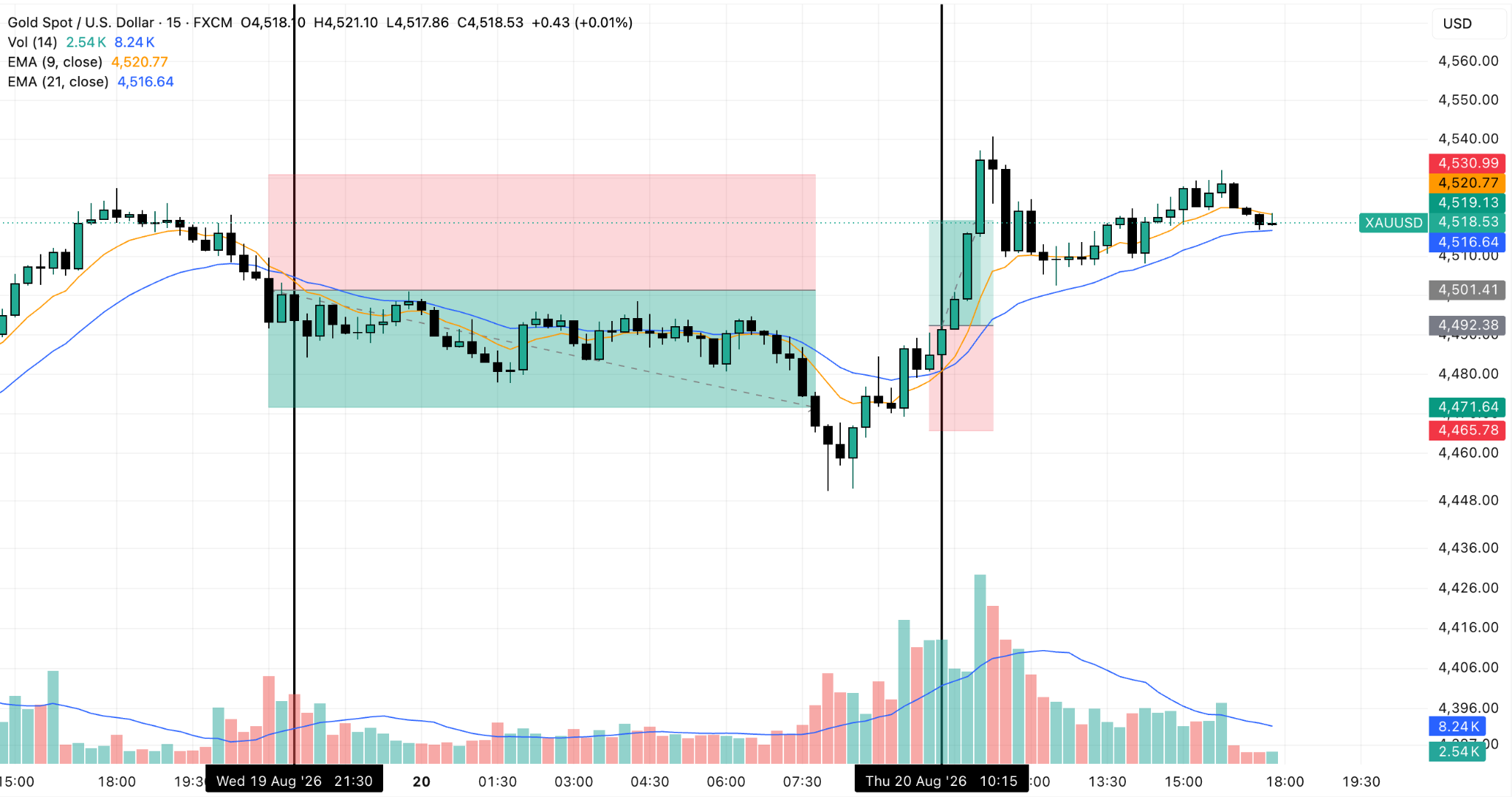
In the example above, this signal triggered twice. The win rate in this small sample was 100%. However, the risk-reward ratio was just 1x. This is the typical scalping setup – high win rate, small profits.
For this system to work, the win rate must be higher than 60%, and the risk-reward ratio must be 1x or higher. However, the impact of trading fees must be considered to determine if the strategy is profitable or not.
A mathematical analysis of this strategy would be as follows:
Let’s say a $10,000 account risks $100 per trade (1%). If this signal triggers 10 times during a given session, there will be an average of 6 winning trades and 4 losing ones.
This results in $600 in gains and $400 in losses. Let’s say that trading fees add up to $100 per day.
This results in $100 in net gains per day, which means a 1% daily return. This is not necessarily a reflection of the true performance of this strategy, but it is a good hypothetical example of how it works in practice.
Strategy B: Bollinger Bands (Mean Reversion)
Bollinger Bands are a technical indicator created by John Bollinger that tracks the market’s upward and downward volatility based on the latest price action by using moving averages.
In theory, when the price of the asset hits the upper Bollinger band, it is due for a pullback. Meanwhile, when the price hits the lower Bollinger band, the price is due to bounce off this level.
Scalpers can use Bollinger bands to identify optimal entries for both long and short positions.
The Setup: Using Bollinger Bands to identify dynamic support or resistance levels.
Execution: Opening a long position near the lower Bollinger band in an uptrend or shorting after the price hits the upper Bollinger band during a downtrend.
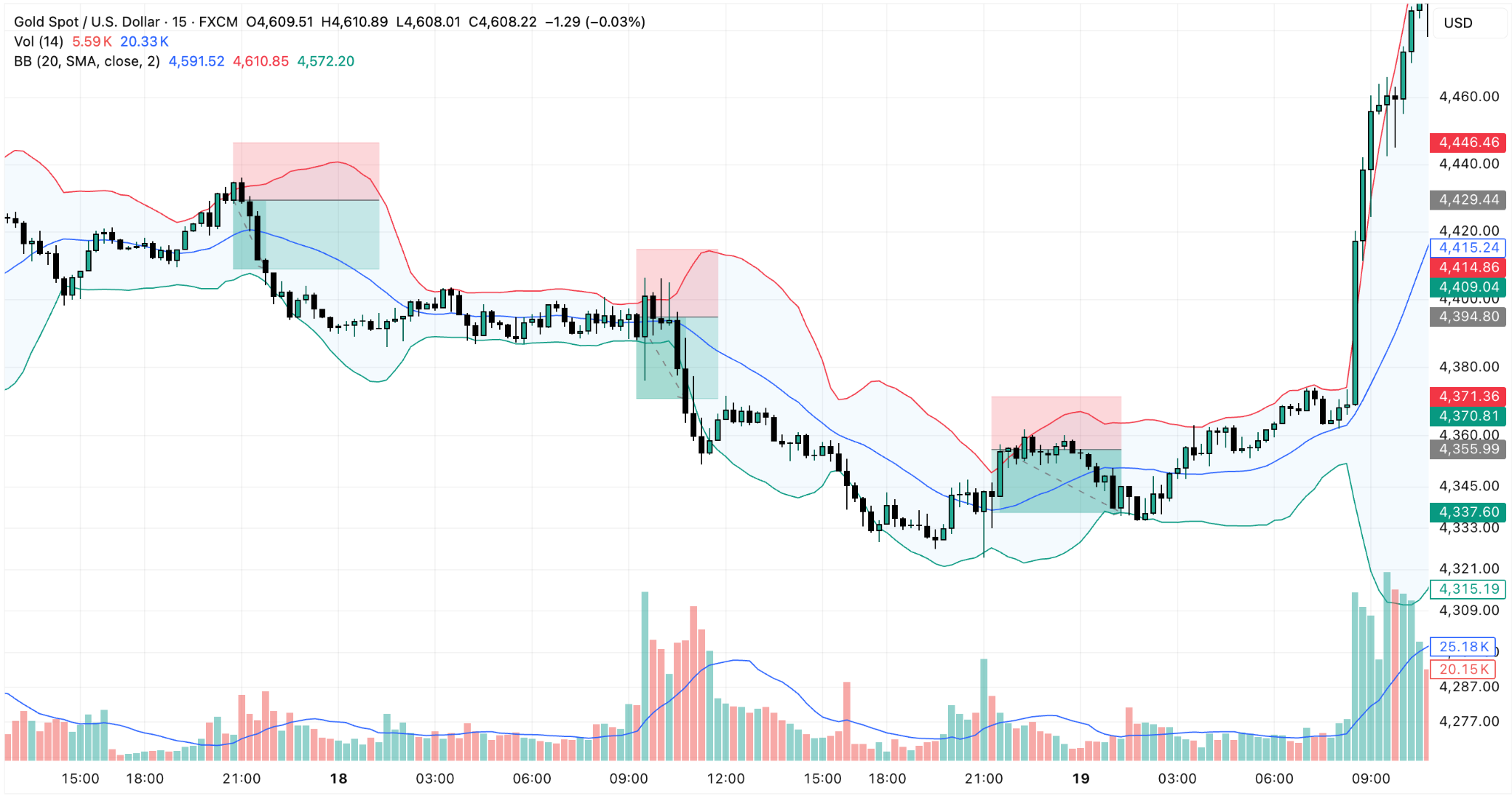
In the example above, this particular signal triggered three times. The win rate for these three trades was 100%, although the last one barely made it. The risk-reward ratio was 1.2x. This is, in theory, a better strategy than the first one – high win rate, higher profits.
For this system to work, the win rate must be at least 60% with a 1.2x risk-reward ratio. Still, the impact of trading fees must be considered to determine if the strategy is profitable or not.
A mathematical analysis of this strategy would be as follows:
Let’s say a $10,000 account risks $100 per trade (1%). If this signal triggers 10 times during a given session, there will be an average of 6 winning trades and 4 losing ones.
This results in $720 in gains and $400 in losses. Let’s say that trading fees add up to $100 per day.
This results in $220 in net gains per day, which means a 2.2% daily return.
Open a Scalping Trading Account
“Trade gold CFDs with an ASIC-regulated broker. Fast AUD funding via PayID. ”
The Golden Rules of Scalping Risk Management
Apart from a winning system that features a high win rate and a decent risk-reward ratio per trade, there are several other risk management procedures that need to be implemented to limit the impact of a long streak of losses.
In addition, these safeguards prevent traders from panicking after a series of losses and other psychological traps like overtrading and skipping the system’s rules to play catch-up.
Position Sizing: This refers to the maximum percentage of an account’s total balance that the trader risks for every transaction.
This allows the trader to prevent big drawdowns resulting from emotional trades and reduces the psychological toll that big trades tend to take. It also prevents them from burning the account with just a couple of bad trades. In general, scalpers may allocate anywhere from 0.25% to 1% of their total capital on each trade.
The Dangers of Overtrading: Taking too many emotional trades or trying to play catch-up after a long streak of bad trades can result in overtrading. One way to keep that in check is to limit the number of losing transactions permitted per day. If the trader loses 5 trades in a row, this should trigger a forced stop.
Strict Daily Loss Limits: Knowing when to walk away after a hard stop is critical to prevent high losses. This limit could be set as a percentage of the account (3% maximum daily loss) or a maximum amount of money lost per day.
Avoiding Hidden Traps: Low Volume or News-Heavy Sessions
Scalpers in general should avoid two things:
Low-Volume Sessions or Instruments: These can be more easily manipulated by deep-pocketed participants. Stop-hunting and liquidity traps are common in these scenarios, and they can result in consistent losses for traders despite their commitment to operate within the boundaries of their systems.
News-Heavy Sessions: During sessions where certain economic data is expected to be released or earnings reports from certain companies, scalpers should abstain from placing trades, as these events can drive significant spikes in the price of the asset, and the direction of such movement is too hard, if not impossible, to predict.
Is Scalping the Right Approach for You?
Scalping is definitely not for everyone. To succeed with this method, traders must be highly disciplined, stick to their system, and implement appropriate risk management procedures that limit their losses when the outcome doesn’t turn out as expected.
However, if a system is good enough, it can turn small starting balances into sizable accounts due to the frequency with which trades are made.
Beginners should first test their strategies on demo accounts to analyze their win rate and try out different parameters for risk-reward ratios and position sizing.

 Enjoy simple and fast trading Flexible leverage options available Follow real-time trading strategies Demo account with $50,000 virtual funds

You might be interested in…
1. What is the primary goal of scalping trading?
Scalping aims to capture small price movements across lower timeframes to accumulate high returns over a trading session.
2. Why must scalpers carefully factor in transaction costs?
Since profit margins in scalping are small relative to trade size, accumulated spreads and commissions can quickly erode net gains.
3. What is the purpose of setting a strict daily loss limit?
It acts as a safeguard to prevent emotional overtrading and stop heavy drawdowns after a streak of bad trades.
Disclaimer: The content presented above, whether from a third party or not, is considered as general advice only. CFD trading involves significant risk of loss. Past performance does not guarantee future results. This article serves informational purposes only and does not constitute financial advice. Consider your risk tolerance before trading.


