




CoreWeave Is Down 40% This Year. Is This a Once-in-a-Lifetime Buying Opportunity?
Key Points
CoreWeave’s revenue is growing fast, but net losses are widening.
The company’s debt is massive, and it has grown faster than its backlog since going public.
However, demand for CoreWeave’s business should persist, and its current valuation appears reasonable.
- 10 stocks we like better than CoreWeave ›
The artificial intelligence (AI) revolution is in full swing. Yet, some notable companies in the industry aren't convincing investors. One of them is CoreWeave (NASDAQ:CRWV), a corporation that offers cloud-based AI compute capacity through a network of data centers. CoreWeave went public last year in what was a successful IPO. However, the company's shares have dropped 40% this year and are now near the IPO price of $40. Is this an amazing buying opportunity for patient investors focused on the long game?

Image source: The Motley Fool.
Missed AI’s "Act 1"? Act 2 Could Be 15x Bigger. Most investors think they missed the AI boat because they didn't buy Nvidia in 2005. But according to our analysts, we’re only at the end of "Act 1"—the R&D phase. "Act 2" is the global rollout. Continue »
Looking at the financial results
CoreWeave isn't a particularly big player in the vast cloud computing market. However, demand for the company's services has been soaring. Since it specializes in providing the computing infrastructure needed to train, deploy, and run AI models, and companies are racing to do just that, CoreWeave's business is booming, and that's being reflected in its financial results.
In the third quarter, the company's revenue increased by 168% year over year to $3.7 billion. CoreWeave's year-over-year revenue growth had been slowing sequentially since the tech company went public, before reaccelerating sharply this quarter.
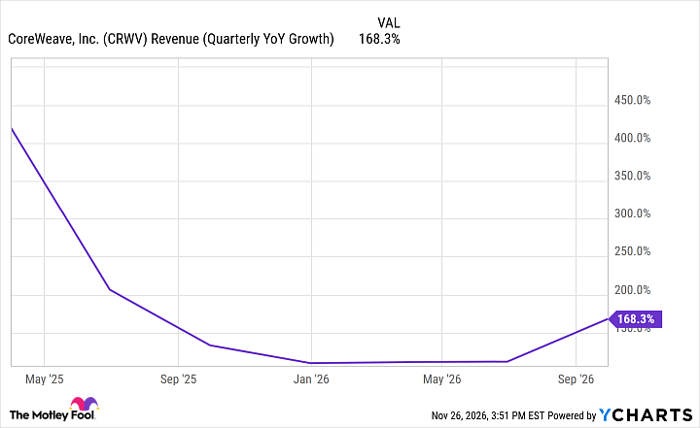
CRWV Revenue (Quarterly YoY Growth) data by YCharts
That's a great sign for the business. Meanwhile, the company's operating income of $207 million was much higher than the $52 million reported in the year-ago period. However, CoreWeave is spending quite a bit of money to build the infrastructure necessary to support the demand for its services, and then some. That's why the net loss widened during the third quarter, coming in at $709 million -- or $1.27 per share -- versus the net loss of $110 million ($0.22 per share) reported in the prior-year quarter.
Is the spending justified?
CoreWeave also announced that it is raising its capital expenditure guidance for the fiscal year 2026. It now expects it to come in between $37 billion and $39 billion, compared to its previous range of $35 billion to $39 billion. CoreWeave is incurring significant debt to fund its ambitions. It has secured more than $30 billion in debt and equity capital this year.
It currently has about $66.2 billion in debt (including leases, as of the end of the third quarter), which seems like a lot for a company worth $23.67 billion. True, CoreWeave continues to see sustained demand for its services, and this demand may persist for a while. Michael Intrator, CoreWeave's CEO, said demand for infrastructure is outpacing the capacity to deliver it.
That's why CoreWeave is largely sold out through 2027. We can also see this through the company's revenue backlog, which hit $132.5 billion as of the end of the third quarter, representing a 138% year-over-year increase. Now for the interesting part. CoreWeave's debt has ballooned about 457% since the first quarter of 2025, its first update as a public company.
Over the same period, CoreWeave's revenue backlog has grown about 412% -- not as fast as the debt, but the difference isn't huge either. This comparison is meaningful, but it may hide some important details. For instance, CoreWeave is demonstrating meaningful pricing power, having increased its prices across the board this year for various generations of GPUs (graphics processing units).
The company estimates that more than 130,000 GPUs will come off contract next year, with about 170,000 more doing so in 2028. Renewing contracts at current market prices could mean even higher revenue for the company without having to dish out billions to expand its capacity. That means higher margins as well.
That's just one of the dynamics that could lift CoreWeave's revenue and profits over the medium term, but that assumes that the AI tailwind persists. The company also faces a meaningful risk due to significant customer concentration, with just one of its clients accounting for more than 60% of its revenue in fiscal year 2025.
The market has adjusted for these risks, at least somewhat. CoreWeave's current price-to-sales ratio is 2.6, down from 15 in September 2025. That seems like a fair price to me, given CoreWeave's expanding revenue and backlog. Even with rising debt and customer concentration, the stock looks attractive at current levels, though I wouldn't call it a once-in-a-lifetime opportunity.
Should you buy stock in CoreWeave right now?
Before you buy stock in CoreWeave, consider this:
The Motley Fool Stock Advisor analyst team just identified what they believe are the 10 best stocks for investors to buy now… and CoreWeave wasn’t one of them. The 10 stocks that made the cut could produce monster returns in the coming years.
Consider when Netflix made this list on December 17, 2004... if you invested $1,000 at the time of our recommendation, you’d have $328,591!* Or when Nvidia made this list on April 15, 2005... if you invested $1,000 at the time of our recommendation, you’d have $924,693!*
Now, it’s worth noting Stock Advisor’s total average return is 791% — a market-crushing outperformance compared to 201% for the S&P 500. Don't miss the latest top 10 list, available with Stock Advisor, and join an investing community built by individual investors for individual investors.
See the 10 stocks »
*Stock Advisor returns as of November 28, 2026.
Prosper Junior Bakiny has no position in any of the stocks mentioned. The Motley Fool has no position in any of the stocks mentioned. The Motley Fool has a disclosure policy.
Recommended Articles


