




Intuit Slides Toward $279.66 After Cutting Its Credit Karma Outlook and Selling Mailchimp
TradingKey - Intuit (NASDAQ: INTU) closed at $310.02 on Thursday, November 19, down 1.03%, before reporting fiscal first-quarter results after the bell. The stock then fell sharply in extended trading, and overnight quotes show it at $279.96, about 9.7% below the close.
The quarter itself beat expectations. What hurt the stock was everything around it: a weaker second-quarter outlook, a lower full-year revenue forecast caused by Credit Karma, and the sale of Mailchimp for about $3.68 billion, roughly a third of what Intuit paid for it. The stock had already lost about 55% from its 52-week high of $682.27 before the report, as investors worried that AI tools could replace parts of its business.
A Beat Above the Top of Guidance
Revenue rose 12% to $4.35 billion, ahead of expectations, and CEO Sasan Goodarzi said revenue, operating income and EPS all came in "above the top end of our guidance." Non-GAAP EPS, which excludes items such as acquisition costs, rose 56% to $2.91, against a FactSet estimate of $2.46, according to Finimize. GAAP EPS rose 63% to $2.59.
Those growth rates need a caveat. Starting this quarter, Intuit's non-GAAP figures include stock-based compensation, the cost of paying staff in shares, and earlier periods were restated to match. That change makes comparisons with older analyst estimates tricky, which is why EPS forecasts from different data providers vary so widely.
The small-business side drove the quarter. Global Business Solutions revenue rose 15% to $3.1 billion, with the Online Ecosystem up 20%, QuickBooks Online Accounting up 19% and Online Services up 21%. Revenue from QuickBooks Online Advanced and Intuit Enterprise Suite, products aimed at larger customers, grew 41%, and mid-market customers grew 30%.
Credit Karma Is Where the Outlook Broke
The consumer side looked very different. Consumer revenue rose 7% to $958 million, with Credit Karma up 9% to $708 million, TurboTax up 1% in its off-season quarter and Mailchimp down 1%.
Intuit cut its fiscal 2027 Credit Karma forecast to $2.72 billion to $2.83 billion, growth of 3% to 7%, from $2.92 billion to $2.97 billion, or 11% to 13%, in August. That trimmed about $173 million from the midpoint, by my calculation, and the full-year revenue outlook fell by the same amount, to $23.08 billion to $23.37 billion, up 8% to 9%. That is below the $23.43 billion consensus, according to BigGo Finance.
Intuit's own fact sheet shows how quickly Credit Karma has slowed. Its growth was 27% in the same quarter a year ago and 9% this quarter, while the guidance column on the right shows the new full-year range of 3% to 7%.

Source: Intuit Q1 FY27 Fact Sheet, November 19, 2026 (investors.intuit.com)
CFO Sandeep Aujla blamed higher-than-expected interest rates and a faster-than-expected shift toward AI-powered product discovery. Goodarzi said search engines had historically brought in less than 1% of Credit Karma's traffic, but more consumers now use large language models, the technology behind AI chatbots, to find financial products. Intuit says it is working to make Credit Karma more visible on those platforms, and QuickBooks, TurboTax and Credit Karma are already available through AI assistants such as ChatGPT and Claude.
The second quarter adds to the pressure. Intuit guided revenue to $4.93 billion to $4.95 billion, up 6% to 7%, about 3.3% below the $5.11 billion consensus at the midpoint. It expects consumer revenue to fall by a mid-single-digit percentage, partly because lower-priced tax offerings will weigh more early in the season and about $30 million of revenue will shift into the third quarter.
Mailchimp Goes for a Third of Its Price
Intuit agreed to sell Mailchimp, the email marketing platform, to Bending Spoons, the Milan-based owner of Evernote, for about $3.68 billion, made up of $3.31 billion in cash and $368 million in Bending Spoons stock. Intuit paid about $12 billion for it roughly five years ago, so the sale price is only about 31% of that.
Goodarzi said the sale will sharpen Intuit's focus on AI-native QuickBooks tools, and Aujla said Intuit intends "to use the entirety of the cash proceeds from the sale to do buybacks in fiscal 2027" once the deal closes, expected in early 2027. Current guidance excludes the sale.
The Earnings Outlook Held
Notice what did not change, though. Intuit kept its full-year EPS guidance at $22.88 to $23.12 on a non-GAAP basis and $20.12 to $20.36 on a GAAP basis, raised its quarterly dividend 15% to $1.38 and bought back $1.5 billion of stock in the quarter, up 73%, with $6.4 billion left under its program. None of that stopped the selloff, which shows how much the market now worries about revenue growth rather than near-term profit.
At the overnight price of $279.96, Intuit trades at about 12.2 times the midpoint of its non-GAAP EPS guidance. That is low for a software company still growing 8% to 9%, but with the new stock-pay treatment it is not directly comparable with older Intuit valuations.
Intuit Technical Analysis: Daily Close Below $279.66 Could Open $260.72
The daily chart was already weak before the report. Intuit failed near $341.23 earlier this month and slipped below both moving averages, which track the average price over recent sessions, at $326.21 and $330.46. If the overnight gap holds, the stock would also break the $301.24 pivot, the 61.8% Fibonacci retracement, a common pullback level, that has held since mid-October, along with $289.64 support.
RSI, a momentum gauge that runs from 0 to 100, has dropped to about 39. The MACD, another momentum indicator, has crossed lower, so momentum now favors sellers.
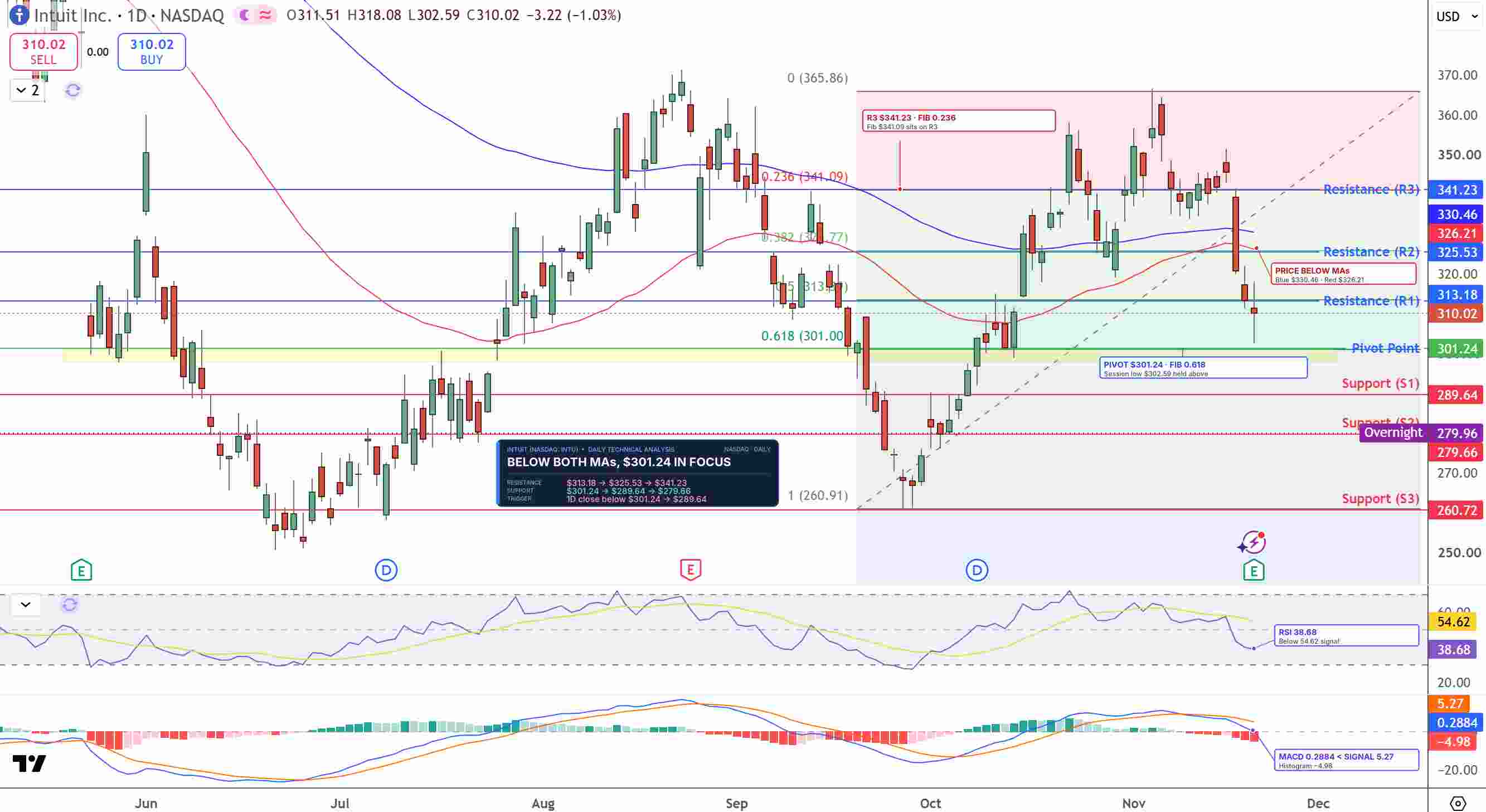
INTU Price Chart - Source: Tradingview
The overnight price is testing $279.66 support. A daily close below it could send Intuit toward $260.72, not far above the 52-week low of $252.84, which would leave little support between the current price and the year's bottom. For buyers, a daily close back above $301.24 would be needed to ease the pressure.
I'm bearish while Intuit stays below $301.24, with $279.66 as the key test.
Key Levels
- Last close: $310.02, down 1.03% on Thursday, November 19 (overnight: $279.96)
- Support: $279.66, $260.72
- Resistance: $289.64, $301.24, $326.21, $330.46
- RSI: 38.68
- Bullish trigger: Daily close above $301.24
- Bearish trigger: Daily close below $279.66
FAQs
Why is Intuit stock falling after earnings?
Intuit beat first-quarter estimates, but it cut its full-year revenue outlook to $23.08 billion to $23.37 billion after lowering Credit Karma growth to 3% to 7%, guided second-quarter revenue below consensus and agreed to sell Mailchimp for about $3.68 billion, roughly a third of what it paid.
What is the Intuit stock forecast now?
The bias is bearish while INTU stays below $301.24. A daily close below $279.66 could send the stock toward $260.72, while a daily close back above $301.24 would ease the pressure.
Bottom Line
Intuit's small-business software is still growing about 20%, but the Credit Karma cut tied to AI-driven discovery and a weak second-quarter outlook overshadowed the beat. The level that matters is $279.66. In my view, a daily close below it would open the way toward $260.72, while only a recovery above $301.24 would show the selloff has run its course.
Recommended Articles


