




XRP below $1.00: Do legal clarity, payment utility, and ETFs still matter in a risk-off market?
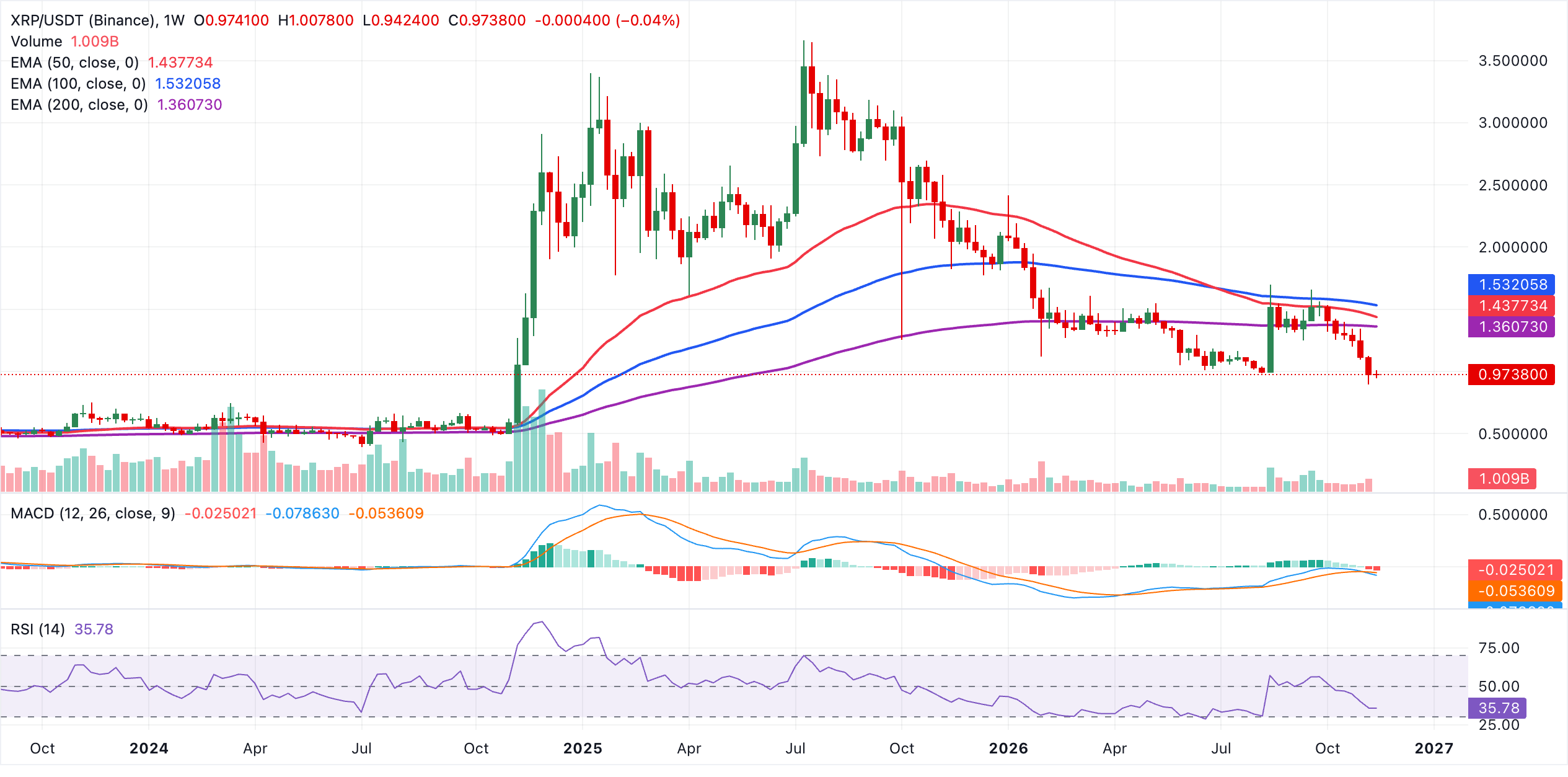
Ripple (XRP) trades near $0.97 on Friday, up less than 1% on the day but still within its six-week slide to levels last seen in November 2024. Hovering roughly 73% from its record high of $3.66, reached in July 2025, XRP has plunged harder than most major cryptocurrencies, even though it boasts a commendable winning combination: regulatory clarity in the United States (US), a rapidly expanding Ripple Payments network, institutional-grade stablecoin RLUSD, strategic acquisitions and partnerships, as well as the launch of XRP spot Exchange-Traded Funds (ETFs) in November 2025.
For investors who bought at the peak, losses are brutal. Yet the paradox remains undeniable: solid fundamentals, spot ETFs, legal clarity, the Securities and Exchange Commission (SEC) settlement, and expanding global utility via Ripple Payments infrastructure. So why is the price collapsing?
The answer might be simple, but it's hard to grasp. Macro liquidity beats fundamentals almost all the time. As capital exits an asset class, regulatory clarity, growing utility and institutional products tend to matter far less.
The macro headwinds and a hawkish Fed
The ongoing XRP crash is not happening in a vacuum, as the broader crypto market is bleeding. A closer look shows a blend of catalysts, starting with the Federal Reserve (Fed) hawkish pivot that continues to drain liquidity from risk assets at an alarming rate.
US inflation data in October poked holes in hopes for monetary easing, even as the Fed left interest rates unchanged in the 3.75-4.00% range. The Consumer Price Index (CPI) rose 0.4% MoM in October, beating market expectations of 0.3%. Core CPI, excluding the volatile food and energy prices, rose 0.3% versus expectations of 0.2%. Moreover, the Producer Price Index (PPI) inflation increased 6.5% YoY in October, the highest rate since November 2022.
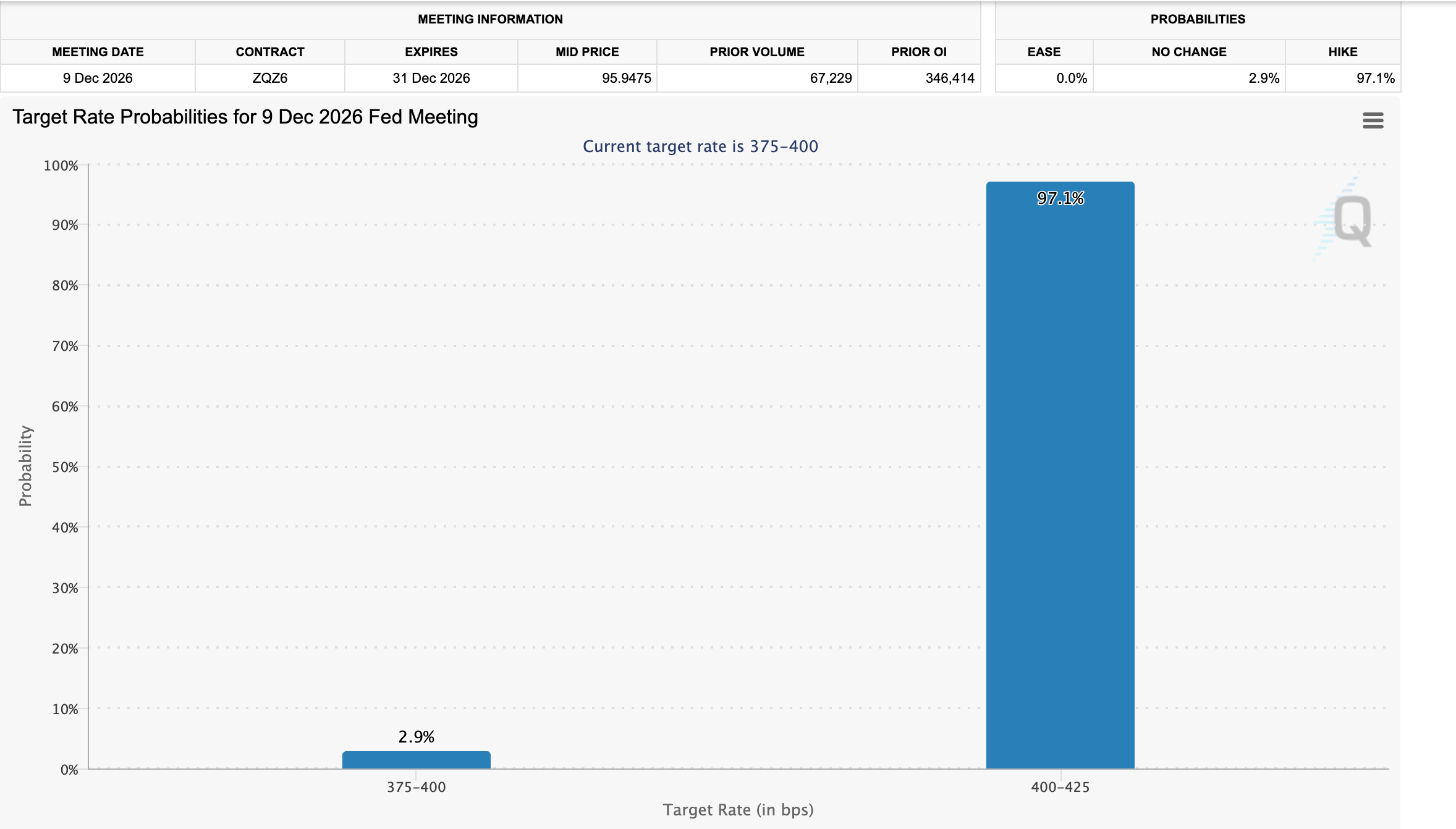
The derivatives market currently assigns roughly 97% odds that the Fed will hike interest rates by 25 basis points to the 4.00-4.25% range at the upcoming December meeting, according to the CME FedWatch tool.
The recent Binance hack, which impacted approximately $6.3 billion in assets, is a notable catalyst behind the persistent risk-averse sentiment. Although Binance covered the entire loss to protect customers using its assets and an internal insurance fund program, the incident remains fresh with investors, and it could take time for normalcy to return.
Capital flight stands out as another catalyst driving risk-off market sentiment. For instance, the 10-year US Treasury yield recently climbed to 5.14%, the highest level since 2007, suggesting traders were repricing interest rate expectations. At the same time, why would investors take on the volatility of crypto assets when they can earn yields over 5% from relatively low-risk Treasury bills?
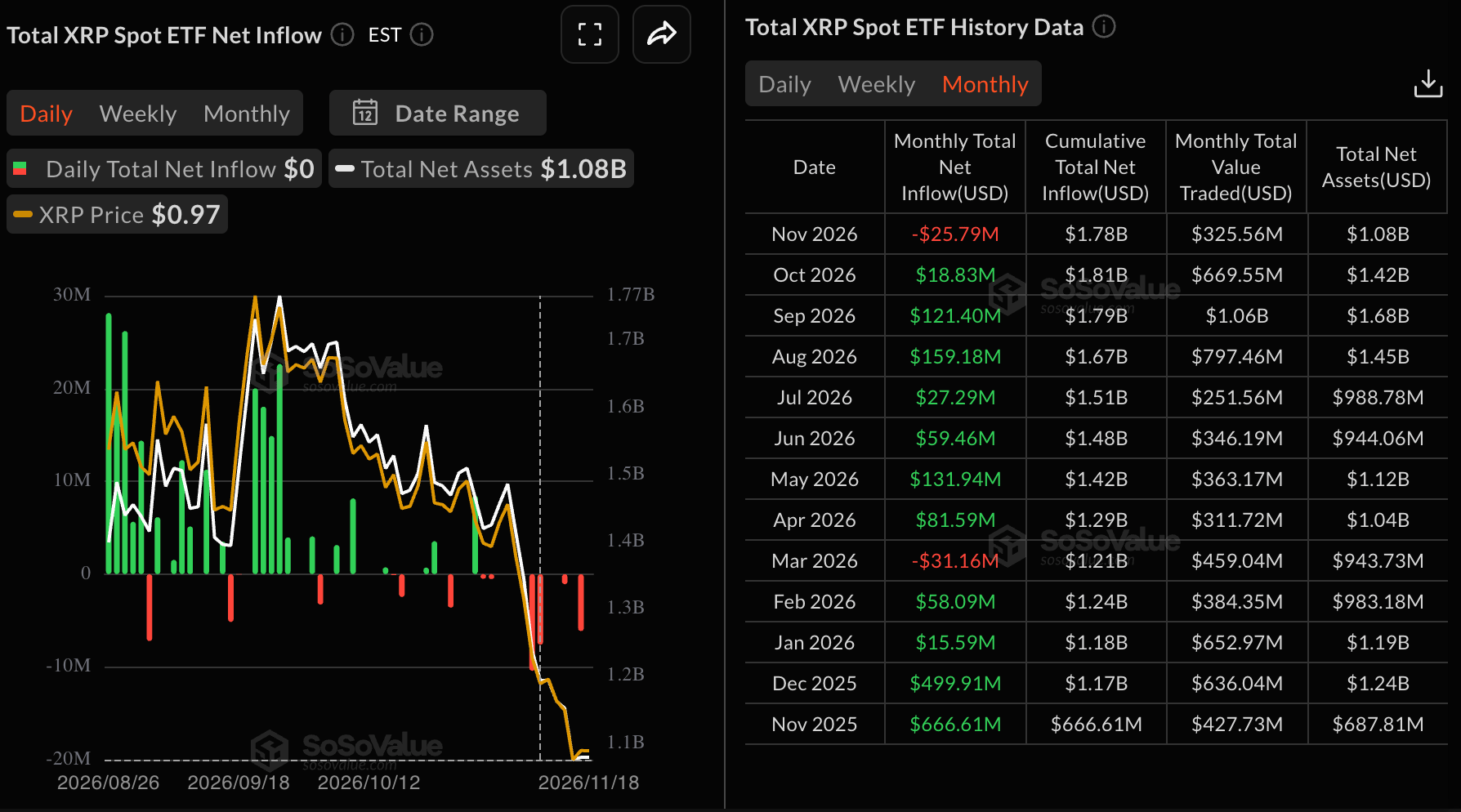
In spot ETFs, the exodus is significantly quantifiable. Bitcoin (BTC) spot ETFs saw $1.07 billion in outflows in the week ending November 13. So far, cumulative outflows in November alone average $2.35 billion. Ethereum (ETH) spot ETFs recorded $399 million in outflows in the same week, with total withdrawals in November standing at $764 million.
XRP spot ETFs, meanwhile, averaged $19 million in outflows through the week ending November 13. So far, cumulative outflows through Wednesday this week sit at $6 million and total $26 million in November, undermining institutional demand.
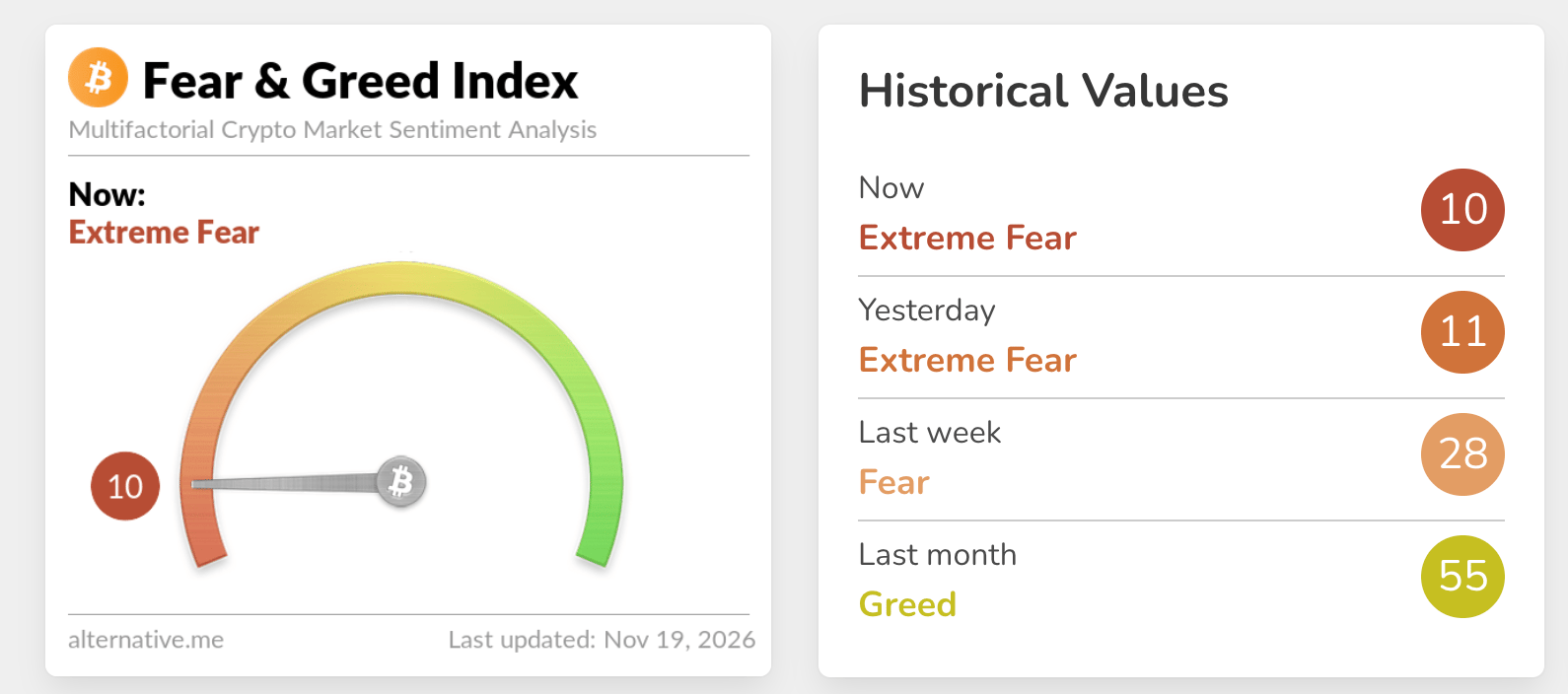
The Fear & Greed Index plunged to 10 in Extreme Fear territory on Thursday, down only marginally from 11 the day before, indicating subdued appetite for crypto assets across the board.
This is the macroeconomic environment XRP is trading in. Still, it has plunged far harder than its peers.
Although all cryptocurrencies were caught in the crosshairs of the November sell-off, XRP stands out as one of the largest losers. It plummeted to $0.89 over the weekend, its lowest level since November 2024, bringing its monthly drop to around 29%. Later, the token staged a mild recovery to highs around $1.00. It has since moderated to $0.97.
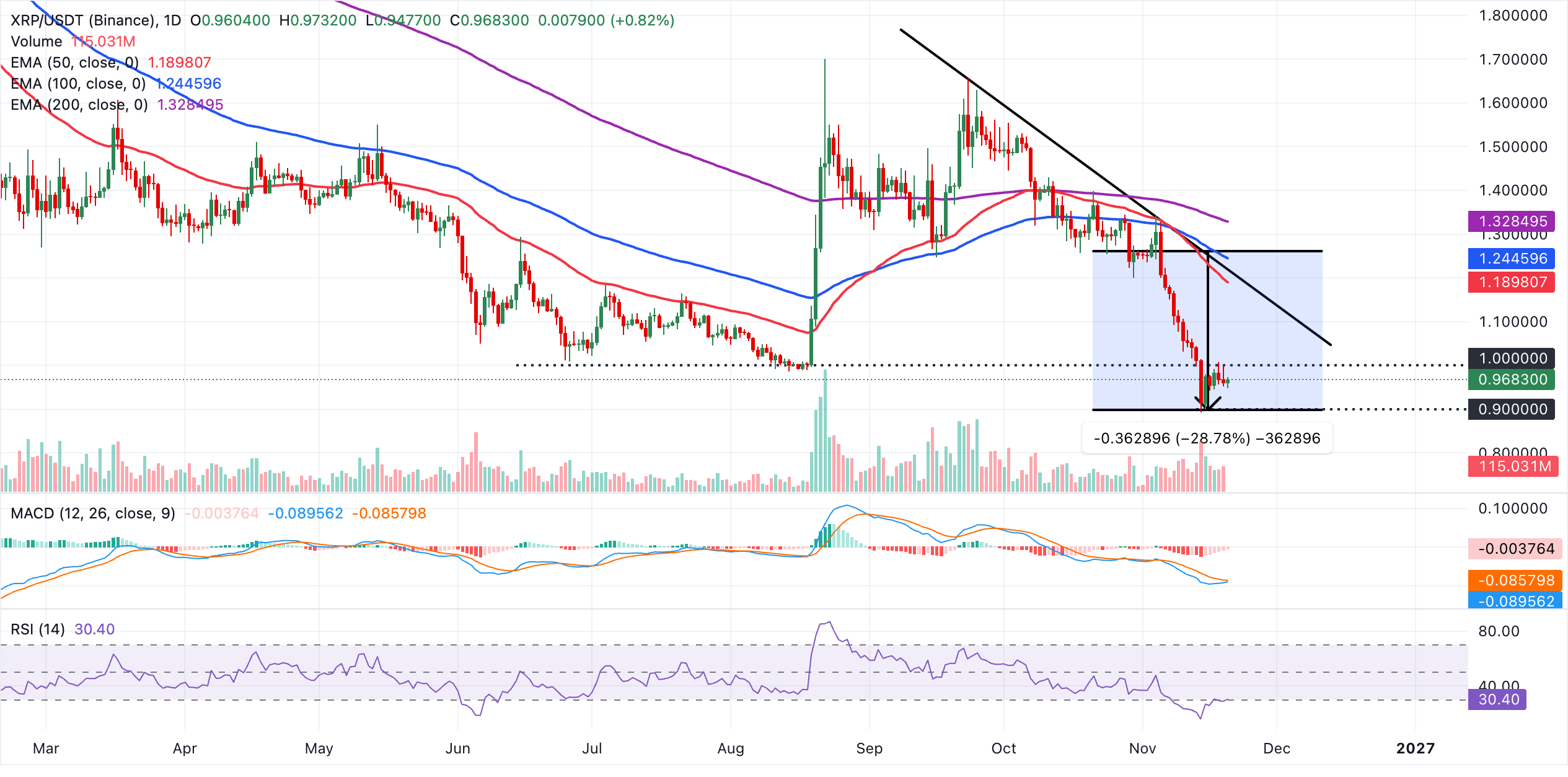
XRP peaked at $3.66 in July 2026 before falling around 73%. A CoinDesk analysis published on October 16 states that “XRP has failed to make holders rich like Bitcoin and Ether.”
Why XRP underperforms ecosystem growth
The XRP ecosystem is fundamentally stronger than ever. However, the token continues to undergo incessant corrections. For many years, Ripple battled the US Securities and Exchange Commission (SEC) lawsuit filed in 2020 and partially won, with XRP sales via third-party platforms like exchanges found not to constitute securities. Ripple then settled with the SEC, paying a $125 million penalty for direct sales to institutional clients in August 2025. Case closed.
In March 2026, the SEC and the Commodity Futures Trading Commission (CFTC) moved to issue a joint interpretation classifying XRP as a “digital commodity,” not a security. This interpretation provided the much-needed regulatory clarity.
In September 2026, regulators approved a rule change for Nasdaq Texas to list XRP commodity trust shares, further confirming the token’s commodity status. Despite securing the regulatory status Ripple fiercely fought for in a multi-year court battle, XRP plunged approximately 60% between January and November.
In context, this implies that regulatory clarity may remove barriers to investment, but it may still not be enough to create steady demand. Institutional exposure and participation are necessary but remain insufficient, especially in a risk-off market where investors are either seeking stability in Treasuries or increasing exposure in the booming Artificial Intelligence (AI) market.
Ripple USD (RLUSD), the regulated, institution-focused stablecoin, officially launched in December 2024, has emerged as a success story for the US-based blockchain company. Valued at $2.8 billion in market capitalization in November, RLUSD is the seventh-largest stablecoin in the market. The token continues to grow even as the larger sector shrinks, up around $102 million over the past week. Ripple’s strategic partnerships have boosted RLUSD adoption, including a partnership with Cross River Bank in October, giving it exposure to thousands of financial institutions. The October partnership with DriveWealth allows RLUSD to support settlements for more than 100 brokerages. Standard Chartered offers institutional custody for RLUSD in Dubai, while Robinhood RLUSD was launched in October on the Robinhood chain and Bitstamp. Moreover, Ripple's strategic investment in Flutterwave in June positioned the network for African-based payment corridors.
Still, RLUSD’s success story does not currently bolster or impact XRP’s outlook. Instead, it is directly linked to Ripple Lab’s revenue, alienating XRP holders. Enterprises are increasingly holding RLUSD without needing XRP. While stablecoin transactions generate fees for the company, they don’t create demand for XRP. This is a strategic investment for Ripple, not a catalyst for XRP.
At the same time, Ripple is becoming a conglomerate in its own right, considering a staggering $2.7 billion in strategic acquisitions. The company’s goal points to a transition into a financial services empire.
Hidden Road, rebranded to Ripple Prime, closed at $1.25 billion in October 2025. Ripple acquired GTreasury, a corporate treasury platform serving more than 1,000 clients and managing at least $13 trillion in yearly transaction volume, for $1 billion in December, according to a CoinDesk report. This is in addition to Rail, a stablecoin platform, which Ripple acquired for $200 million in August 2025.
Like RLUSD, these acquisitions generate revenue for Ripple, and the profits stay with the company, benefiting Ripple Labs and its shareholders.
Assessing payment liquidity
Ripple launched XRP to serve as a bridge currency for cross-border payments. This architecture still functions as designed. The network has continually worked to expand its payment liquidity footprint across global jurisdictions and has entered strategic partnerships with financial institutions and payment processors to demonstrate that its technology works.
However, fundamentally, XRP is largely used as a monetary bridge, not a store of value. For instance, a bank sending a payment from the US Dollar (USD) to the Euro (EUR) using RippleNet will likely hold XRP for three to four seconds during the transaction period. The bank will not accumulate XRP as a reserve currency, since it immediately converts the funds to fiat, avoiding the volatility of holding crypto. In other words, the XRP utility model falls short of building demand or encouraging accumulation, at least from an institutional user standpoint.
As for tokenomics, XRP’s circulating supply has expanded significantly over the years, from roughly 38.7 billion tokens during the 2017-2018 bull market to approximately 63.5 billion tokens currently, according to CoinGecko. This represents a 64% increase in less than eight years, diluting the tokens’ notional value.
More concerning, Ripple Labs still holds approximately 31.1 billion XRP locked in ledger escrow accounts. While Ripple follows a periodic release schedule and sometimes releases far less than the monthly approved batch, the supply overhang creates psychological resistance. Investors are aware more tokens could inflate the current circulating supply.
XRP’s utility doesn't match its peers. Bitcoin stands out as a store of value, the digital Gold, and has earned institutional adoption. Ethereum’s (ETH) liquidity is rooted in its vast smart contract platform, Decentralized Finance (DeFi) ecosystem and non-fungible token (NFT) marketplaces.
Conclusion: Is XRP still worth holding?
I suspect this is one of the key questions haunting XRP holders amid the ongoing sell-off. Should they hold, or cut their losses?
While there’s no one-size-fits-all answer, I will offer a balanced framework for those willing to think through the decision.
Macroeconomic headwinds remain firmly in place, especially with the Fed largely expected to hike interest rates in December and keep them elevated in the near future to battle sticky US inflation. This means less catalyst for risk-on rotation into crypto and related digital assets.
The XRP technical structure is weak and, to some extent, broken. The token is trading below key 50-week, 100-week and 200-week Exponential Moving Averages (EMAs). There’s no sign of immediate technical support, with the token having touched lows of $0.89 in November.
XRP spot ETFs are significantly undersubscribed compared to their counterparts, Bitcoin and Ethereum ETFs, one year after their launch. Cumulative inflows stand near $1.8 billion, with net assets under management at $1.1 billion. Moreover, monthly outflows average $26 million so far in November, the first withdrawal since March 2026.
Conversely, the bull case is still intact and is embedded in the legal clarity around XRP, RLUSD growth, Ripple’s expanding enterprise infrastructure and ETF inflows still positive at $1.8 billion. XRP is also heavily oversold, and with overleveraged long orders reduced, there’s a potential path to recovery. Moreover, long-term investors are likely to keep holding, reducing the supply available for sale in the open market.
The XRP crisis is a paradox: Ripple is building global financial services infrastructure through partnerships, acquisitions and strategic expansion, while XRP misses out on the much-needed utility, demand and potential revenue-sharing models token holders need.
The decision to either keep holding or sell the token boils down to each investor's risk tolerance and conviction in the token and the ecosystem.
Ripple FAQs
Ripple is a payments company that specializes in cross-border remittance. The company does this by leveraging blockchain technology. RippleNet is a network used for payments transfer created by Ripple Labs Inc. and is open to financial institutions worldwide. The company also leverages the XRP token.
XRP is the native token of the decentralized blockchain XRPLedger. The token is used by Ripple Labs to facilitate transactions on the XRPLedger, helping financial institutions transfer value in a borderless manner. XRP therefore facilitates trustless and instant payments on the XRPLedger chain, helping financial firms save on the cost of transacting worldwide.
XRPLedger is based on a distributed ledger technology and the blockchain using XRP to power transactions. The ledger is different from other blockchains as it has a built-in inflammatory protocol that helps fight spam and distributed denial-of-service (DDOS) attacks. The XRPL is maintained by a peer-to-peer network known as the global XRP Ledger community.
XRP uses the interledger standard. This is a blockchain protocol that aids payments across different networks. For instance, XRP’s blockchain can connect the ledgers of two or more banks. This effectively removes intermediaries and the need for centralization in the system. XRP acts as the native token of the XRPLedger blockchain engineered by Jed McCaleb, Arthur Britto and David Schwartz.
Recommended Articles


