




The Biggest Investing Lesson I Learned From My First Bear Market
Key Points
My first bear market was the worst of the 21st century: the 2008 global financial crisis.
The S&P 500 lost about 38.5% in 2008, but I kept investing throughout that bad bear market.
Steady, disciplined, consistent investing with dollar-cost averaging tends to pay off for long-term investors.
A $1,000 investment in the S&P 500 at the end of 2008 would be worth nearly $8,400 today.
- Motley Fool Issues Rare "Total Conviction" Buy Alert ›
I've been investing in stocks since 2004, when I left my first job in the public sector and moved to a corporate employer with a 401(k) plan. I had some money from cashing out my unvested public sector pension. And I had saved up a few thousand dollars to put into a Roth IRA.
I was in my mid-20s and I didn't know what I was doing. The stock market in those days didn't seem real to me. I wasn't a sophisticated investor. But I knew I wanted to save for the future, and that putting money into tax-advantaged accounts and investing in stocks was, in general, the right move for someone like me to make.
Missed Nvidia in 2009? This Rare Signal Is Flashing Again. In 2009, a "Double Down" signal flashed for a little-known chipmaker called Nvidia. For the first time in years, that same "Total Conviction" signal is flashing for a company 1/100th the size of Nvidia. Continue »
The stock market was pretty calm in the first few years of my investing life. Here were the annual stock market returns from the S&P 500 index (SNPINDEX:^GSPC) during those years:
| Year | S&P 500 annual return |
|---|---|
| 2004 | 8.99% |
| 2005 | 3.00% |
| 2006 | 13.62% |
| 2007 | 3.53% |
Data source: S&P historical annual returns, Macrotrends.net.
But then 2008 hit. My first bear market was a bad one. Here's what happened to the S&P 500 in 2008:
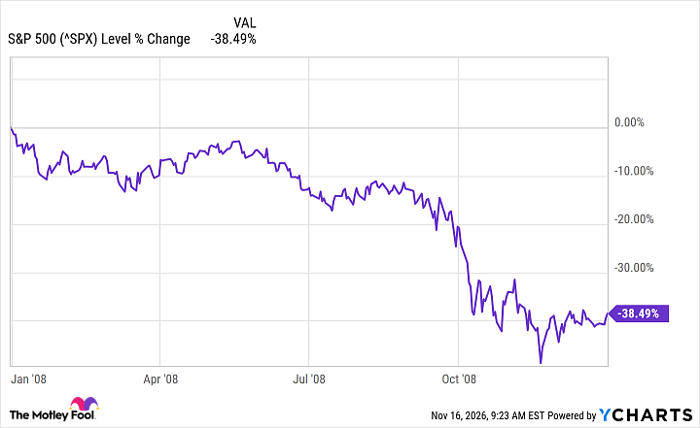
^SPX data by YCharts
Let's look at what I learned from my first bear market -- and how that big investing lesson still inspires my decisions today.

Image source: Getty Images.
My first bear market: 2008 global financial crisis
This wasn't my first rodeo. I had graduated from college in 2001 and lived through the dot-com bust and the Enron scandal. But the 2008 global financial crisis and Great Recession were much more severe and affected the entire economy. And on a personal level, 2008 was much scarier than 2001.
That's because by 2008, I had some skin in the game. I had a job at a major bank. I had become more established in my career and as an investor. I had built up a few years' worth of savings in my 401(k) and Roth IRA. My wife and I had a baby and a mortgage. We were just trying to have a happy little life with a home, family, friends, and some financial stability for the future. And all of a sudden, it seemed like the housing market, the stock market, and the entire financial system were on the brink of collapse.
All bad things seemed possible in 2008. Would I lose my job? Would we lose our house?
It's strange to think back on it now, because while 2008 was happening, I could barely focus on the stock market. Banks were failing and the market was crashing, but I was too worried about holding onto my job. I just wanted to keep paying the bills, putting food on the table, and taking care of our baby. I wasn't making clever moves like buying more stocks when prices were low. I was just trying to hold on to what we had.
The biggest lesson from my first bear market: Keep buying stocks
Perhaps the biggest lesson from my first bear market is: I am incredibly lucky. I never lost my job in 2008. We never missed a mortgage payment. The bank that I worked for did not go out of business; it actually emerged from the financial crisis stronger than ever, unlike other major banks and subprime lenders that failed during the housing crash.
But being lucky is not an actionable lesson for investors. It's good to be lucky. But it's even better to have a plan and stick with it. So the real big lesson from my first bear market is: Keep buying stocks. As long as you have a job, as long as you have steady income, try to keep putting some money into the stock market as often as you can. Every month, every payday.
I never stopped buying stocks in 2008. I kept investing in my 401(k) plan every month, every payday, with dollar-cost averaging. I kept putting cash into my Roth IRA, even when money was tight. Those simple, steady, disciplined, "boring" little investments might end up being some of the most lucrative financial moves I've ever made in my life.
Since those crisis-era lows of 2008, the stock market has skyrocketed with a long, mostly uninterrupted bull market. A $1,000 investment in the S&P 500 at the end of 2008 would have grown to almost $8,400 today.
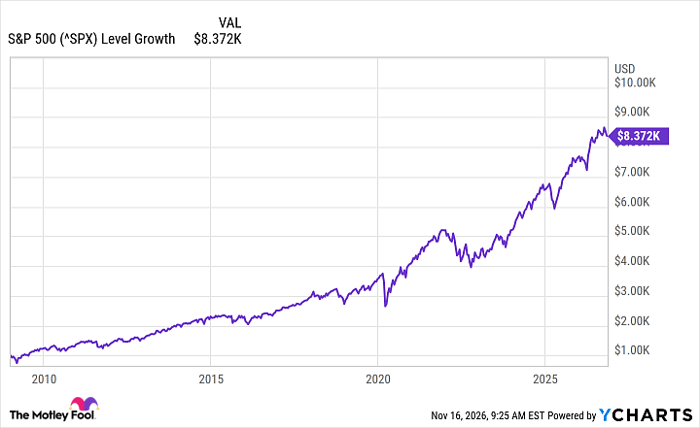
^SPX data by YCharts
How I'm investing for the next bear market
At this point in my life, I try to stay calm and unbothered during big swings in the stock market. Hopefully, 2008 will be the worst economic crisis of my lifetime. But even if there is another terrible short-term crisis like 2008, I know that in the long run, the S&P 500 is likely to bounce back.
Buying low-cost index funds like the Vanguard Morningstar Total Stock Market ETF (NYSEMKT:VTI) tends to be a great move for people with a long-term time horizon, even if you end up buying stocks at "the wrong time" right before a crash.
This total stock market ETF is a big part of my portfolio. It holds 3,511 U.S. stocks of all sectors and sizes, from the S&P 500 to small caps. Even if there is a tech stock crash or a big sell-off in artificial intelligence (AI) stocks soon, I believe that in the long run, index funds like the Vanguard Morningstar Total Stock Market ETF will eventually recover and rebalance. VTI lets me own the future "winners" of the economy, one way or another.
That's why I keep buying stocks. Even when the market is crashing, when investor fear is rampant, when the headlines are full of doom. I've lived through worse. And in the long run, the stock market tends to go up. If you keep buying during the lowest points of a bear market, when stocks are cheapest, your investments will slingshot upward as the market rises in the future.
Should you buy stock in Vanguard Morningstar Total Stock Market ETF right now?
Before you buy stock in Vanguard Morningstar Total Stock Market ETF, consider this:
The Motley Fool Stock Advisor analyst team just identified what they believe are the 10 best stocks for investors to buy now… and Vanguard Morningstar Total Stock Market ETF wasn’t one of them. The 10 stocks that made the cut could produce monster returns in the coming years.
Consider when Netflix made this list on December 17, 2004... if you invested $1,000 at the time of our recommendation, you’d have $321,850!* Or when Nvidia made this list on April 15, 2005... if you invested $1,000 at the time of our recommendation, you’d have $955,232!*
Now, it’s worth noting Stock Advisor’s total average return is 793% — a market-crushing outperformance compared to 203% for the S&P 500. Don't miss the latest top 10 list, available with Stock Advisor, and join an investing community built by individual investors for individual investors.
See the 10 stocks »
*Stock Advisor returns as of November 19, 2026.
Ben Gran has positions in Vanguard Morningstar Total Stock Market ETF. The Motley Fool has no position in any of the stocks mentioned. The Motley Fool has a disclosure policy.
Recommended Articles


