




Wall Street's Next Blockbuster Stock Split Arrives Later Today -- and This Industry Titan Has Skyrocketed Nearly 2,400% in Less Than 2 Years
Key Points
Though AI has been Wall Street’s premier growth driver for years, stock-split euphoria has also played an important role.
One of the biggest beneficiaries of the AI data center build-out will effect its first-ever forward stock split after the close of trading today, Nov. 19.
Despite this company generating its highest-ever gross margin, history might be the biggest enemy of Wall Street’s newest blockbuster stock-split stock.
- 10 stocks we like better than Sandisk ›
Though the last four years have been dominated by the evolution of artificial intelligence (AI), AI isn't the only trend propelling the stock market to new heights. Stock-split euphoria has also played an important role -- and later today, Nov. 19, these two catalysts will converge.
After the close of trading today, Wall Street's next blockbuster stock split becomes effective, with memory and storage solutions specialist Sandisk (NASDAQ:SNDK), which is up nearly 2,400% since its February 2025 debut, completing its first-ever split.
Missed AI’s "Act 1"? Act 2 Could Be 15x Bigger. Most investors think they missed the AI boat because they didn't buy Nvidia in 2005. But according to our analysts, we’re only at the end of "Act 1"—the R&D phase. "Act 2" is the global rollout. Continue »
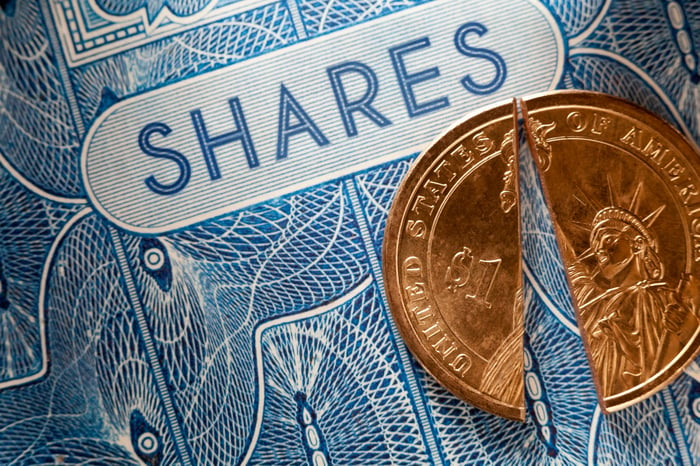
Image source: Getty Images.
Investors commonly gravitate toward forward stock splits
A stock split allows a publicly traded company to alter its share price and outstanding share count by the same factor without affecting its market cap or underlying operating performance. Though there are two varieties of splits, investors tend to gravitate toward one and shy away from the other.
Reverse stock splits, designed to increase a company's share price, are often shunned by investors. This type of split is typically undertaken by struggling companies attempting to avoid delisting from a major stock exchange.
By comparison, investors tend to pile into companies announcing and completing forward stock splits. Forward splits make a company's stock more nominally affordable for everyday investors who can't purchase fractional shares through their broker.
More importantly, companies enacting forward splits are usually firing on all cylinders, with consistent sales and profit growth. If a public company needs to lower its share price to ensure retail investors can take part in its growth story, it must be doing something right.
After the close of trading today, Sandisk will effect an 8-for-1 forward split, reducing its share price to (presumably) a little over $100 and increasing its outstanding share count by a factor of eight.

Image source: Getty Images.
Sandisk has been one of the biggest beneficiaries of the AI data center build-out
Businesses are spending nothing short of an arm and a leg on the AI infrastructure build-out, and Sandisk has been one of the prime beneficiaries. The company's NAND flash memory solutions and solid-state drives are being gobbled up in bulk.
The AI data center expansion is benefiting Sandisk on both ends. The insatiable demand for its memory and storage solutions, coupled with ongoing supply shortages for AI hardware, has collectively beefed up its pricing power and lifted its gross margin to never-before-seen levels. Sandisk's gross margin reached 85% in the fiscal first quarter (ending Oct. 2) on $11.03 billion in sales.
SanDisk’s gross margin has climbed from 22.5% to 85% in just six quarters. $SNDK https://t.co/1zlflMhfuv
— StockAnalysis.com (@stock_analysisx) November 11, 2026
Furthermore, at the company's mid-August Investor Day, CEO David Goeckeler outlined nearly $94 billion in signed contracts through fiscal 2030. Locking in future deals at premium price points can help Sandisk sustain its highest-ever gross margin.
But history might be Sandisk's biggest foe. Decades of history show that memory and storage solutions are highly cyclical. In other words, premium pricing power rarely lasts, with a contraction in price-to-earnings (P/E) multiples often indicating the late innings of a semiconductor cycle. Sandisk's forward P/E ratio of 3 offers all the hallmarks of an eventual bubble-bursting event in the AI arena.
Should you buy stock in Sandisk right now?
Before you buy stock in Sandisk, consider this:
The Motley Fool Stock Advisor analyst team just identified what they believe are the 10 best stocks for investors to buy now… and Sandisk wasn’t one of them. The 10 stocks that made the cut could produce monster returns in the coming years.
Consider when Netflix made this list on December 17, 2004... if you invested $1,000 at the time of our recommendation, you’d have $321,850!* Or when Nvidia made this list on April 15, 2005... if you invested $1,000 at the time of our recommendation, you’d have $955,232!*
Now, it’s worth noting Stock Advisor’s total average return is 793% — a market-crushing outperformance compared to 203% for the S&P 500. Don't miss the latest top 10 list, available with Stock Advisor, and join an investing community built by individual investors for individual investors.
See the 10 stocks »
*Stock Advisor returns as of November 19, 2026.
Sean Williams has no position in any of the stocks mentioned. The Motley Fool has no position in any of the stocks mentioned. The Motley Fool has a disclosure policy.
Recommended Articles


