




Bank of America vs. JPMorgan Chase: Which Financial Stock Is a Better Buy for 2027?
Key Points
Bank of America offers a more attractive valuation based on its book value and future earnings estimates.
JPMorgan Chase maintains superior scale and a higher net margin despite its premium price.
Which banking giant is the smarter play for your 2027 portfolio?
- Motley Fool Issues Rare "Total Conviction" Buy Alert ›
Investors often look to Bank of America (NYSE:BAC) and JPMorgan Chase (NYSE:JPM) when seeking stability. These banking titans dominate the financial landscape, but choosing the better buy for 2027 requires a closer look.
Bank of America focuses on a balance of consumer banking and wealth management while maintaining a vast digital footprint. JPMorgan Chase operates as a global financial powerhouse with unparalleled scale across investment banking and retail services. This comparison evaluates their financial health, growth trajectories, and valuation to determine which better fits your long-term goals.
The case for Bank of America
Bank of America offers a wide range of financial services across segments such as consumer banking, wealth management, and global markets. Among diversified bank stocks, it currently serves roughly 69 million consumer and small business clients across more than 35 countries. Its strategy focuses on digital integration, operating approximately 3,500 retail financial centers and 15,000 ATMs to maintain local presence while expanding its online capabilities.
Reliable recent quarterly figures for at least one of these companies aren't available, so this comparison uses each company's latest full fiscal year. In fiscal 2025, revenue reached nearly $113.1 billion, representing growth of roughly 6.8% over the previous year. The company reported net income of approximately $30.5 billion, resulting in a net margin of close to 27%.
As of its December 2025 balance sheet, the debt-to-equity ratio was roughly 1.2, calculated by dividing total debt by shareholder equity. The current ratio stood at approximately 0.4, and free cash flow for the year reached nearly $12.6 billion. Note that stock-based compensation accounted for roughly 31.7% of operating cash flow, inflating reported cash generation, since SBC is a non-cash expense added back in the cash flow statement.
The case for JPMorgan Chase
JPMorgan Chase is a global financial leader serving millions of individual customers, corporations, and governments across more than 100 markets. The firm operates through major segments including consumer and community banking, the commercial and investment bank, and asset and wealth management. Its scale is extensive, with the Chase brand providing national coverage through more than 5,000 branches across the 48 contiguous states.
In fiscal 2025, the bank generated revenue of approximately $182.4 billion, representing nearly 2.8% growth over the prior year. Net income reached close to $57 billion for the same period. This resulted in a net margin of roughly 31.3%, showing the amount of revenue that remained as profit after all expenses.
As of JPMorgan's December 2025 balance sheet, the debt-to-equity ratio was approximately 2.6, illustrating that the company uses more debt relative to its equity than its peer. The current ratio was roughly 0.5, and free cash flow for the fiscal year 2025 was nearly negative $147.8 billion. Free cash flow represents cash from operations minus capital expenditures, showing the surplus cash available after maintaining operations.
Risk profile comparison
Bank of America deals with significant regulatory and legal risks, highlighted by a December 2024 consent order regarding its anti-money laundering compliance. The company is also managing ongoing securities fraud class action lawsuits with deadlines extending into late 2026. Market instability and competition from other large institutions like Morgan Stanley (NYSE:MS) also pressure the bank's long-term outlook.
JPMorgan Chase faces legal and regulatory risks, including ongoing investigations and a cash sweep lawsuit that was partially allowed to proceed in early 2026. Credit risk remains a factor, particularly given concentrations in industries such as commercial real estate, alongside operational risks posed by emerging technologies. The company competes intensely with major rivals such as Wells Fargo (NYSE:WFC) to maintain its dominant market position.
Valuation comparison
Bank of America appears to be the more value-oriented choice, trading at a lower multiple of both its future earnings estimates and its book value.
| Metric | Bank of America | JPMorgan Chase |
|---|---|---|
| Forward P/E | 11.6 | 13.9 |
| P/B ratio | 1.1 | 2.5 |
Valuation metrics include sourcing from Financial Modeling Prep (FMP) and may differ from other data providers.
The forward P/E compares a stock price to its future earnings estimates over the next year. The P/B ratio compares the stock price with the company's book value (its assets minus its liabilities, roughly what shareholders would own on paper), and investors lean on it for insurers and banks. A lower P/B ratio means the stock costs less relative to book value.
Which stock would I buy for 2027?
I think these two stocks are pretty conservative investments. It's obviously not impossible for banks to blow up, but these are massive, established institutions, and they've been bailed out by the U.S. government before. So, in that sense, they strike me as relatively safe investments.
Bank of America's recent revenue growth was stronger, but JPMorgan has a higher net margin. Bank of America's dividend yields more, but on an absolute basis, JPMorgan's payout is higher.
Let's see how both stocks have performed:
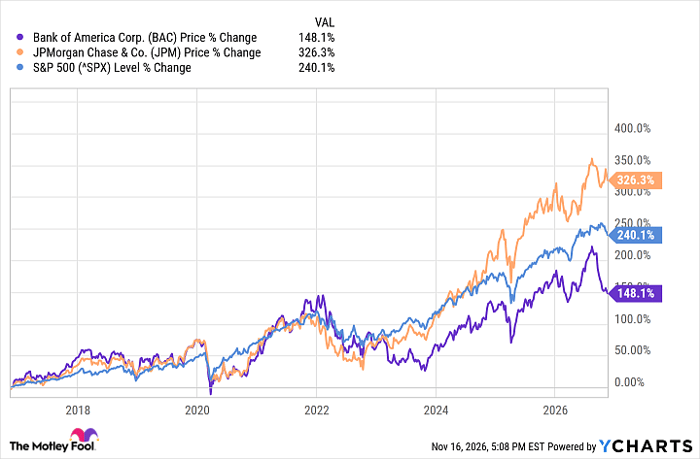
BAC data by YCharts
Bank of America badly trails JPMorgan, but more importantly, the former hasn't even kept pace with the S&P 500 (SNPINDEX:^GSPC). The whole point of investing in individual stocks is to beat the market's average return. B of A is not making a strong argument for itself here.
Past performance, of course, is no indication of future results. The next 10 years may look very different than the past. But if I'm buying a bank stock for 2027 and beyond, JPMorgan gets my vote.
Should you buy stock in Bank of America right now?
Before you buy stock in Bank of America, consider this:
The Motley Fool Stock Advisor analyst team just identified what they believe are the 10 best stocks for investors to buy now… and Bank of America wasn’t one of them. The 10 stocks that made the cut could produce monster returns in the coming years.
Consider when Netflix made this list on December 17, 2004... if you invested $1,000 at the time of our recommendation, you’d have $335,171!* Or when Nvidia made this list on April 15, 2005... if you invested $1,000 at the time of our recommendation, you’d have $1,000,640!*
Now, it’s worth noting Stock Advisor’s total average return is 823% — a market-crushing outperformance compared to 208% for the S&P 500. Don't miss the latest top 10 list, available with Stock Advisor, and join an investing community built by individual investors for individual investors.
See the 10 stocks »
*Stock Advisor returns as of November 17, 2026.
Bank of America is an advertising partner of Motley Fool Money. Wells Fargo is an advertising partner of Motley Fool Money. JPMorgan Chase is an advertising partner of Motley Fool Money. Erin Kennedy has no position in any of the stocks mentioned. The Motley Fool has positions in and recommends JPMorgan Chase. The Motley Fool has a disclosure policy.
Recommended Articles


