




Worried About a Bear Market? This Is the Single Best Investing Move You Can Make Right Now.
Key Points
The S&P 500 is down about 2.5% since its all-time high on Oct. 6.
If you’re worried about a bear market, think about diversifying your portfolio now.
Together, the three index funds below can help you achieve that objective.
- 10 stocks we like better than Vanguard S&P 500 ETF ›
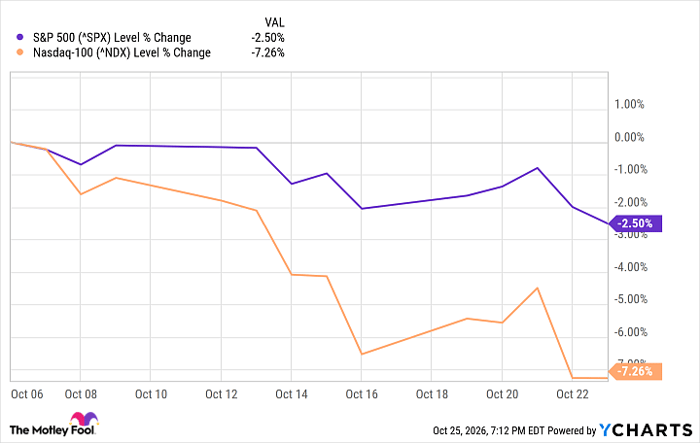
The stock market is always risky, and there's always something to be worried about in the economy. But many investors are feeling anxious. In the past few weeks since hitting a new record high on Oct. 6, the S&P 500 (SNPINDEX: ^GSPC) is down about 2.5% as of this writing. The tech-heavy Nasdaq-100 has dropped about 7.3% since then.
Missed AI’s "Act 1"? Act 2 Could Be 15x Bigger. Most investors think they missed the AI boat because they didn't buy Nvidia in 2005. But according to our analysts, we’re only at the end of "Act 1"—the R&D phase. "Act 2" is the global rollout. Continue »
^SPX data by YCharts
Investors are nervous about rising interest rates and high energy prices dragging on the economy. There's also a big debate raging about the risks that artificial intelligence (AI) won't deliver the transformative gains in productivity (and corporate profits) its supporters have hoped for.
Are tech stocks overpriced? Is the stock market sell-off of the past few weeks just a temporary hiccup, or the start of a new bear market?
If you're losing sleep over stocks, the best move right now is one simple word: diversify. Let's look at what investors in a few different scenarios should do right now to diversify their portfolios and manage their risks.

Image source: Getty Images.
Are you too top-heavy with tech stocks? Buy the S&P 500
Tech stocks have been a great place to put your money for the past several years. But what if that trend doesn't continue? As the past few weeks have shown, the tech-heavy Nasdaq-100 can decline much faster and more sharply than the S&P 500.
If you feel like your portfolio is riding on just a few big tech names, now could be a good chance to diversify your money into a wider range of stocks. Buying low-cost index funds like the Vanguard S&P 500 ETF (NYSEMKT: VOO) is a simple way to do that. "VOO and chill" is a good strategy for peace of mind. Instead of just a few stocks, you can own all 500 of the biggest large-caps of the U.S. market.
There's no guarantee that the S&P 500 will be spared the volatility of a bear market. But it tends to be a good long-term bet. The S&P 500 has delivered 9.98% annualized returns since 1928.
Want to balance the risks of a stock market crash? Buy bonds
A classic rule of investing is that when stock prices go down, bond prices go up. When the stock market crashes, there is often a "flight to safety" among investors who move more money into "safe" assets like U.S. Treasury bonds. More people wanting to buy bonds lowers bond yields and raises bond prices.
One of the best, easiest, low-cost ways to buy bonds is the Vanguard Total Bond Market ETF (NASDAQ: BND). This bond ETF can put your money into an extensively diversified portfolio of U.S. Treasury bonds, investment-grade corporate bonds, and other high-quality U.S. bonds.
With bond yields over 5%, now could be a good time to lock in some of that safe, risk-free return. And if bond yields drop in the future as part of a stock market sell-off, that would deliver even bigger returns to people who buy higher-yield bonds today.
Want to manage risks of a falling dollar? Buy international stocks
If U.S. tech stocks enter a prolonged downturn, it could mean a weaker U.S. dollar. If investors around the world expect the U.S. economy to grow more slowly and U.S. stocks to deliver lower returns, that means less demand for dollars -- and the value of the dollar will go down.
A weaker dollar is bad news for Americans who want to go on vacation abroad -- it means your dollar has less purchasing power in other currencies. But it's good news for American investors who buy international stocks. The Vanguard Total International Stock Market ETF (NASDAQ: VXUS) holds 8,901 global stocks from dozens of other countries.
There's no guarantee international stocks will be "safer" or outperform the U.S. stock market long term. But when the U.S. dollar weakens against foreign currencies, international stocks become more valuable in dollar terms.
There's no perfect way to diversify your portfolio against a stock market crash. Choosing the right mix of assets depends on your risk tolerance, time horizon, and overall investment goals.
But in general, try not to put too many eggs in too few baskets. Owning a broadly diversified portfolio of stocks and bonds can be a good way to manage risk and protect you from potential downside when a bear market strikes.
Should you buy stock in Vanguard S&P 500 ETF right now?
Before you buy stock in Vanguard S&P 500 ETF, consider this:
The Motley Fool Stock Advisor analyst team just identified what they believe are the 10 best stocks for investors to buy now… and Vanguard S&P 500 ETF wasn’t one of them. The 10 stocks that made the cut could produce monster returns in the coming years.
Consider when Netflix made this list on December 17, 2004... if you invested $1,000 at the time of our recommendation, you’d have $337,166!* Or when Nvidia made this list on April 15, 2005... if you invested $1,000 at the time of our recommendation, you’d have $1,339,143!*
Now, it’s worth noting Stock Advisor’s total average return is 904% — a market-crushing outperformance compared to 213% for the S&P 500. Don't miss the latest top 10 list, available with Stock Advisor, and join an investing community built by individual investors for individual investors.
See the 10 stocks »
*Stock Advisor returns as of October 28, 2026.
Ben Gran has positions in Vanguard Total Bond Market ETF and Vanguard Total International Stock ETF. The Motley Fool has positions in and recommends Vanguard S&P 500 ETF and Vanguard Total Bond Market ETF. The Motley Fool has a disclosure policy.
Recommended Articles


