




Does Jensen Huang Know Something Wall Street Doesn't? Nvidia's CEO Sees No Signs of Memory Demand Fading by 2029
Key Points
Recent news has made investors anxious about how persistent high demand for memory will be.
The memory business has long been cyclical, with periods of strong demand and high prices leading to production capacity increases and eventual supply gluts.
- Motley Fool Issues Rare "Total Conviction" Buy Alert ›
Shares of memory-chip makers Micron (NASDAQ: MU), SK Hynix (NASDAQ: SKHY), and Samsung (OTC: SSNLF) have all exploded higher this year. This is thanks to incredible demand for memory, particularly in artificial intelligence data centers, where vast quantities of it are needed to rapidly feed data to graphics processing units (GPUs) and AI accelerators.
The memory chip industry has long been cyclical because it's a commodity business in which it is difficult for the manufacturers to keep supply and demand balanced. For decades, new technologies and devices would periodically appear that led to surges in demand and rising chip prices. Chipmakers would then collectively build out production capacity -- a process that takes a couple of years -- only to overshoot as a group, leading to an excess of supply. That excess often arrived as demand was retreating, leading to large gluts of chips and slumping prices.
Missed AI’s "Act 1"? Act 2 Could Be 15x Bigger. Most investors think they missed the AI boat because they didn't buy Nvidia in 2005. But according to our analysts, we’re only at the end of "Act 1"—the R&D phase. "Act 2" is the global rollout. Continue »
It is for this reason that the market has historically been unwilling to price memory stocks at a premium: Investors have viewed the down cycles as inevitable.
Recently, memory stocks have once again come under pressure as investors worry about new competition in the space and signs that future demand may not be as ironclad as the market thinks.
However, Nvidia (NASDAQ: NVDA) CEO Jensen Huang told CNBC that he isn't worried that memory demand will slacken even by 2029, which is a longer time horizon than most analysts have speculated on thus far. Does Huang know something Wall Street doesn't?
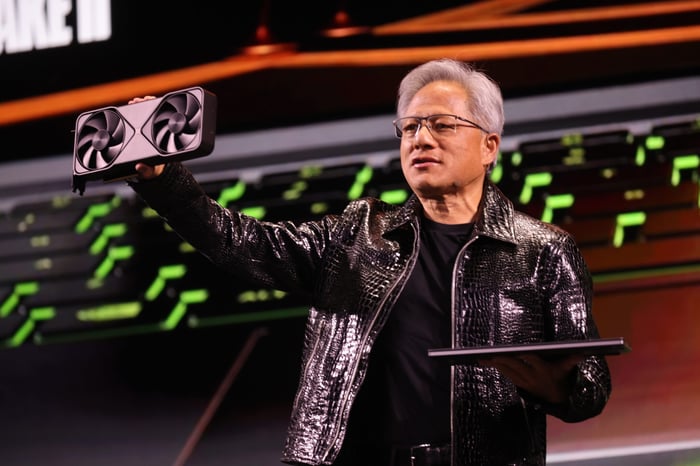
Image source: Getty Images.
China emerges as a threat
Memory, including NAND flash memory and dynamic random-access memory (DRAM), has become deeply supply-constrained as GPU clusters and data centers have scaled, creating unheard-of levels of demand.
Memory supply is so constrained that several consumer electronics companies have announced price hikes on products due specifically to higher memory prices. As such, the memory stocks mentioned above have soared this year. Micron is up roughly 172%, Samsung is up 66%, and SK Hynix has risen roughly 81%.
This has led much of the industry to conclude that memory will be supply-constrained until sometime next year, or even into 2028.
This thesis was recently put to the test when the Chinese memory maker ChangXin Memory Technologies (CXMT) announced it would roll out a new memory architecture by year-end that could pack more memory cells into the same amount of space.
CNBC also reported that a well-known South Korean publication, citing Professor Hwang Cheol-seong, a distinguished professor of materials science and engineering at Seoul National University, and Ahn Ki-hyun, executive director of the Korea Semiconductor Industry Association, published an article that said the two expect a "flood of new [memory] supply" that will create a "red ocean" in 2019.
These comments naturally led to a big sell-off in the memory space. But on Oct. 22, Huang told CNBC that he doesn't foresee a memory glut by 2029 as his base case.
"One of the things that's really great about memory is that you can always use more of it," Huang told CNBC at a recent conference in Berlin. Huang also said Nvidia is open to working with a company like CXMT.
Investors are anxious
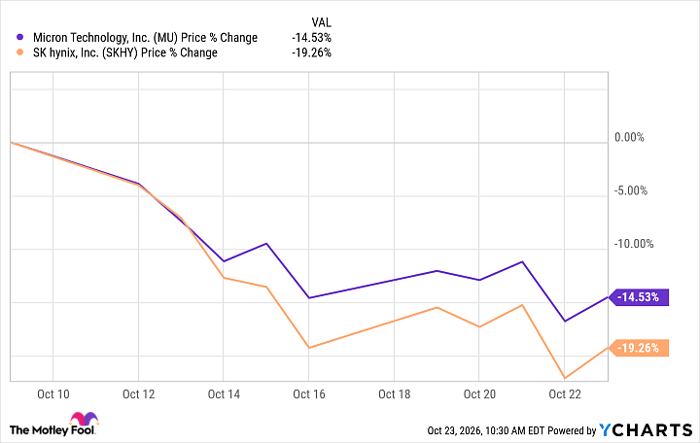
Wall Street has been anxious in recent months, and the latest spate of news items has been crushing memory stocks.
MU data by YCharts.
Although Huang tends to be a perma-bull on artificial intelligence, aside from the ChangXin news and the South Korean article, there is no evidence that demand is slowing. For instance, Micron and SK Hynix have signed numerous three- to five-year deals with some of their largest customers that lock in price ranges and sales volumes. This cyclical sector has not seen such longer-term contracts before.
Meanwhile, SK Hynix has said it plans to triple its wafer capacity by 2034 to meet the incredible demand it's seeing.
Counterpoint Research actually forecasts that DRAM prices will fall by 23% in 2028 compared to 2027. However, even after that decline, they would still be 230% higher than levels seen in 2025.
"The current memory market is considered to be in a 'New Normal' era, and the down cycle will differ from previous ones," Counterpoint senior research analyst Jeongku Choi told CNBC.
This recent rout in memory stocks shows how touchy the market is.
As with everything in AI, memory prices don't show any sign of coming down, but the slightest hint that they could begin to retreat to their pre-AI supercycle levels would certainly send the stocks tumbling.
That's why I'd still recommend investors not go too heavy on their exposure to this group. I think it's certainly OK to have some portfolio exposure because the AI trade could still be a long-term winner, but this sector will be volatile, and it will be quite difficult to get ahead of the memory cycle.
Should you buy stock in Nvidia right now?
Before you buy stock in Nvidia, consider this:
The Motley Fool Stock Advisor analyst team just identified what they believe are the 10 best stocks for investors to buy now… and Nvidia wasn’t one of them. The 10 stocks that made the cut could produce monster returns in the coming years.
Consider when Netflix made this list on December 17, 2004... if you invested $1,000 at the time of our recommendation, you’d have $355,124!* Or when Nvidia made this list on April 15, 2005... if you invested $1,000 at the time of our recommendation, you’d have $1,296,254!*
Now, it’s worth noting Stock Advisor’s total average return is 901% — a market-crushing outperformance compared to 210% for the S&P 500. Don't miss the latest top 10 list, available with Stock Advisor, and join an investing community built by individual investors for individual investors.
See the 10 stocks »
*Stock Advisor returns as of October 27, 2026.
Bram Berkowitz has no position in any of the stocks mentioned. The Motley Fool has positions in and recommends Micron Technology and Nvidia. The Motley Fool has a disclosure policy.
Recommended Articles


