




Amazon Is Underperforming the S&P 500 and Nasdaq-100. Could Oct. 29 Mark a Turning Point?
Key Points
Amazon's strong business results haven't stopped the company from underperforming the S&P 500.
The company is due to report its third-quarter results after the market closes on Oct. 29.
Investors should focus on the long-term view rather than trying to time short-term moves.
- Motley Fool Issues Rare "Total Conviction" Buy Alert ›
Amazon (NASDAQ: AMZN) continues to be the world's leading provider of e-commerce services. Amazon Web Services (AWS) also continues to lead the cloud infrastructure market, and the company's digital advertising business has been posting very impressive growth.
While the tech giant has generally been posting impressive business results, this hasn't translated into market-beating performance for its stock. Amazon's share price has risen slightly over 7% this year, while the S&P 500 and the Nasdaq-100 have risen 11% and 16%, respectively, in 2026.
Missed AI’s "Act 1"? Act 2 Could Be 15x Bigger. Most investors think they missed the AI boat because they didn't buy Nvidia in 2005. But according to our analysts, we’re only at the end of "Act 1"—the R&D phase. "Act 2" is the global rollout. Continue »

Image source: Getty Images.
Amazon stock's market-lagging performance isn't confined to a short-term window. Over the last five years, Amazon stock has risen roughly 49%. Meanwhile, the S&P 500 has posted a total return of 80%. Now, Amazon is gearing up to publish its third-quarter results after the market closes on Oct. 29. Does the upcoming quarterly report present a potential turning point that makes Amazon stock a buy?
Investors should view Amazon as a long-term play
Before getting into the significance of Amazon's upcoming Q3 report, it's worth exploring why the company's stock has been underperforming the S&P 500 index. While the company's leading position in the cloud infrastructure market gives it plenty of ways to benefit from the rise of artificial intelligence (AI), Amazon is posting margins far below those of other leading tech companies. This dynamic stems from the fact that the majority of the company's revenue still comes from its e-commerce business.
Amazon's online retail business is profitable, but it's relatively low-margin due to high operational costs. Meanwhile, companies including Nvidia, Apple, Microsoft, and Alphabet aren't reliant on low-margin businesses for large portions of their sales -- and their stocks have played outsize roles in pushing the S&P 500 higher over the last half-decade.
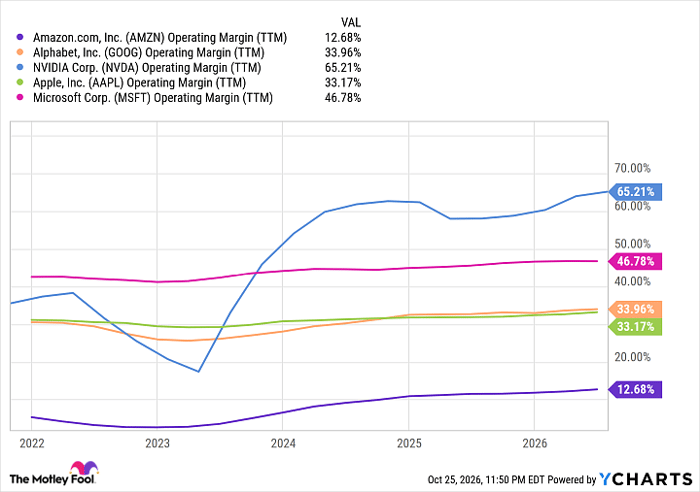
AMZN Operating Margin (TTM) data by YCharts.
Massive capital expenditures have been another source of valuation pressure for Amazon in recent years, and that trend is unlikely to change in the upcoming quarterly report. Last quarter, the company raised its capex target for the year from roughly $200 billion to roughly $220 billion. It wouldn't be shocking to see the company announce another increase to its annual capex estimate in its Q3 report.
On the other hand, this week's earnings report will likely show strong growth for AWS, solid momentum in e-commerce, and another period of impressive expansion in its high-margin digital ads business. But that also doesn't mean investors shouldn't treat a single earnings report as a catalyst to buy Amazon stock.
The good news for long-term investors is that the Q3 report doesn't need to deliver that kind of turning point. While Amazon's stock performance has lagged the S&P 500, the underlying business has generally performed very well. The cash-guzzling phase in AWS today, including the investment in custom AI chips Trainium and Graviton, has been keeping the stock down, but should reaccelerate revenue growth and lead to a free-cash-flow-generating phase over the next two to five years.
For long-term investors, I think that Amazon stock still has the makings of a strong buy-and-hold play. The company is spending massively right now, but it's investing in categories to support sales and margin expansion -- and these initiatives should pay off over the long haul.
Should you buy stock in Amazon right now?
Before you buy stock in Amazon, consider this:
The Motley Fool Stock Advisor analyst team just identified what they believe are the 10 best stocks for investors to buy now… and Amazon wasn’t one of them. The 10 stocks that made the cut could produce monster returns in the coming years.
Consider when Netflix made this list on December 17, 2004... if you invested $1,000 at the time of our recommendation, you’d have $355,124!* Or when Nvidia made this list on April 15, 2005... if you invested $1,000 at the time of our recommendation, you’d have $1,296,254!*
Now, it’s worth noting Stock Advisor’s total average return is 901% — a market-crushing outperformance compared to 210% for the S&P 500. Don't miss the latest top 10 list, available with Stock Advisor, and join an investing community built by individual investors for individual investors.
See the 10 stocks »
*Stock Advisor returns as of October 27, 2026.
Keith Noonan has no position in any of the stocks mentioned. The Motley Fool has positions in and recommends Alphabet, Amazon, Apple, and Nvidia. The Motley Fool has a disclosure policy.
Recommended Articles


