




SpaceX Bids for Space Dominance, Plans 456 Starship Launches Per Year
Key Points
SpaceX currently has permission to launch 25 Starships per year.
SpaceX just asked the FAA to quadruple its launch authorization -- then more than quadruple it again.
If granted, SpaceX's request will permit the company to put the mass equivalent of three nuclear aircraft carriers in orbit -- annually.
- Motley Fool Issues Rare "Total Conviction" Buy Alert ›
In the year 2000, U.S. space companies launched a grand total of 28 rockets. From 2001 to 2010, America's space odyssey slowed further, averaging just 18 rocket launches per year.
But then SpaceX happened.
Missed AI’s "Act 1"? Act 2 Could Be 15x Bigger. Most investors think they missed the AI boat because they didn't buy Nvidia in 2005. But according to our analysts, we’re only at the end of "Act 1"—the R&D phase. "Act 2" is the global rollout. Continue »
Founded in 2002, Space Exploration Technologies (NASDAQ: SPCX) launched its first Falcon 9 rocket in 2010. It took a few years to work out the kinks, and a few more to turn Falcon 9 into a reusable rocket, but by 2020, SpaceX was cooking. That year saw 44 launches by U.S. companies -- the most launches since the Apollo era.
And according to research from The Motley Fool, more than half of those launches were by SpaceX.
Thanks to SpaceX, the number of U.S. rocket launches has increased every year since. SpaceX alone launched 31 commercial missions in 2021, 57 in 2022, 92 in 2023, 130 in 2024, and 161 in 2025, putting literally thousands of tons of payload in Earth orbit.
All of this would be very impressive, except for one thing -- and that one thing is what SpaceX is planning to do next.
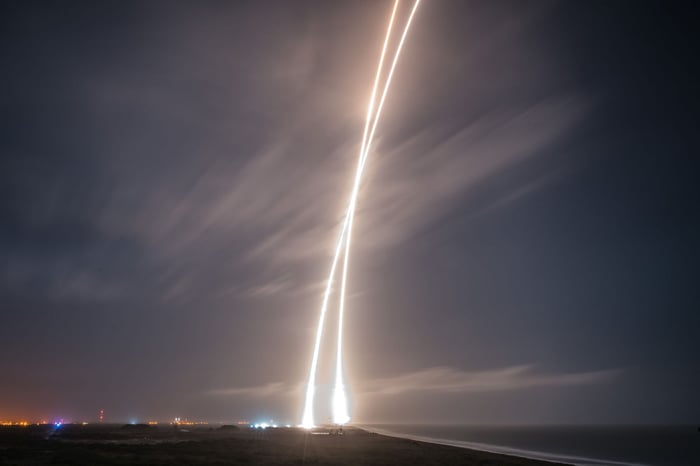
Image source: SpaceX.
Going where no space stock has ever gone before
What SpaceX plans to do next, as we learned from a Federal Aviation Administration (FAA) disclosure Tuesday, is to launch its Starship megarocket -- a rocket with multiple times the payload capacity of any other rocket on Earth -- an astounding 456 times in a single year.
We learned this from a "Notice of Intent ... on the Proposed SpaceX Starship-Super Heavy Launch and Landing Operations at the Boca Chica Launch Site at Starbase, Texas and Expansion of Starship Landing and Expenditure Locations." This seven-page document describes a conversation SpaceX has begun with the FAA, outlining plans to dramatically increase Starship's flight cadence.
SpaceX currently has permission to conduct "up to 25 annual launches" of its Super Heavy booster and Starship rocket per year from the company's Boca Chica Launch Site at Starbase, Texas. But that's not enough to support everything SpaceX wants to do in orbit (or beyond).
In a two-phase plan of action, SpaceX describes its goal of launching 100 times per year in Phase 1, before expanding to an eye-popping 456 launches per year. (Recognizing that the reusable Super Heavy and Starship land separately after each launch, the document also covers 200 annual landings in Phase 1, and 912 landings in Phase 2.)
The document does not specify when SpaceX hopes to begin Phase 1, but it states that once Phase 1 begins, Phase 2 will follow "within several years."
What happens next
The "notice of intent" is just the beginning of a conversation between SpaceX and the FAA, and even just Phase 1 of SpaceX's plan probably lies years in the future. Between now and then, environmental impact studies assessing the effects of so many high-energy launches on coastlines, fish and wildlife populations, and human populations will be needed.
There will be studies of effects on "farmlands; hazardous materials, solid waste, and pollution prevention; historical, architectural, archaeological, and cultural resources; land use; natural resources and energy supply." "Noise" studies, "visual" studies, and "socioeconomic" studies, too. Enough studies, one imagines, to keep a small city's worth of environmental and regulatory lawyers fully employed for years.
Even at the end of it all, there's no guarantee the FAA will agree to SpaceX's ambitious plans.
What investors need to know
But what if the FAA does agree?
Four hundred fifty-six Starship launches, each carrying up to 150 tons of payload, have the potential to put upwards of 68,400 tons of payload into orbit annually. That's more than twice the payload that's been put into orbit in the entire history of human spaceflight, from the Oct. 4, 1957, Sputnik launch to today.
And once it gets started, SpaceX would launch this every single year.
If that's not enough to boggle your mind, though, consider this: SpaceX's notice of intent specifically limits itself to requesting permission to conduct this number of launches from Starbase's two launch pads in Boca Chica. Meanwhile in Louisiana, SpaceX has begun a separate project to build a second Starbase with 10 launch pads. Should SpaceX have similar "intentions" for that Starbase as it has for Texas, we could, in the not-too-distant future, see SpaceX launch more than 2,000 rockets per year and put close to 300,000 tons of payload into orbit annually.
That's roughly the equivalent of launching three Ford-class aircraft carriers to orbit per year.
Compared to this goal, the six rockets that ULA launched in 2025, the seven launches by Arianespace, and even the 18 launches by Rocket Lab -- they all dwindle to insignificance next to SpaceX. So long story short?
If the FAA agrees to SpaceX's plan and SpaceX itself can get anywhere near fulfilling it, SpaceX is going to dominate the space industry. Full stop.
Missed AI’s "Act 1"? Act 2 Could Be 14x Bigger
Most investors think they missed the AI boat because they didn't buy Nvidia in 2005.
But according to our analysts, we’re only at the end of "Act 1"—the R&D phase. "Act 2" is the global rollout, a massive technology build-out that Google’s CEO says could be more profound than fire or electricity.
While everyone watches the chip designers, one "backbone" company provides the critical technology that Nvidia and AMD literally cannot function without. We’ve detailed this under-the-radar player in our new AI Playbook.
Continue »
Rich Smith has positions in Rocket Lab. The Motley Fool has positions in and recommends Rocket Lab. The Motley Fool has a disclosure policy.
Recommended Articles


