




Nuclear Wipeout: These 5 Nuclear Stocks Are Now Down 44.3% to 82.2%. Time to Buy?
Key Points
Next-generation nuclear stocks are one of the hardest-hit sectors of the stock market.
Recent IPOs Standard Nuclear and X-Energy are both down over 40%.
Small modular reactor and modular microreactor companies were hit even harder.
- 10 stocks we like better than Oklo ›
A lot of industries have underperformed over the past year, but the nuclear industry has been absolutely clobbered.
Despite a friendly presidential administration and growing concerns about electricity supply, nuclear stocks have notched some of the worst performances in the market. And next-generation nuclear stocks have been among the hardest hit. But that could be about to change.
Missed Nvidia in 2009? This Rare Signal Is Flashing Again. In 2009, a "Double Down" signal flashed for a little-known chipmaker called Nvidia. For the first time in years, that same "Total Conviction" signal is flashing for a company 1/100th the size of Nvidia. Continue »
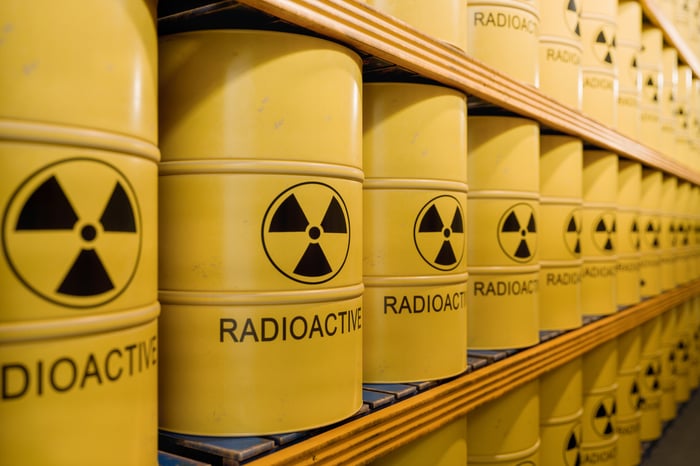
Image source: Getty Images.
Let's check out five of the worst performers in the nuclear industry and see if they look like buys at these lower prices.
Standard Nuclear, down 44.3%
The youngest company on the list is also the best performer (if you can even call a 44.3% drop from its IPO price the "best").
Standard Nuclear (NYSE: STDN) made its Nasdaq debut less than a month ago, and its share price quickly plunged. Even so, the start-up is still valued at $1.4 billion, which seems high for a company that only brought in $593,802 in revenue in Q1.
The company currently operates the only U.S. manufacturing facility capable of producing TRISO nuclear fuel at an industrial scale. TRISO fuel consists of encapsulate poppy seed-sized uranium kernels, which are heat-resistant and meltdown-proof. Standard Nuclear plans to supply small modular reactor (SMR) companies with TRISO fuel, but in order for it to grow into its valuation, it needs the SMR industry to take off.
X-Energy, down 48.4%
TRISO fuel is also key to the fortunes of the second-youngest company on our list, X-Energy (NASDAQ: XE), which had its IPO in April. The $7.5 billion company is currently developing a nuclear fuel campus in Oak Ridge, Tennessee, to manufacture its patented version of TRISO fuel, called TRISO-X.
X-Energy has also designed a high-temperature gas-cooled SMR called the Xe-100, which it believes is simpler, safer, and more efficient than other types of SMRs. X-Energy is partnering with chemical company Dow (NYSE: DOW) to build a four-reactor nuclear plant at a Dow facility in Texas. However, the regulatory review of its application is ongoing, so it likely can't even begin construction until Q1 2027.
Nano Nuclear, down 67.9%
Another company developing a high-temperature gas-cooled reactor is Nano Nuclear Energy (NASDAQ: NNE), but its Kronos reactor is actually a modular microreactor (MMR), which is smaller than an SMR. It plans to submit a construction permit in the coming months to build an MMR on the campus of the University of Illinois, which it hopes to begin by mid- to late 2027.
Now that it's dropped 67.9% from its all-time high, Nano Nuclear is the smallest of these companies by market cap, at just $946.9 million.
Oklo, down 75.1%, and NuScale, down 82.2%
Oklo (NYSE: OKLO) and NuScale Power (NYSE: SMR) -- valued at $7.5 billion and $3.1 billion, respectively -- are actively building their first SMRs. NuScale has received design approval for its light-water SMR from U.S. regulators, with 12 modules already in production and plans to deploy six of them through a partnership with the Tennessee Valley Authority (TVA). Meanwhile, Oklo is building its prototype Aurora Powerhouse with a sodium-cooled fast SMR at the Idaho National Laboratory under Department of Energy authorization.
What you've probably noticed is that none of these SMRs or MMRs have actually been deployed. Most of them aren't even under construction yet! That's one big reason why the industry's share prices have plunged: while the science may be sound and the designs promising, there's no way to tell if a next-gen reactor will work as planned until someone actually builds it and turns it on for the first time. And that will take months or, in some cases, years.
Given the uncertainty around any new technology and the inherent risk of investing in a pre-commercial or early-stage company, all of these companies' valuations still look too high, and only extremely risk-tolerant investors should even consider buying in. That said, the valuations are looking a lot more reasonable now than they did a few months ago. But until the SMR and MMR deployments actually begin -- likely at least a year from now -- these stocks will have limited upside. They may also have to issue additional shares to keep afloat in the interim, diluting the positions of existing investors.
Nuclear investors should probably hold off on buying any of these until we're much closer to actual deployments.
Should you buy stock in Oklo right now?
Before you buy stock in Oklo, consider this:
The Motley Fool Stock Advisor analyst team just identified what they believe are the 10 best stocks for investors to buy now… and Oklo wasn’t one of them. The 10 stocks that made the cut could produce monster returns in the coming years.
Consider when Netflix made this list on December 17, 2004... if you invested $1,000 at the time of our recommendation, you’d have $400,155!* Or when Nvidia made this list on April 15, 2005... if you invested $1,000 at the time of our recommendation, you’d have $1,345,502!*
Now, it’s worth noting Stock Advisor’s total average return is 955% — a market-crushing outperformance compared to 214% for the S&P 500. Don't miss the latest top 10 list, available with Stock Advisor, and join an investing community built by individual investors for individual investors.
See the 10 stocks »
*Stock Advisor returns as of August 6, 2026.
John Bromels has positions in Dow and Oklo. The Motley Fool recommends NuScale Power. The Motley Fool has a disclosure policy.
Recommended Articles


