




Tesla Trades at 140 Times Forward Earnings. Here's What Has to Go Right to Justify This Valuation
Key Points
The high earnings multiple suggests there are growth assumptions embedded in Tesla's share price.
Tesla’s electric-vehicle business remains its flagship operation, but concerns are mounting.
The company’s best near-term and long-term opportunity may be its smallest one making the fewest headlines.
- These 10 stocks could mint the next wave of millionaires ›
There's no denying Tesla (NASDAQ: TSLA) is one of the market's most exciting growth companies right now. But, currently priced at 140 times next year's expected earnings of $2.23 per share, there's also no denying Tesla stock is outrageously expensive. For perspective on that figure, the S&P 500's forward-looking price-to-earnings (P/E) ratio right now is only 21.
Sure, plenty of stocks have been rightfully valued at sky-high levels like this in the past. Think Amazon, or Cisco back in the 1990s. These outfits were positioned to capitalize on the internet's then-budding explosion. Investors were willing to pay a steep price because future growth was likely to be strong enough to justify the premium.
Missed Nvidia in 2009? This Rare Signal Is Flashing Again. In 2009, a "Double Down" signal flashed for a little-known chipmaker called Nvidia. For the first time in years, that same "Total Conviction" signal is flashing for a company 1/100th the size of Nvidia. Continue »
This doesn't hold true every time, though. Sometimes, the assumptions of future growth driving wildly high P/E ratios end up being just plain wrong. Businesses such as Groupon, GoPro, and meal-kit company Blue Apron come to mind. Only in retrospect did the flaws in these companies' business models become evident.
So what must Tesla get right in the foreseeable future to justify its stock's rich valuation right now? Here are the top five things the company must do to justify its stock's present price, but one in particular is a huge must-do.
1. It must lead an EV market that eventually displaces combustion-engine cars
Tesla technically isn't the leader of the world's electric-vehicle business anymore. That honor belongs to China's BYD (OTC: BYDDY), which delivered 557,090 battery-electric vehicles last quarter, versus Tesla's 480,126. But there's arguably room for two (or more) titans in the EV business. Tesla just needs to make sure it's one of them.
Perhaps the more important factor here, rather, is electric vehicles' continued penetration of the global automobile market itself. This is still happening, too; the International Energy Administration reports that worldwide EV sales topped 20 million last year -- about one out of every four cars purchased in 2025, up 20% from 2024's count. But headwinds appear to be blowing. BloombergNEF predicts that global EV demand will only grow 11% year over year to 23 million passenger vehicles in 2026, with most of the demand coming from China, where Tesla is increasingly uncompetitive. Meanwhile, although the U.S. remains Tesla's biggest market, this market isn't growing. Tesla's second-quarter U.S. sales fell 20% year over year to only 114,629 vehicles, according to numbers from Cox Automotive.
Something's got to change with either or both of these trajectories.
2. Lots of Tesla owners must subscribe to full self-driving features
Tesla's vehicles come with a range of safety-minded driver assistance features. What many non-Tesla owners might not fully appreciate, however, is that the full self-driving features you hear so much about aren't free. They're now only offered on a subscription basis, at a cost of $99 per month. That's not a fortune, but it's certainly enough of an added cost that many owners might balk at the price.
And most of them have balked. Only about 1.5 million (roughly 15%) of all Tesla owners are currently paying this monthly fee, although to its credit, the company added a record-breaking 200,000 full-self-driving subscribers last quarter alone. That doesn't translate into a ton of revenue yet. It could someday, though, and this is very high-margin revenue.
For reference, a key component of Chief Executive Officer Elon Musk's trillion-dollar compensation package calls for a minimum of 10 million full-self-driving subscribers.
3. Robotaxis must work and gain wide adoption
Speaking of self-driving cars, although its growth has been uneven and the underlying technology remains far from perfect, Tesla continues cultivating its robotaxi business, adding Orlando and Tampa, Florida, to its served markets just last month, and bringing its total markets up to seven. That's not nearly as much presence as Musk intimated would be the case when he first unveiled Tesla's new venture back in 2024.
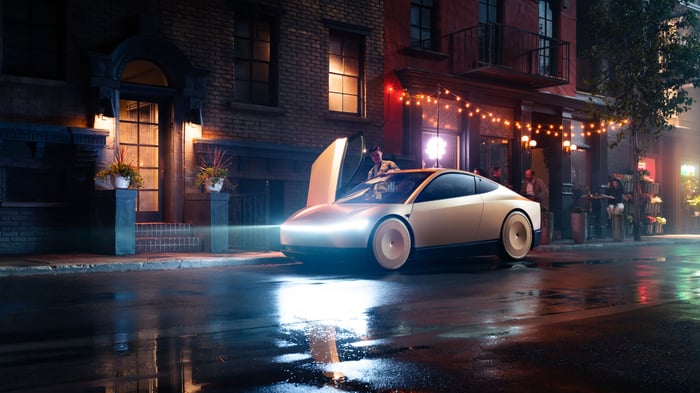
Image source: Tesla.
That could change. Goldman Sachs predicts the worldwide robotaxi market could be worth more than $400 billion by 2035. Even winning a fraction of this business would be a boon for Tesla.
But it's miles away from capturing even a respectable fraction of the current and future robotaxi market.
4. Tesla's clean-energy arm must become a significant profit center
Ironically, perhaps one of Tesla's biggest and best opportunities is also currently one of its smallest and least-discussed businesses. That's its solar panels (and solar roofs) and corresponding battery storage. Last quarter's energy revenue of $3.1 billion only accounted for about a tenth of Tesla's total Q2 top line.
The money is there to be made, though. Market research outfit Technavio says the U.S. residential solar market is poised to grow at an average annualized pace of more than 13% through 2030, when it will be worth more than $30 billion, although this outlook still arguably only scratches the surface of what's possible in the long run. Wood Mackenzie believes more than 70 million homes in the U.S. could conceivably install solar panels within the next 25 years.
5. Its AI robot, Optimus, must live up to Elon Musk's hype
Last but hardly least, Tesla's artificial intelligence (AI)-controlled humanoid robot, Optimus, must be a smashing success to justify Tesla shares' forward P/E of 140.
This is the biggie. Indeed, it wouldn't be unreasonable to suggest that Tesla is now an AI robot company that also happens to manufacture electric vehicles and solar panels. Musk's certainly painted that picture anyway, suggesting more than once that Optimus will be "the biggest product ever, of any kind." That sort of rhetoric dramatically builds lofty expectations.
And to be fair, it might be possible. Although it's a long-term outlook, Morgan Stanley predicts the number of humanoid robots on the planet could reach 1 billion by 2050, translating into a $5 trillion market opportunity. However. as Morgan Stanley's head of global autos and shared mobility research, Adam Jonas, adds, "Adoption should be relatively slow until the mid-2030s, accelerating in the late 2030s and 2040s."
There's the rub for current and prospective Tesla shareholders. The market might support a premium valuation based on Musk's originally suggested commercial launch of Optimus sometime in 2027. If it takes much longer than that for Optimus to become a meaningful, profitable business, though -- giving competitors time to catch up -- investors may dial back their bullishness.
Don’t miss this second chance at a potentially lucrative opportunity
Ever feel like you missed the boat in buying the most successful stocks? Then you’ll want to hear this.
On rare occasions, our expert team of analysts issues a “Double Down” stock recommendation for companies that they think are about to pop. If you’re worried you’ve already missed your chance to invest, now is the best time to buy before it’s too late. And the numbers speak for themselves:
- Nvidia: if you invested $1,000 when we doubled down in 2009, you’d have $521,325!*
- Apple: if you invested $1,000 when we doubled down in 2008, you’d have $58,876!*
- Netflix: if you invested $1,000 when we doubled down in 2004, you’d have $386,727!*
Right now, we’re issuing “Double Down” alerts for three incredible companies, available when you join Stock Advisor, and there may not be another chance like this anytime soon.
See the 3 stocks »
*Stock Advisor returns as of August 4, 2026.
James Brumley has no position in any of the stocks mentioned. The Motley Fool has positions in and recommends Amazon, Cisco Systems, Goldman Sachs Group, and Tesla. The Motley Fool recommends BYD Company. The Motley Fool has a disclosure policy.
Recommended Articles


