




Samsung vs SK Hynix vs CXMT: Who Wins the AI Memory War and Which Stock Should You Buy?
TradingKey - Three companies dominate the global AI memory market and all three were in the news at the same time. SK Hynix (SKHY) hit the 30% daily limit, and gained more than 17%, on July 31, as South Korea's KOSPI Index experienced the largest single-day gain ever. Samsung gained 27% on the same day. CXMT went public in Shanghai on July 27, and gained 466% on the first day, which triggered a 53% sell-off of SanDisk and a 41% peak to trough sell-off of Micron. SK Hynix alone is expected to make more in 2026 than in the previous 27 years combined.
Each company makes different offerings. We look at the most volatile week in the memory market and analyze the charts to determine the best investment opportunity.
SK Hynix - The Definitive AI Memory Play, and the Defacto Leader
The three companies have SK Hynix as the most obvious AI memory stock. It commands about 50% of the world HBM market and is HBM’s largest supplier to NVIDIA. SK Hynix experienced a strong YOY profit increase for Q2 2026, and has 2027 and 2028 HBM contracts. UBS started coverage today with a price target of $204 and a Buy rating. The strong demand for agentic AI means that the AI memory market is booming with DRAM forecasted for a 36% increase by 2027.
There is strong support for the profit estimate as there is more upside for 2026 compared to the last 27 years combined, which is a positivity bias placed on the stock. This is also due to the pricing of HBM, which is 5 to 8 times that of standard DRAM with NVIDIA’s priority access.
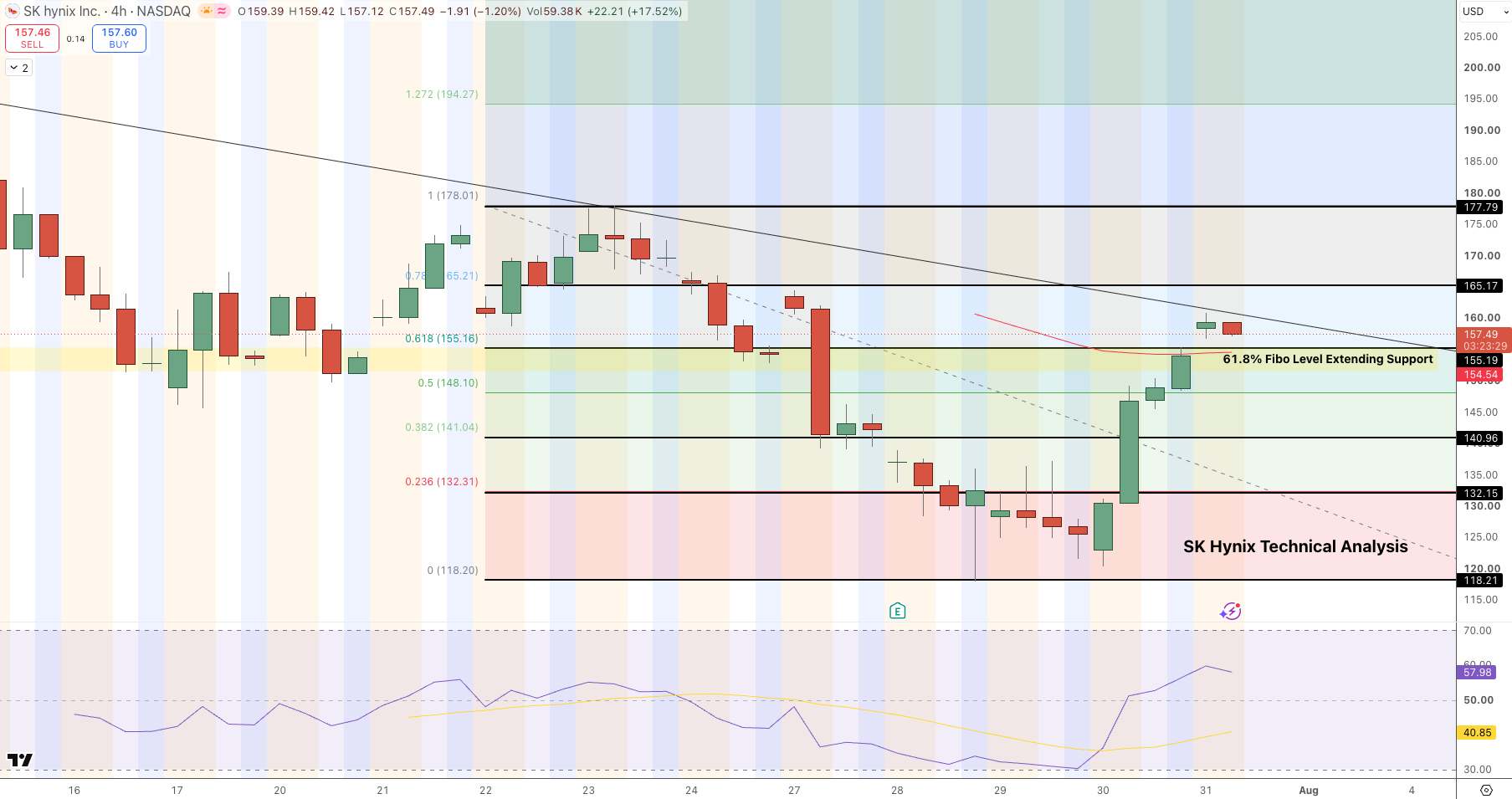
SK Hynix Price Chart - Source: Tradingview
From the 4H chart, SK Hynix is trading at $157.49 with a +17.52% session increase. The support level is at $155.16 (65.8% Fibonacci) and the RSI is at 57.98. A drop to $155.16 would push the stock to $165.17 (descending trendline resistance), with a medium-term target of $178.01 (100% Fibonacci level). The supports below $155 are $140.96 and $132.15.
Samsung - Less Costly, Broader, More Variable
In the world of memory makers, Samsung is number one. It is the largest company in the KOSPI. Results from Samsung's Q2 2026 showed record quarterly operating profits from sales of DRAM and HBM. In addition to being Samsung's group company, SK Hynix's business is circuits for consumer electronics.
Samsung's performance in circuits has lagged. HBM3E from Samsung had qualification problems with NVidia in 2025, which allowed SK Hynix to have premium pricing for a longer time. Samsung is now in the qualification stage of HBM4 and is improving, but for the cleanest trade on AI memory, SK Hynix is still the way to go.
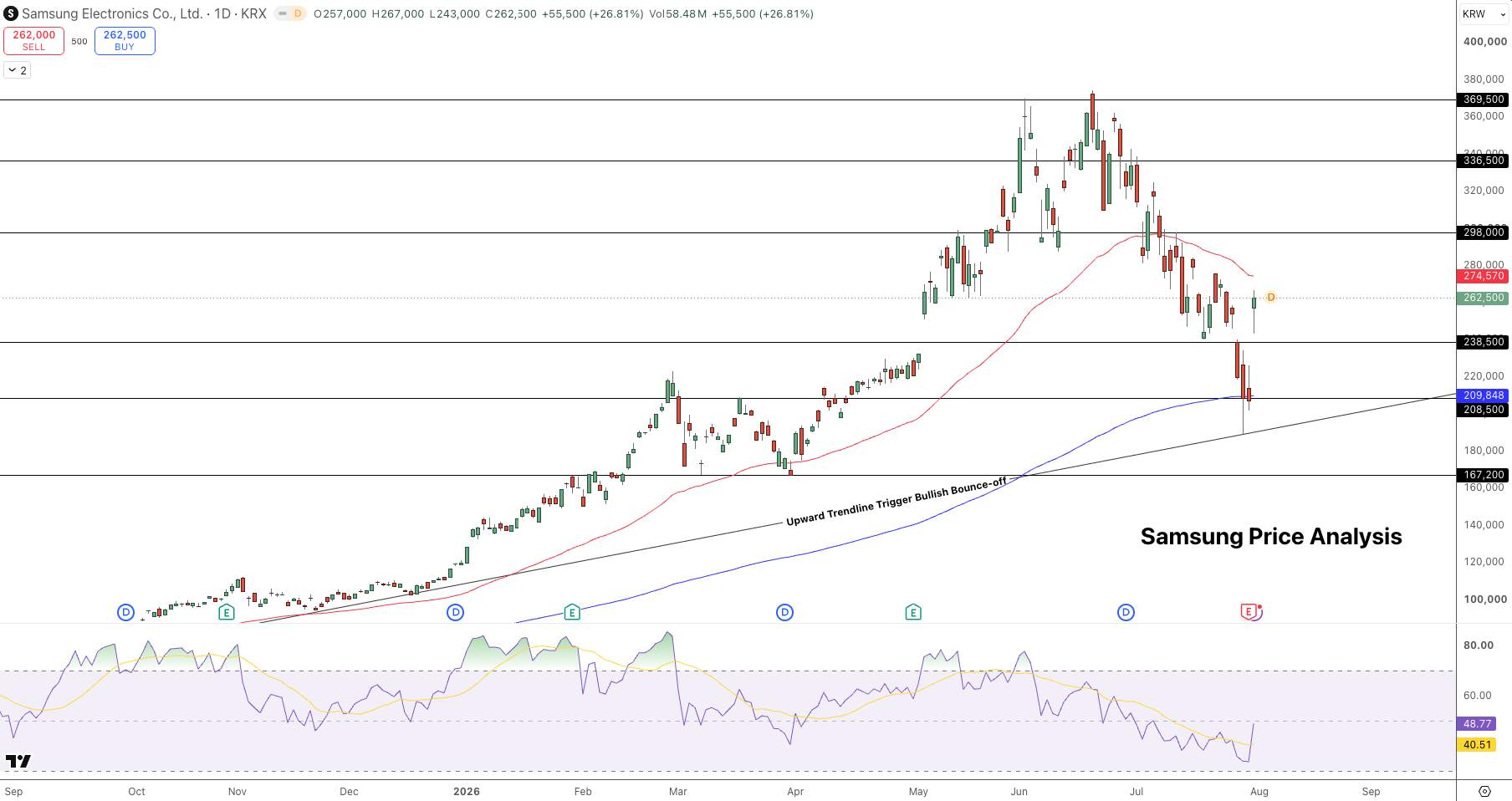
Samsung Price Chart - Source: Tradingview
In the daily chart of the KRX, Samsung closed on July 31 at ₩262,300, an increase of 26.81%. The long-term rising trend from September 2025 held the ₷208,500 level during the decline of July. The trend line is called Upward Trendline Trigger Bullish Bounce-off. The RSI value is 48.77 and is a recovery from a value of 40.51 with no return to a neutral position. The close of the day to the resistance of ₩298,000 will have a target of ₩336,500 and a secondary target of ₩369,500. The critical floor is ₩208,500.
CXMT - The Threat, Not The Trade (Yet)
On July 27, 2023, CXMT became the most popular company in the global memory markets, making waves by becoming the first company to be worth $487 billion in memory markets without shipping any HBM Chips. It captured 7.68% of the global DRAM market and in Q1 of 2026 posted 719% year-on-year sales growth.
This growth was a result of the same memory market pricing which benefited Samsung and Hynix. The threat posed by CXMT to Hynix and Samsung is valid, but its timeline is going to be between 2028 and 2030, not 2026. Manufacturing HBM Chips at the required level of precision and with Advanced Packaging is something CXMT has not yet shown the capability to do at a commercial level.
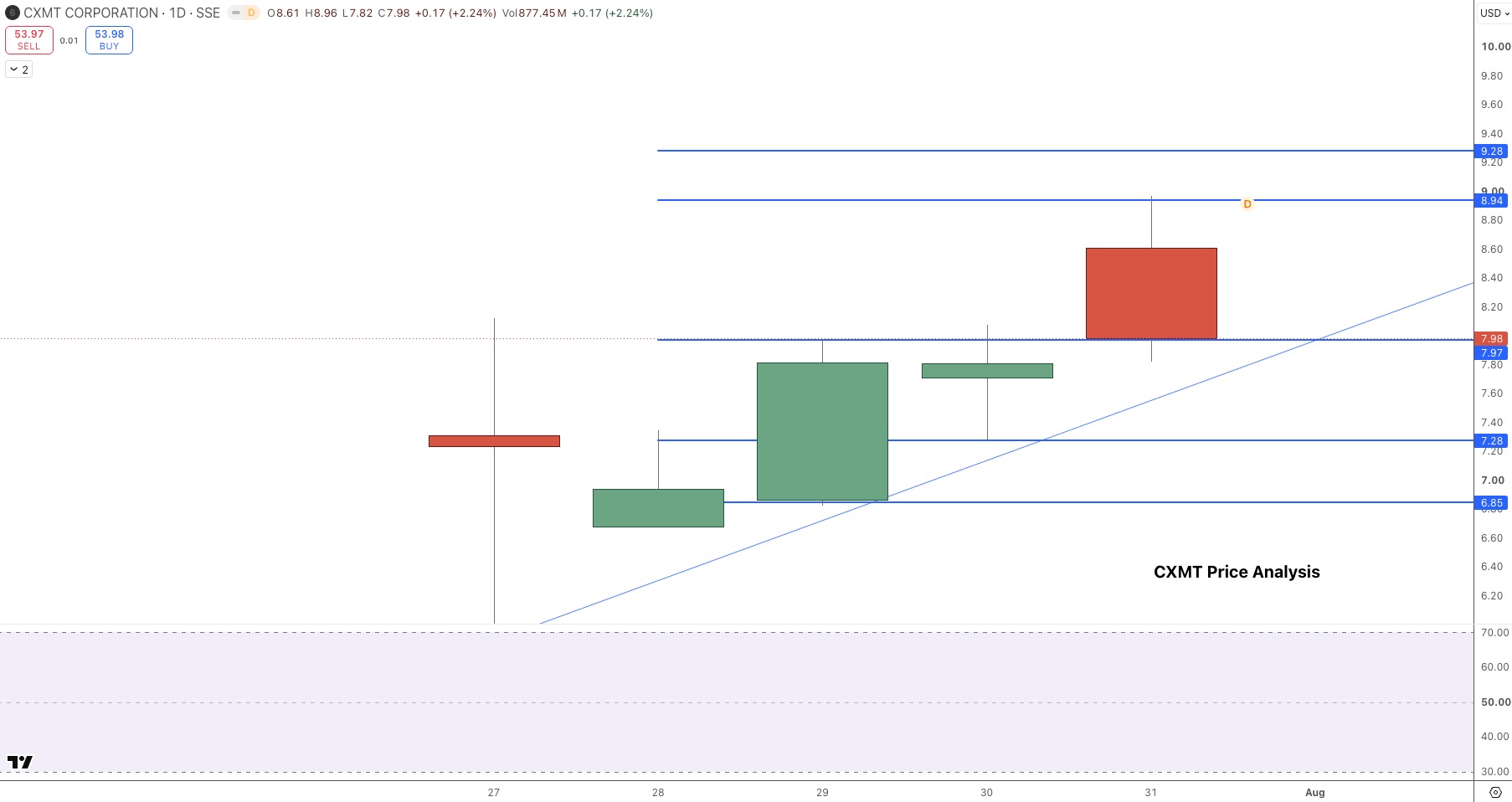
CXMT Price Chart - Source: Tradingview
Daily chart shows that CXMT recorded a $7.98 closing price and after a big red candle on July 31 was pulling back from the intraday high of $8.94. Support from the IPO low is provided by an ASC trendline. The support level is $7.28, with $6.85 below that. The resistance is $8.94 with $9.28 above. The instrument shown in the chart is likely a derivative of USD or an International listing as the underlying stock is listed in Shanghai and trades in Yuan.
Only 7% of CXMT's shares were publicly tradable as a result of the IPO lock-up period, therefore, explains the extreme volatility. Thus, selling CXMT at a lower price constitutes a speculative instrument, and it has nothing to do with an earnings backed equity position.
The Comparison
- SK Hynix: Exemplary HBM operation, with 50% market share. NVIDIA’s primary supplier. 2026 earnings expected to be > earnings in previous 27 years. ADR is $157, with a support of $155 (61.8% Fib). UBS buy with a target of $204.
- Samsung: The biggest memory manufacturer with record Q2 earnings. Catching up with HBM. Diversified activities reduces risk of pure AI upside. Currently at KRX ₩262,300, bouncing off long term trendline. Valuation trades at a lower premium.
- CXMT: 7.68% of DRAM market share and no HBM. 2028-2030 is considered the competitive threat period. Currently a highly speculative asset with a 7% free float and trades at $7.98 from a 5 day old chart. This is not an earnings play.
Which Should You Buy?
For AI memory exposure based on the strongest fundamentals, choose SK Hynix. They have confirmed their position as the HBM leader. NVIDIA dependence should be viewed positively, as the AI infrastructure capex is expected to significantly grow through 2028, according to the CEO of Amazon, and the stock is currently sitting at a clean level of risk at its 155.16 Fibonacci support. UBS has a price target of $204, giving a 29% upside at $157. Samsung is the other value play, as their position is straightforward, as they have a broad exposure and low earnings, but have less direct exposure to AI. CXMT isn't a play on a competitive memory business, but on Chinese semiconductor Nationalism with a weak float. The AI memory race is rapidly advancing, and will be won by the faster producer of HBM4 and HBM4E, and is currently a race between SK Hynix and Samsung, as CXMT is not competitive.
Bottom Line
All three companies have benefitted from the recent AI memory supercycle, the cleanest being SK Hynix, the broadest being Samsung, and the most questionable being CXMT. This week has shown the demand with Andy Jassy's comments of striking demand in 2028. CXMT is at $7.98, with a locked up 93% of shares for six days. SK Hynix is currently the most appealing, sitting at $157 at the 61.8% Fibonacci support, offering the most direct AI HBM upside of this group. Samsung is at ₩262,300, bouncing off a long term ascending trendline support, and offering a diversified play. CXMT at $7.98 is the speculative play, not CXMT.
Recommended Articles


