




Apple Stock Price Forecast: Can AAPL Break $400 by 2026? Wall Street’s Highest Price Target Analysis
Apple Stock Performance: Strongest Among the Magnificent Seven
TradingKey - As of late July 2026, Apple Inc. ( AAPL) stock has demonstrated exceptional resilience and rebounding strength in 2026. Although it experienced volatile adjustments early in the year, the stock subsequently surged as its stellar financial results and capital-light AI strategy gained market recognition. On July 28, the stock price broke through $340 to hit an all-time high, with the company's market capitalization surpassing the $5 trillion milestone, making it the world's most valuable publicly traded company.
As of July 28, Apple's stock price has risen more than 20% year-to-date (YTD) in 2026, leading the Magnificent Seven (Mag 7) of US tech stocks, as follows:
Company Name | Ticker | 2026 Year-to-Date Change (YTD) |
Apple (Apple) | AAPL | +25% |
Alphabet (Google) | GOOGL/ GOOG | +5% |
Nvidia (Nvidia) | NVDA | +4% |
Amazon (Amazon) | AMZN Winters | -1% |
Meta Platforms | META Winters | -11% |
Microsoft (Microsoft) | MSFT | -19% |
Tesla (Tesla) | TSLA | -33% |
Why Apple Stock Is Rising
Although Apple's stock price performed strongly, it did not rise continuously. From January to March, it fluctuated widely within the $240-$280 range, before breaking out in April to officially begin leading the market. However, Apple's stock price experienced a correction in June, with the real rally primarily achieved in May and July, driven by its earnings report and AI capital expenditure strategy, respectively.
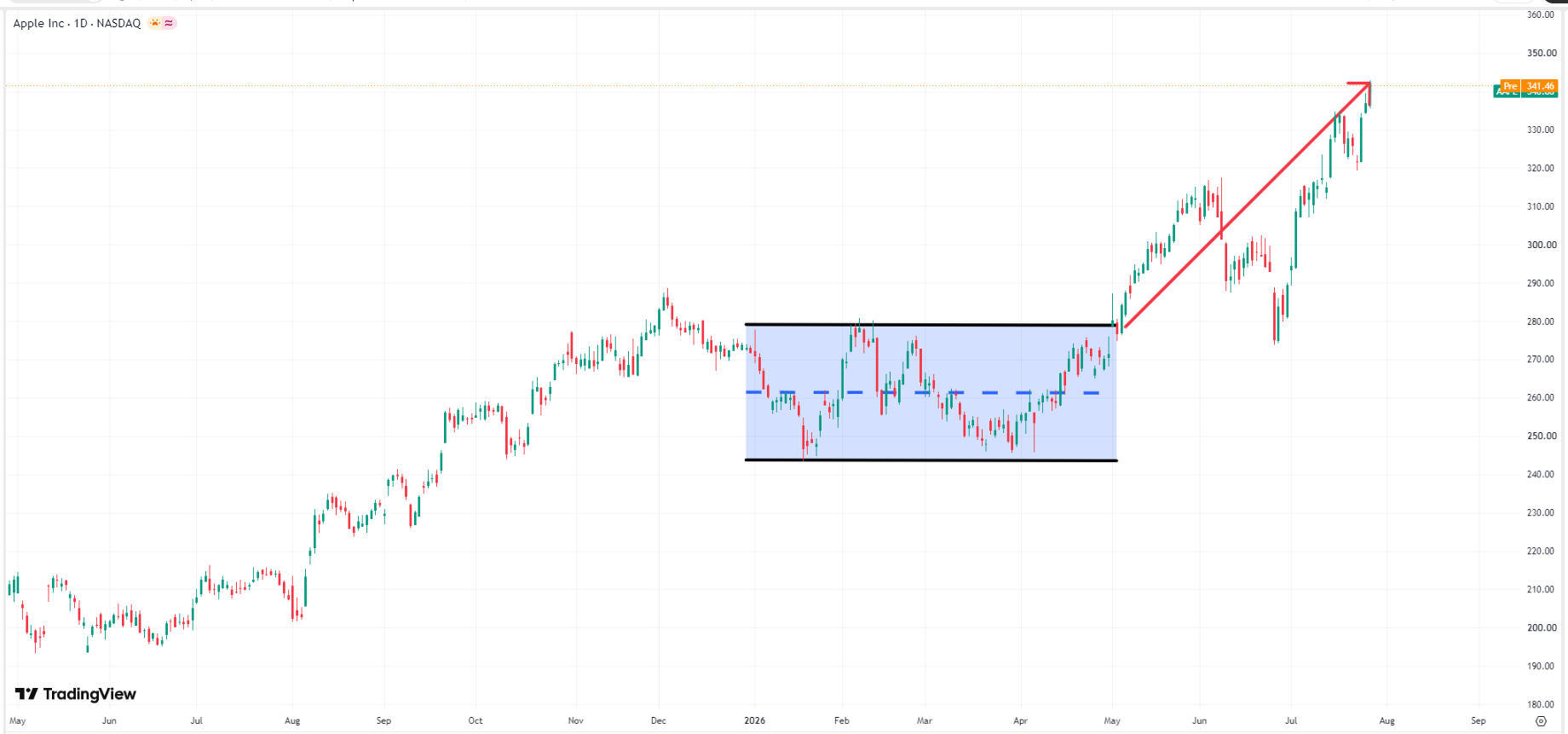 Apple stock price chart, Source: TradingView
At the end of April, Apple announced a record-breaking Q2 earnings report, with revenue increasing 17% year-over-year to $111.2 billion and EPS rising 22% year-over-year to $2.01, marking its best-ever March quarter performance. In addition, the board authorized an additional share buyback program of up to $100 billion and increased the cash dividend by 4% to strongly reward shareholders.
Earnings reports released by companies like Google and Tesla intensified market concerns that massive AI infrastructure hardware spending (Capex) would erode profits. Conversely, Apple's consistently executed asset-light AI strategy gained high market recognition, making AAPL an investment target with both defensive and growth qualities. Currently, Apple focuses on on-device applications and integration without the need to self-develop ultra-large-scale foundation models, keeping its capital expenditure at only about 2% of revenue, far below the 10%-40% of other tech giants, particularly META, which reached 50%.
Will Apple Shares Keep Rising?
Despite Apple's stock price recently rising to new highs, Wall Street institutions remain bullish on its prospects, with Wedbush aggressively targeting $400, the highest target price currently given to Apple on Wall Street. However, some institutions hold a bearish view, as follows:
Institution | Target Price (USD) | Bullish/Bearish Logic |
Wedbush | 400 | The AI monetization engine has started, driving a full-scale boom in both hardware and services businesses. |
Bank of America | 380 | Optimistic about the asset-light AI strategy safeguarding free cash flow, with continuous optimization of services gross margin. |
Goldman Sachs | 370 | A highly loyal user base brings robust fundamentals, sufficient to absorb the pressure of rising component costs. |
UBS / Jefferies | 296 – 300 | Concerned about a high forward P/E ratio, and rising chip costs could weigh on hardware gross margins. |
Can Apple Stock Price Rise to $400?
As can be seen from the above, Apple's rally this year has been primarily driven by strong financial performance and an asset-light AI strategy. If these drivers persist or are further strengthened, they will propel its stock price to continue rising and challenge the $400 mark. However, if unfavorable circumstances arise—especially once concerns over AI capital expenditures are alleviated—Apple's advantages could turn into disadvantages, and investors are highly likely to rotate into other tech stocks, leaving Apple sidelined.
From a technical perspective, Apple's stock price is in need of a short-term pullback. Currently, the RSI is at 68.9, approaching the overbought territory (above 70), indicating that buying pressure is overly strong and the price may soon fall or pull back. Furthermore, Apple's stock price has touched the upper band of the Bollinger Bands, presenting the possibility of a downward correction.
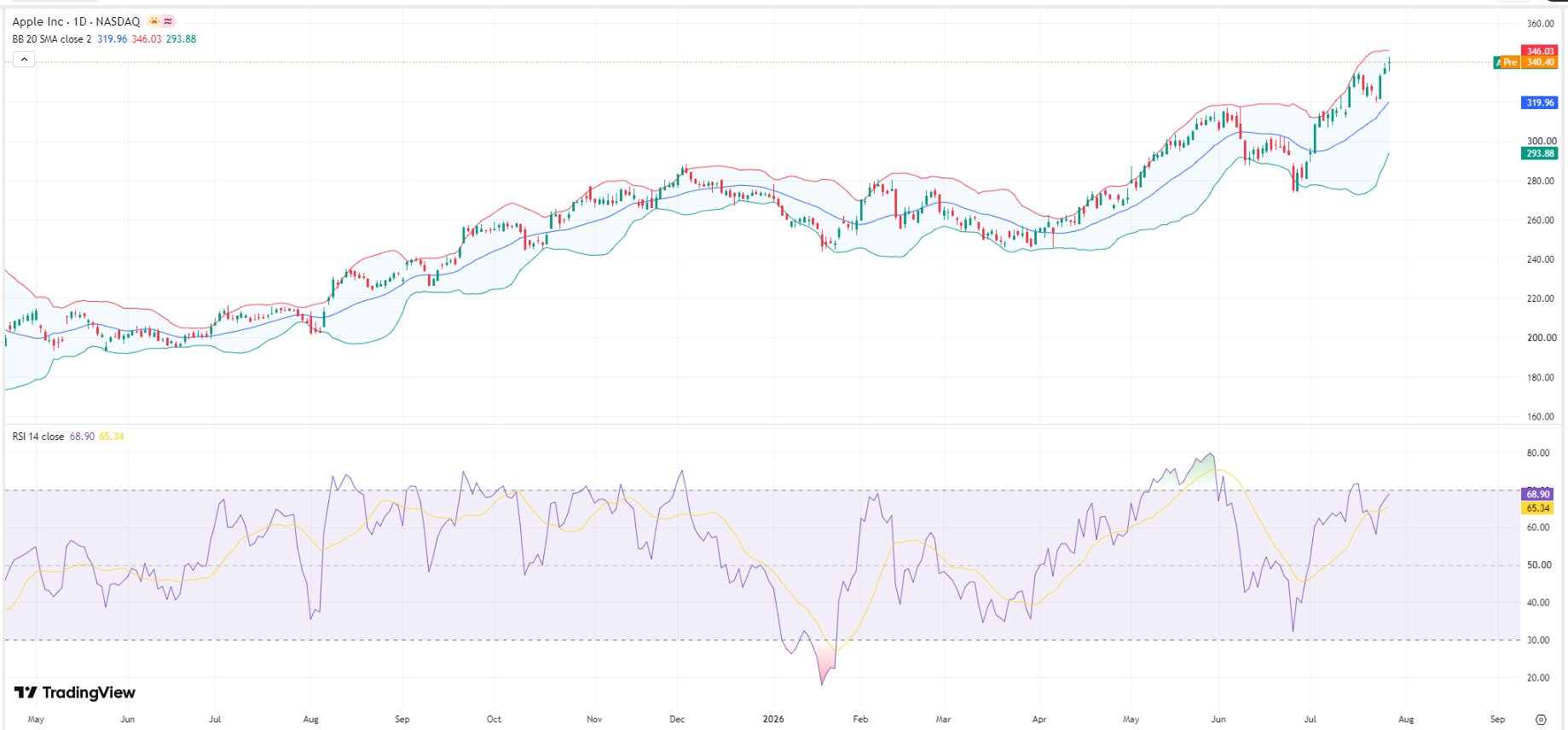 Apple stock price chart, Source: TradingView
Conclusion
Apple has emerged as the strongest performer among the Magnificent Seven, driven by record-breaking earnings, robust share buybacks, and a low-capital expenditure (Capex) AI strategy, pushing its stock price past $340 and its market capitalization to $5 trillion. Although facing short-term overbought conditions and technical pullback pressure, Wall Street firms are widely optimistic about its fundamentals, with the highest price target reaching $400.
Recommended Articles


