




Oracle Stock Is Down 64% in 10 Months. Is This the Best Buying Opportunity in AI -- or a Falling Knife?
Key Points
Oracle stock has dropped more than 63% from its September peak, pushing its valuation to nearly a five-year low.
The company has taken on nearly $130 billion in debt to build AI data centers, with a debt-to-equity ratio of 300%.
Roughly $300 billion of Oracle's backlog depends on OpenAI, a deeply unprofitable company.
- 10 stocks we like better than Oracle ›
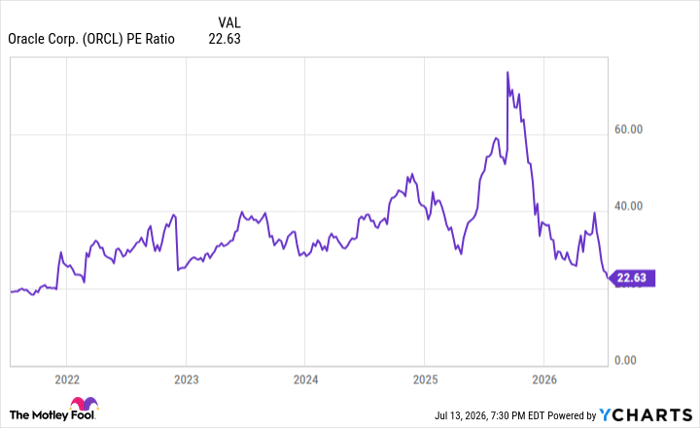
Nine months ago, Oracle (NYSE: ORCL) was one of the hottest stocks in AI -- hotter than Nvidia, Alphabet, or Micron Technology. Shares have fallen nearly 60% since, even as its earnings have grown. Its price-to-earnings ratio (P/E) -- the price of the stock relative to its profits -- has collapsed from 76 at its September peak to about 22 today.
It sure looks like a buying opportunity, but there's an old Wall Street saying about situations like this: Never catch a falling knife. A stock dropping this fast usually has a reason, and reaching for it on the way down is how investors lose fingers.
Missed Nvidia in 2009? This Rare Signal Is Flashing Again. In 2009, a "Double Down" signal flashed for a little-known chipmaker called Nvidia. For the first time in years, that same "Total Conviction" signal is flashing for a company 1/100th the size of Nvidia. Continue »
But sometimes the market overdoes it, and the "knife" turns out to be a bargain. So, which is Oracle?
Image source: Getty Images.
The bull case: Explosive growth and a cheap valuation
Oracle's business is growing quickly. Its most recent earnings showed revenue rising 21% year over year to $19.2 billion. Oracle Cloud Infrastructure (OCI) -- the division that rents out computing power for AI workloads -- grew an incredible 93% to $5.8 billion.
The backlog is the eye-popping part and was a big factor in the stock's run last September. Oracle's remaining performance obligations (RPO) -- contracted revenue it hasn't yet delivered -- hit $638 billion as of last quarter, up 363% from a year ago. $85 billion was added in a single quarter.
While OpenAI is its biggest, this is a company with no shortage of customers. Nvidia, Meta Platforms, and SpaceX all intend to lease computing power.
Finally, after the sell-off, the stock trades well below its five-year average P/E of 34.
Data by YCharts.
This is a big reason why 84% of Wall Street analysts rate Oracle stock a buy.
The bear case: Mounting debt and a risky customer
Now, here's the issue: To build all of this AI capacity, Oracle has taken on nearly $130 billion in debt against just $43 billion in stockholders' equity -- a debt-to-equity ratio around 300%. Compare that to ratios of 50% for Amazon and 30% for Microsoft.
Capital expenditures (capex) hit $55.7 billion in its fiscal 2026; free cash flow (FCF) -- the money left over after operations and capex -- sat at negative $24.5 billion through 2026. Company management plans to raise another $40 billion to $50 billion this year to keep building.
The debt market has noticed. The cost of insuring Oracle's debt against default recently hit record levels, and though its bonds still hold investment-grade status from the major rating agencies, the bonds themselves are trading more like junk debt.
The defining factor here is simple: Roughly $300 billion of the company's massive backlog -- and the primary reason it is taking on such enormous debt -- is supposed to come from one customer: OpenAI.
Why the concern? OpenAI's finances are quite simply atrocious. The company is making enormous revenue, and that revenue is growing at an incredible rate. However, at least up to this point, the costs have kept pace and still far outpace sales.
Leaked figures, confirmed by the Financial Times, show $21 billion in losses last year against $13 billion in sales. It has roughly $1 trillion in compute commitments -- something like 77 times its current annual sales.
Making matters worse, OpenAI recently delayed its IPO, reigniting fears and sending Oracle stock lower. Shares had their worst week in years.
The verdict: Is Oracle stock a buy right now?
While the opportunity is substantial and the valuation looks attractive if Oracle can deliver on its promise, that's a big "if" at this point.
For my money, this is a falling knife. Oracle is borrowing too much money to build too many data centers for a company with too much risk. I think there is a very good chance OpenAI can't raise the cash it needs to pay Oracle. If that happens, Oracle stock will take a beating.
Should you buy stock in Oracle right now?
Before you buy stock in Oracle, consider this:
The Motley Fool Stock Advisor analyst team just identified what they believe are the 10 best stocks for investors to buy now… and Oracle wasn’t one of them. The 10 stocks that made the cut could produce monster returns in the coming years.
Consider when Netflix made this list on December 17, 2004... if you invested $1,000 at the time of our recommendation, you’d have $377,990!* Or when Nvidia made this list on April 15, 2005... if you invested $1,000 at the time of our recommendation, you’d have $1,269,518!*
Now, it’s worth noting Stock Advisor’s total average return is 896% — a market-crushing outperformance compared to 206% for the S&P 500. Don't miss the latest top 10 list, available with Stock Advisor, and join an investing community built by individual investors for individual investors.
See the 10 stocks »
*Stock Advisor returns as of July 27, 2026.
Johnny Rice has no position in any of the stocks mentioned. The Motley Fool has positions in and recommends Alphabet, Amazon, Meta Platforms, Micron Technology, Microsoft, Nvidia, and Oracle. The Motley Fool has a disclosure policy.
Recommended Articles


