




Texas Instruments Can Ride AI Demand to New Highs
Key Points
Texas Instruments posted its highest revenue growth rate in multiple years while cutting down on expenses.
While investors worry about high capital expenditures from tech giants, they don't have to worry about that for Texas Instruments.
Analog chips are a key part of the AI infrastructure that is gaining momentum. Texas Instruments' recent guidance shows that it is a major beneficiary.
- 10 stocks we like better than Texas Instruments ›
Texas Instruments (NASDAQ: TXN) is relatively late to the artificial intelligence (AI) party. The stock was mostly flat over the past five years until a 58% year-to-date rally surprised investors. Its analog chips manage the electrical power that AI chips need.
These analog chips essentially serve as the middleman between electric grids and AI chips. Analog chips process electricity and distribute it to AI chips in a way that lets them function without overheating. They position Texas Instruments for a multiyear run as AI infrastructure demand accelerates.
Missed Nvidia in 2009? This Rare Signal Is Flashing Again. In 2009, a "Double Down" signal flashed for a little-known chipmaker called Nvidia. For the first time in years, that same "Total Conviction" signal is flashing for a company 1/100th the size of Nvidia. Continue »
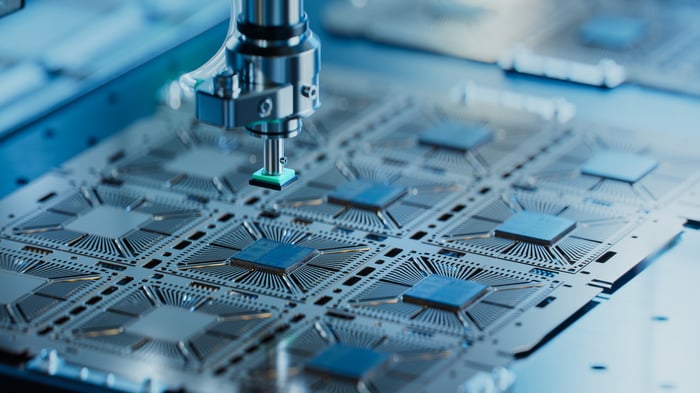
Image source: Getty Images.
Revenue growth is picking up
Fundamental growth is a key factor for stocks that beat the S&P 500 over the long run, and Texas Instruments has been checking off that box. Its 23% year-over-year growth rate in the second quarter was its highest in multiple years.
The recent growth isn't a fluke. Texas Instruments anticipates $5.65 billion to $6.15 billion in Q3 revenue. A midpoint of $5.9 billion implies a 24.5% year-over-year growth rate. Sequential growth has been solid, but that is a normal trend for Texas Instruments. If the company delivers positive sequential growth in Q4, that's a major catalyst, since that's the slower season for Texas Instruments.
Texas Instruments barely beat the top end of its Q2 guidance when delivering results. If its analog chips continue to gain momentum in data centers, it might end up beating the top end of Q3 guidance. That would position the company for at least 38% year-over-year revenue growth.
Texas Instruments is achieving this growth while boosting its net income. Profits were up by 53% year over year in the second quarter.
Prudent financial management
Texas Instruments isn't a flashy name, and the executives never intended for it to reach that point. The company's website starts with a boring quote from CEO Haviv Ilan, but it's boring in a good way.
"We believe that long-term growth of free cash flow per share is the ultimate measure to generate value. We achieve this by strengthening our competitive advantages, being disciplined with capital allocation and pursuing efficiency," Ilan wrote on the investor relations site.
The emphasis on cash flow explains why Texas Instruments' net income is rising faster than revenue. It also offers some insight into why it's one of the few fast-growing AI stocks that still has a dividend yield above 2%.
To top it all off, Texas Instruments actually pulled back on capital expenditures (capex) while other companies are rushing to throw their money at AI. The company heavily invested in manufacturing capabilities for multiple years. Now, it's scaling down capex while enjoying the fruits of its labor.
The second quarter featured $514 million in capex, which is a 60.6% year-over-year reduction. At a time when tech giants can deliver good results that get overlooked due to rising capex, Texas Instruments is delivering high growth rates while cutting back on spending. It's a rarity in the current market that can justify an extended rally.
Should you buy stock in Texas Instruments right now?
Before you buy stock in Texas Instruments, consider this:
The Motley Fool Stock Advisor analyst team just identified what they believe are the 10 best stocks for investors to buy now… and Texas Instruments wasn’t one of them. The 10 stocks that made the cut could produce monster returns in the coming years.
Consider when Netflix made this list on December 17, 2004... if you invested $1,000 at the time of our recommendation, you’d have $377,990!* Or when Nvidia made this list on April 15, 2005... if you invested $1,000 at the time of our recommendation, you’d have $1,269,518!*
Now, it’s worth noting Stock Advisor’s total average return is 896% — a market-crushing outperformance compared to 206% for the S&P 500. Don't miss the latest top 10 list, available with Stock Advisor, and join an investing community built by individual investors for individual investors.
See the 10 stocks »
*Stock Advisor returns as of July 26, 2026.
Marc Guberti has no position in any of the stocks mentioned. The Motley Fool has positions in and recommends Texas Instruments. The Motley Fool has a disclosure policy.
Recommended Articles


