




Blue Origin Raised $10 Billion at a $130 Billion Valuation Under Jeff Bezos
Key Points
Blue Origin is raising $10 billion in new cash.
For the first time ever, Jeff Bezos isn't the only participant. Outside investors are contributing $8 billion.
Jeff Bezos' ownership stake in Blue Origin will no longer be 100%.
- These 10 stocks could mint the next wave of millionaires ›
Since leaving his CEO job at Amazon (NASDAQ: AMZN) in 2021, Jeff Bezos has spent every waking moment trying to make his other company -- space company Blue Origin -- a success. He's spent every waking moment... and about $30 billion.
And it still isn't enough.
Missed Nvidia in 2009? This Rare Signal Is Flashing Again. In 2009, a "Double Down" signal flashed for a little-known chipmaker called Nvidia. For the first time in years, that same "Total Conviction" signal is flashing for a company 1/100th the size of Nvidia. Continue »
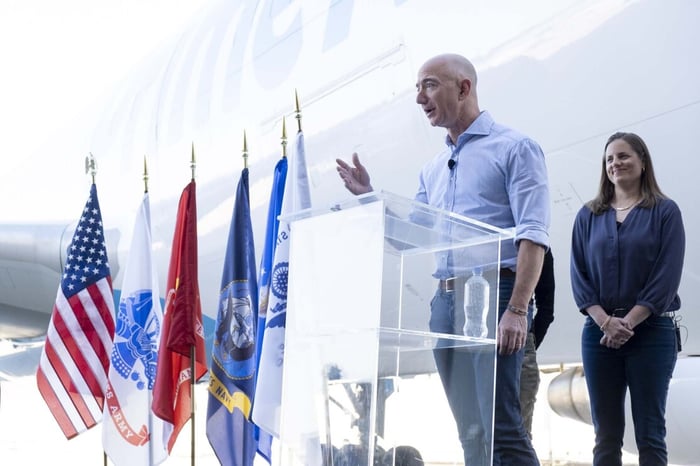
Jeff Bezos, Executive Chairman of Amazon. Image source: Amazon.com.
Blue Origin seeks outside cash
Through May 2026, Bezos' personal contributions to Blue Origin's bank account totaled about $28 billion, averaging about $1 billion per year. Last month, Bezos confirmed he will double that annual contribution in 2026, investing $2 billion in Blue Origin as part of a reported $10 billion financing round -- the first time Blue Origin has ever sought outside, non-Jeff Bezos investment since the company first started up 26 years ago.
Participants in this inaugural funding round, in addition to Bezos himself, are said to include hedge fund Coatue Management ($4 billion) as well as several other "major investors," according to CNBC.
All of these investors will be investing at a valuation of $130 billion for the entire company. Bezos' interest will presumably shrink slightly from 100% to perhaps 94%, while Coatue takes a 3% stake and the remaining investors split the remaining 3% among themselves.
Why Blue Origin needs money
If Blue Origin is already worth $130 billion, though, why does it need to attract outside investment? Because, market cap notwithstanding, Blue Origin requires liquid cash to spend on multiple projects it has in the works.
Analysts forecast Blue Origin will spend $4.8 billion on capital investment this year to rebuild its Cape Canaveral launch pad (destroyed when a New Glenn rocket blew up during engine testing in May), investigate why New Glenn exploded in the first place, replace the rocket that exploded, and build several more new rockets to support an eventual launch cadence of 100 rocket flights per year.
On top of all this, Blue Origin is building a constellation of 5,408 TeraWave broadband internet satellites that could cost $10 billion (and probably more), at the same time as it develops lunar landing ships for NASA's Project Artemis, and also helps build an Orbital Reef space station in low-Earth orbit.
That's billions and billions and billions of dollars in new spending for a company that has heretofore been supported solely by Jeff Bezos' (admittedly plump) bank account. It makes sense Blue Origin would seek other sources of cash, given its funding needs. Given the financial drain Blue Origin faces, an IPO probably isn't out of the question either.
Whether you should invest in a Blue Origin IPO at its $130 billion valuation, with no reported profit and annual revenue estimated at only $26.4 million (according to S&P Global Market Intelligence's current estimate), is another question entirely.
Where to invest $1,000 right now
When our analyst team has a stock tip, it can pay to listen. After all, Stock Advisor’s total average return is 896%* — a market-crushing outperformance compared to 206% for the S&P 500.
They just revealed what they believe are the 10 best stocks for investors to buy right now, available when you join Stock Advisor.
See the stocks »
*Stock Advisor returns as of July 26, 2026.
Rich Smith has no position in any of the stocks mentioned. The Motley Fool has positions in and recommends Amazon. The Motley Fool has a disclosure policy.
Recommended Articles


